























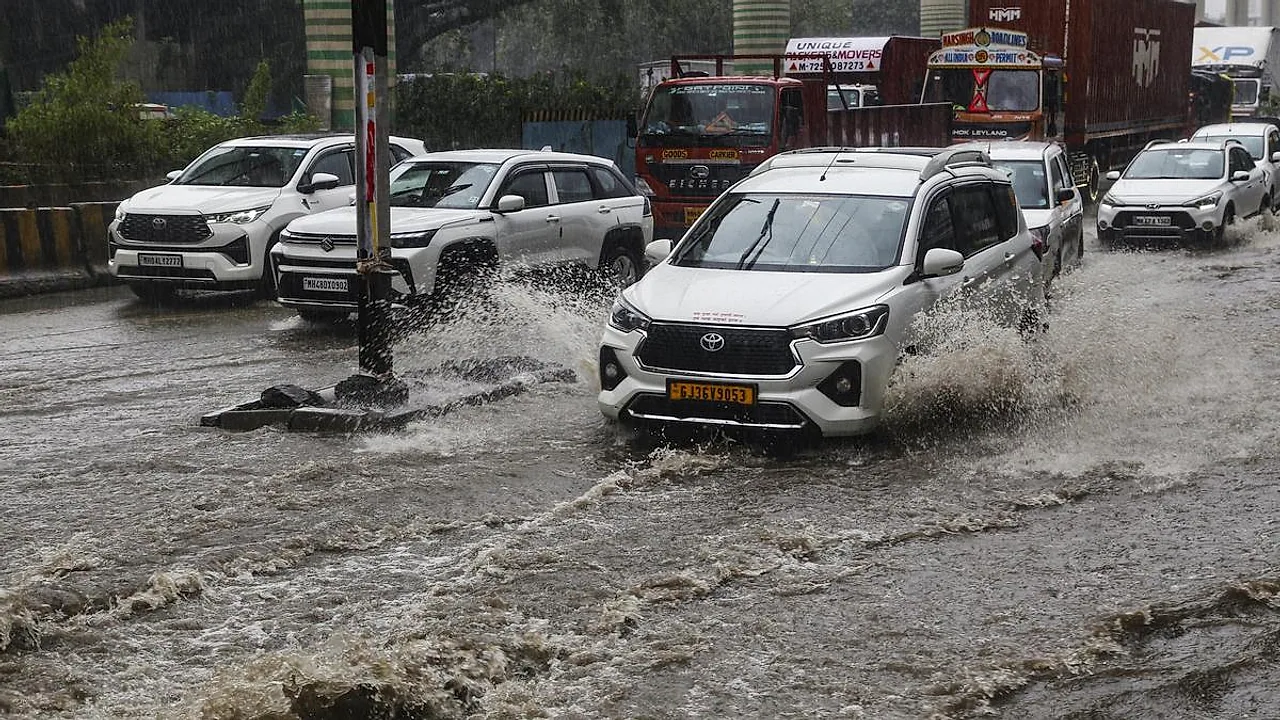

The monsoon has turned severe across large parts of the country. Mumbai and Thane remain under a red alert from the India Meteorological Department through July 6, while helicopters have been ferrying emergency relief to remote, flood cut villages in Arunachal Pradesh. In Himachal Pradesh, National Highway 5 was blocked by debris but reopened within hours, while Odisha, West Bengal, Rajasthan, Gujarat and Delhi are all under varying degrees of rain warnings. In Jammu, four children got stranded when the Tawi river's water level rose suddenly, though all were rescued unhurt.
Mumbai and Thane under red alert, schools and colleges shut
The weather department has kept a red alert in place for Mumbai and Thane for July 4, 5 and 6. In response, authorities ordered all schools and colleges in Thane district and the Kalyan Dombivli municipal area to remain closed on Saturday, July 4, 2026, while emergency helpline numbers were activated across the region. With torrential rain expected, educational institutions are shut and emergency services have been deployed on high alert between July 4 and 6. The Brihanmumbai Municipal Corporation also declared a holiday for the afternoon session at all schools and colleges in the city on Saturday after the IMD's red alert for extremely heavy rain. A civic spokesperson said the decision was taken keeping students' safety in mind, and citizens were also urged to step out only if necessary, since heavy rain continues in several parts of the city.
Waterlogging disrupts Mumbai, metro and rail services hit
Relentless heavy rain in Mumbai and its metropolitan region on Friday brought life to a standstill. Roads caved in, trees fell and a house collapsed, while both road and rail traffic were badly affected. Several low lying areas of the city, including Andheri, Kurla, Sakinaka, Chembur, Santacruz, Goregaon and Powai, were waterlogged, halting public transport and causing considerable trouble for private vehicle owners as well. Train operations on the Western Railway line were disrupted after water accumulated on the tracks between Nalasopara and Virar stations. Railway officials said trains were running 15 to 20 minutes late on this stretch, though commuters said services had come to a complete halt. Services on the main line and harbour line were also affected. Separately, a technical snag hit Mumbai Metro Line 2A on Saturday amid the heavy rain, disrupting operations briefly and adding to commuter woes as trains ran late during peak hours. MMMOCL, the line's operator, confirmed that services were affected for close to 90 minutes before technical teams fixed the fault, after which train services returned to normal on both tracks across the corridor. The line, which runs between Dahisar East and Andheri West, saw the snag occur between the Dahisar East and Kandarpada metro stations.
CM Fadnavis urges caution, emergency agencies on alert
Maharashtra Chief Minister Devendra Fadnavis on Friday urged residents of the Mumbai Metropolitan Region and the Pune Nashik belt to strictly follow official weather warnings and avoid unnecessary travel, with heavy rain and thunderstorms expected in these areas until July 6. Speaking to reporters, the Chief Minister also clarified that any genuine deficiencies found in recently built infrastructure, including the connecting link on the Pune Mumbai Expressway, would be addressed. The IMD's regional meteorological centre has forecast extremely heavy rainfall, thunderstorms and significantly above normal rain in the affected region until July 6. Fadnavis said the state government is sending weather alerts to citizens every three hours via SMS, besides circulating warnings through several other channels. "We have requested people not to travel unless necessary, so that accidents caused by heavy rain and storms can be avoided. Citizens should follow official alerts and step out only as per the guidelines issued. The NDRF, SDRF and the state disaster management cell are keeping a close watch on the situation," he said.
Woman electrocuted near transformer in Thane during heavy rain
A 35 year old woman died in Maharashtra's Thane district amid torrential rain after she slipped near an electricity transformer and came into contact with a live wire. Police disclosed the incident on Saturday, July 4. The tragedy occurred on the night of July 1 in Kacheri village in Dombivli. The deceased has been identified as Shashi Rahul Chakra, who owned a local shop and had stepped out that night to fetch supplies for her establishment. An official said the victim slipped while returning home and fell near an electricity transformer installed close to a public toilet.
Flood cut villages in Arunachal Pradesh reached by helicopter relief
Flash floods and large scale landslides triggered by heavy rain nearly a week ago had completely cut off several remote villages in Arunachal Pradesh from the rest of the state. Authorities were subsequently forced to send emergency food and medical supplies to these flood hit areas using a commercial helicopter. In Lower Siang district, the collapse of bridges at several points and landslides blocking roads left the villages of Rotte, Rame, Loglu, Lipen, Mane, Tene, Sipu, Kakki, Kadu, Riga, Sido and Korang completely isolated.
Debris hit NH-5 in Himachal Pradesh restored within hours
Traffic on National Highway 5 in Himachal Pradesh's Kinnaur district came to a complete halt on Saturday, July 4 morning after debris fell on the road, but district officials have now reopened it fully for all vehicles. According to the district administration, debris fell on the highway around 6:15 am as the monsoon arrived in the region, disrupting vehicle movement. Authorities immediately deployed heavy machinery and cleared the road within a short span, restoring traffic flow.
Shimla sees a monsoon tourism surge, bookings ahead of last year
Light drizzle, fog, pleasant weather and cloud covered hills are drawing tourists to Shimla this monsoon season. Those in the tourism industry say hotel bookings have been coming in steadily, with no major cancellations reported so far. According to tourism sector stakeholders, weekend hotel occupancy in the hill town is running between 40 and 50 percent, more than 10 percent higher than the same period last year. A local hotelier said bookings during the first two weeks of July used to be around 70 percent before the monsoon disasters of 2023 and 2025, but the natural disasters caused by rain in those years instilled fear among tourists, affecting footfall. Even though vehicle queues and slow traffic persist on Shimla's roads, the monsoon's charm, drizzle, mist, cool weather and cloud draped hills, has continued to pull tourists to the hill station. The devastating 2023 monsoon, marked by landslides, flash floods, cloudbursts and other rain related disasters that wrecked roads, power and communication networks, had made many tourists wary of travelling to hill areas. However, no major rain related disaster has been reported in Shimla so far this year. Even so, flash floods triggered by heavy rain in the tribal districts of Kinnaur, Lahaul Spiti and Chamba have washed away bridges and damaged road connectivity. Slow moving traffic in Shimla has troubled regular commuters, but tourists have not stopped heading to the state capital to escape the scorching heat of the plains.
Four children rescued as Tawi river's water level rises suddenly in Jammu
Four children who had gone to bathe in the Tawi river near Jammu's Peer Kho temple on Saturday found themselves in serious trouble when the river's water level rose sharply and they got stranded. Police confirmed the incident and said rescue teams were rushed to the spot immediately. Jammu Police and the State Disaster Response Force, or SDRF, carried out a joint rescue operation. The four children caught in the rising waters were aged around 11 to 12 years. A police officer said all of them were pulled out safely without any injuries, and the swift action by rescue teams averted what could have been a major tragedy.
Red alert for extremely heavy rain in five Odisha districts
A low pressure area over the Bay of Bengal has intensified into a well marked system, prompting the weather department to issue a red alert on Saturday, July 4 for extremely heavy rain in five districts of Odisha. The red alert covers Kandhamal, Boudh, Angul, Sambalpur and Sonepur districts. According to the IMD's latest bulletin, the well marked low pressure area over the northwest Bay of Bengal and adjoining north Odisha, West Bengal coasts remained over the same region as of 8:30 am on July 4, 2026, and is likely to move west northwest across north Odisha and north Chhattisgarh over the next three days. Manorama Mohanty, director of the Bhubaneswar meteorological centre, said extremely heavy rain is likely at isolated places in the red alert districts and that the spell of rain in Odisha could continue until July 7.
West Bengal also under red alert as low pressure may deepen
The low pressure area over the Bay of Bengal could intensify into a deep depression, raising the risk of extremely heavy rain in the southern parts of West Bengal over the weekend. Local authorities have begun round the clock monitoring in response. As the weather system moves closer to the West Bengal Odisha coast, the IMD has issued its most severe warning, a red alert, for South 24 Parganas and Purba Medinipur districts.
Heavy rain in Rajasthan, orange alert issued for seven districts
According to the weather department, light to moderate rain was recorded across several parts of Rajasthan in the 24 hours ending Saturday, July 4 morning, with heavy showers at a few places. Pachpadra in Balotra district recorded the highest rainfall at 8 cm, while Dungarpur received 7 cm. Dhambola in Dungarpur and Balotra each recorded 6 cm of rainfall. The department said Banswara, Pindwara in Sirohi, Arnod in Pratapgarh, Vallabhnagar in Udaipur, Abu Road in Sirohi, Siwana in Barmer and Bhinmal in Jalore each received 5 cm of rain, while Ghatol in Banswara and Mount Abu recorded 4 cm. Rainfall at other locations stayed below 4 cm.
Storm damages banners hours before Pachpadra refinery inauguration
The Pachpadra refinery in Balotra, Rajasthan, was scheduled to be inaugurated by Prime Minister Narendra Modi, but just hours before the event, a heavy storm accompanied by rain damaged banners and hoardings put up at the venue. According to the weather department, the storm hit the Pachpadra area around 7 pm on Friday, June 4, tearing banners at the venue and uprooting several hoardings. Workers were put to work from the morning of Saturday, June 3, to repair the damage ahead of the inauguration ceremony. The refinery project has been built at an estimated cost of around Rs 79,450 crore and is connected to Gujarat's Mundra port through a 487 kilometre long pipeline.
Gujarat monsoon at full intensity, fishermen warned to stay off the sea until July 8
The monsoon is active at full strength in Gujarat, and Junagadh district recorded extremely heavy rainfall, causing severe waterlogging at several places. The weather department has strictly warned fishermen not to venture into the sea until July 8 and has forecast more rain across various districts of the state on Saturday. According to the IMD's afternoon bulletin, monsoon activity continued over the Gujarat region and Saurashtra Kutch, with extremely heavy rainfall recorded at isolated places in Junagadh district of the Saurashtra Kutch region over the past 24 hours. The department also said weather conditions are turning favourable for the southwest monsoon to advance further into the north Arabian Sea and additional parts of Gujarat. The bulletin further said that from 8:30 am on Sunday, heavy to very heavy rain, with extremely heavy rain at isolated places, is highly likely in Surat, Tapi, Dang, Navsari and Valsad districts of south Gujarat and in Daman, Dadra and Nagar Haveli, as well as in Bhavnagar, Amreli and Gir Somnath districts of Saurashtra and in Diu.
Light rain in Delhi, yellow alert issued
Several parts of Delhi received light rain on Saturday, July 4, though residents also had to contend with humid conditions. The sky remained cloudy through the day and relative humidity stood at 77 percent in the morning. The IMD has issued a yellow alert for the capital, forecasting light to moderate rain accompanied by thunder and lightning. According to the weather office, some parts of the city could see light to moderate rain over the next few hours, along with thunder, lightning and winds blowing at 30 to 40 kilometres per hour. The minimum temperature at the Safdarjung observatory on Saturday, July 4, was recorded at 29 degrees Celsius, 1.1 degrees above normal.
Delhi's civic body exceeds pre-monsoon desilting target
Ahead of the monsoon's arrival, the Municipal Corporation of Delhi, or MCD, cleared its first phase desilting benchmark, removing more than 1.77 lakh metric tonnes of silt from drains shallower than four feet across the city. According to official civic data, a total of 1,77,499 metric tonnes of silt was removed from 793 major drains as of June 25, against a first phase target of 1,41,003 metric tonnes, meaning the corporation achieved 125.88 percent of the set target. The deadline for this phase was June 30. For smaller drains shallower than four feet, the MCD cleared 29,686.83 metric tonnes of silt against a first phase target of 25,850.5 metric tonnes, an achievement of 114.84 percent. Among major drains, the Central Zone's performance stood out the most, with 49,245.58 metric tonnes removed against a target of 39,880.61 metric tonnes. The West Zone also exceeded its quota, clearing 17,840.18 metric tonnes of silt against a target of 13,410.01 metric tonnes.
Chhattisgarh advises farmers to switch to short duration crops
Anticipating the possible effects of El Nino and a delayed monsoon, the Chhattisgarh government has advised farmers to opt for short and medium duration crop varieties and adopt water saving farming practices for the 2026 kharif season. Officials disclosed this on Saturday, July 4. The state's agriculture department, under Chief Minister Vishnu Deo Sai, has prepared a contingency plan anticipating scenarios such as a delayed monsoon onset, an early withdrawal, and prolonged dry spells during the cropping season. A government official said the plan aims to protect crops even in the event of below normal rainfall, sustain agricultural output, and reduce the cost of farming.