





















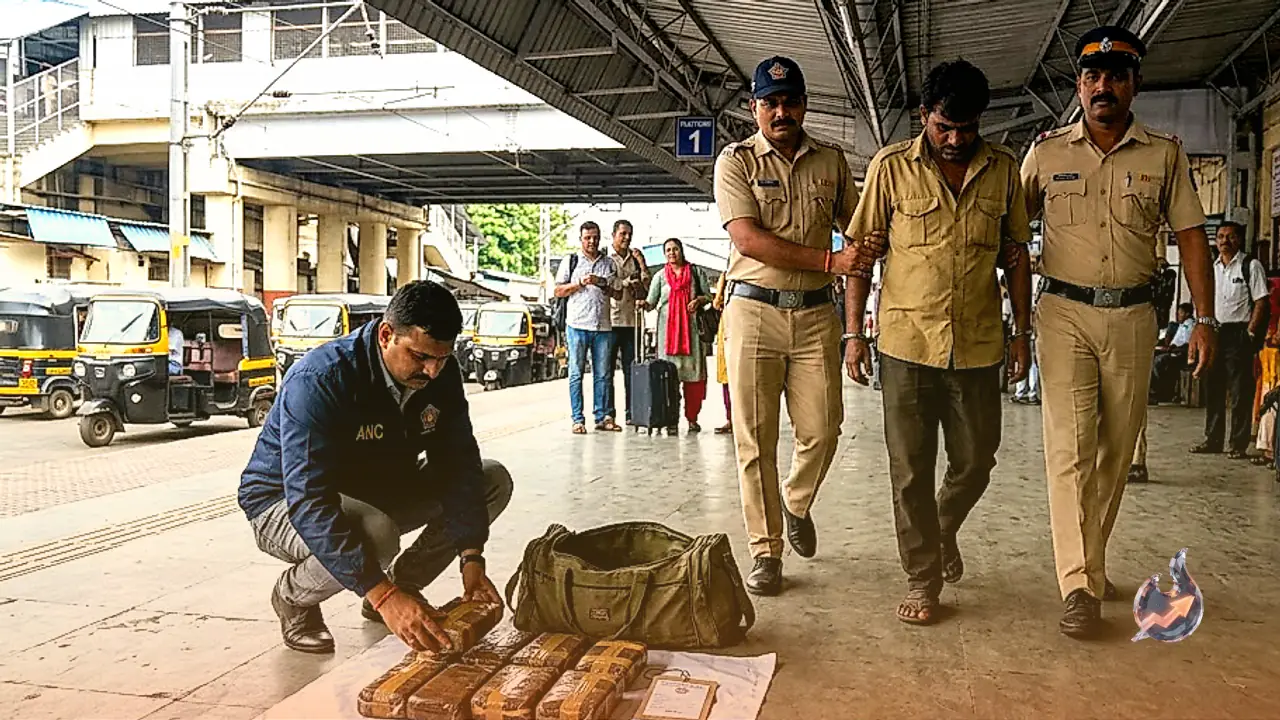

In a significant crackdown on illicit drug trafficking, the Anti Narcotics Cell (ANC) of the Mumbai Police has executed a major operational success at Bandra Railway Station, arresting a suspect caught with 10 kg 10 grams of high-grade hashish (charas). The seized contraband is estimated to be worth over Rs 10.10 crore in the international market. The targeted police action was launched following specific intelligence gathered by the Worli unit of the ANC, indicating that a drug courier traveling from Bihar was transporting a substantial consignment of narcotics to Mumbai by train. The intelligence was received under the leadership of DCP Purnima Chaugule Shringi. Acting swiftly on the tip-off, law enforcement teams intensified patrolling, established strict checkpoints, and tightened surveillance across the platforms, exit points, and surrounding premises of Bandra Railway Station.
Suspect Boarded Train From Motihari in General Class to Avoid Detection
Preliminary investigations and interrogation of the suspect revealed crucial details regarding his operational methods. The arrested individual has been identified as a 31-year-old auto-rickshaw driver originally residing in Bihar. According to police officials, he boarded an express train from Motihari railway station in Bihar to travel to Bandra Station in Mumbai. To evade detection by police personnel and intelligence operatives during his long journey, he adopted a calculated strategy. He specifically opted to travel in the overcrowded, unreserved General compartment of the train, believing that blending into the heavy rush of daily passengers would allow him to pass unnoticed. However, as soon as the train pulled into Bandra Railway Station and the suspect disembarked carrying his baggage, the waiting ANC officers intercepted him on suspicion. A detailed physical inspection of his luggage resulted in the recovery of 10 kg 10 grams of packaged hashish stored inside his bag. Officers also seized a mobile phone from the suspect, which has been sent for forensic analysis to retrieve call logs, messaging data, and contact lists.
Operated as Drug Courier: Investigation Focuses on Supply Links in Nepal
Further interrogation established that the accused was operating purely as a 'drug courier' or carrier within a larger organized crime syndicate. His assigned responsibility was restricted to transporting the heavy narcotics consignment safely from Bihar to Mumbai, delivering it to a designated local recipient in the city, and immediately returning to his home state. Following the arrest, the ANC has launched a comprehensive investigation to trace the original source and manufacturing location of the seized hashish. Investigators are probing whether the narcotics were cultivated and processed within remote regions of India or illegally smuggled across the porous international border from Nepal or another neighboring country before being routed toward Mumbai. Additionally, police are working to identify the intended recipient of the consignment in Mumbai and uncover all individuals linked to this inter-state trafficking network. The suspect was produced before a local magistrates court, which remanded him to police custody (PC) until August 21 to facilitate deeper questioning. Interrogation is currently ongoing to track down key handlers and financial beneficiaries of the network. This successful interception follows a previous major operation by the ANC, where officers busted an illegal mephedrone (MD) manufacturing facility worth Rs 50 crore and conducted coordinated raids across 13 locations, including Agripada.
'Drug Free Mumbai' Campaign Implements 15-Department Strategy
The high-value narcotics seizure at Bandra Station aligns directly with the Maharashtra government's broader 'Drug Free Mumbai' initiative. Chief Minister Devendra Fadnavis officially launched the comprehensive campaign on July 30, laying out a decisive roadmap to eliminate illicit drugs from the metropolis within the next 2 to 4 years. The state's multi-pronged strategy focuses on systematically severing narcotics supply lines, dismantling smuggling networks, and enforcing strict legal measures, alongside running structured rehabilitation, counseling, and reintegration programs for youth affected by substance addiction.
To ensure seamless coordination across administration levels, the state government has implemented a 'Whole of Government' operational framework for the campaign. Under this unified model, 15 key government departments are working in close synchronization to execute enforcement, awareness, and rehabilitation tasks without bureaucratic bottlenecks. Chief Minister Devendra Fadnavis issued a stern warning stating that any police officer or government official found complicit in drug trade activities will face severe penal action and immediate dismissal. Furthermore, preventative interventions have been introduced at the school level. The state government has directed the formation of anti-drug guidance and counseling committees across schools while actively running the 'Drug-Free School' campaign to educate students on the severe dangers of narcotics consumption.
Crackdown Spans 1,497 Illegal Structures and Kiosks Across Mumbai
In addition to arresting individual couriers, municipal and law enforcement authorities have launched an aggressive drive to eliminate physical spaces where illicit drug trading and suspicious gatherings take place. As part of this citywide enforcement campaign, authorities have targeted and demolished or cleared 1,497 unauthorized structures, unauthorized kiosks, and roadside paan stalls across various neighborhoods in Mumbai. Administrative officials noted that unauthorized roadside kiosks frequently serve as hubs for vagrants, anti-social elements, and street-level drug distribution. The Anti Narcotics Cell had previously executed several successful raids and arrests throughout the month of July, demonstrating sustained administrative pressure to cleanse Mumbai of narcotics networks.