




















When considering the cities burdened with the most severe traffic congestion nationwide, Delhi, Bengaluru, and Mumbai invariably emerge at the forefront. In Mumbai particularly, commuters are routinely forced to spend hours stranded on roads just to travel from one point to another within the metropolis. A prime example includes the heavily transited corridors between Thane and Borivali, where travellers currently endure commute times ranging anywhere from one to one and a half hours. To alleviate this persistent bottleneck, the government is actively constructing a dedicated underground tunnel linking these two zones, a development designed to compress the journey into a mere fifteen minutes upon completion. The most fascinating engineering aspect of this subterranean corridor is that while passenger cars will race through the lower depths at speeds reaching one hundred kilometres per hour, leopards and bears will roam freely across the natural habitat directly above.
The MMRDA Infrastructure Initiative
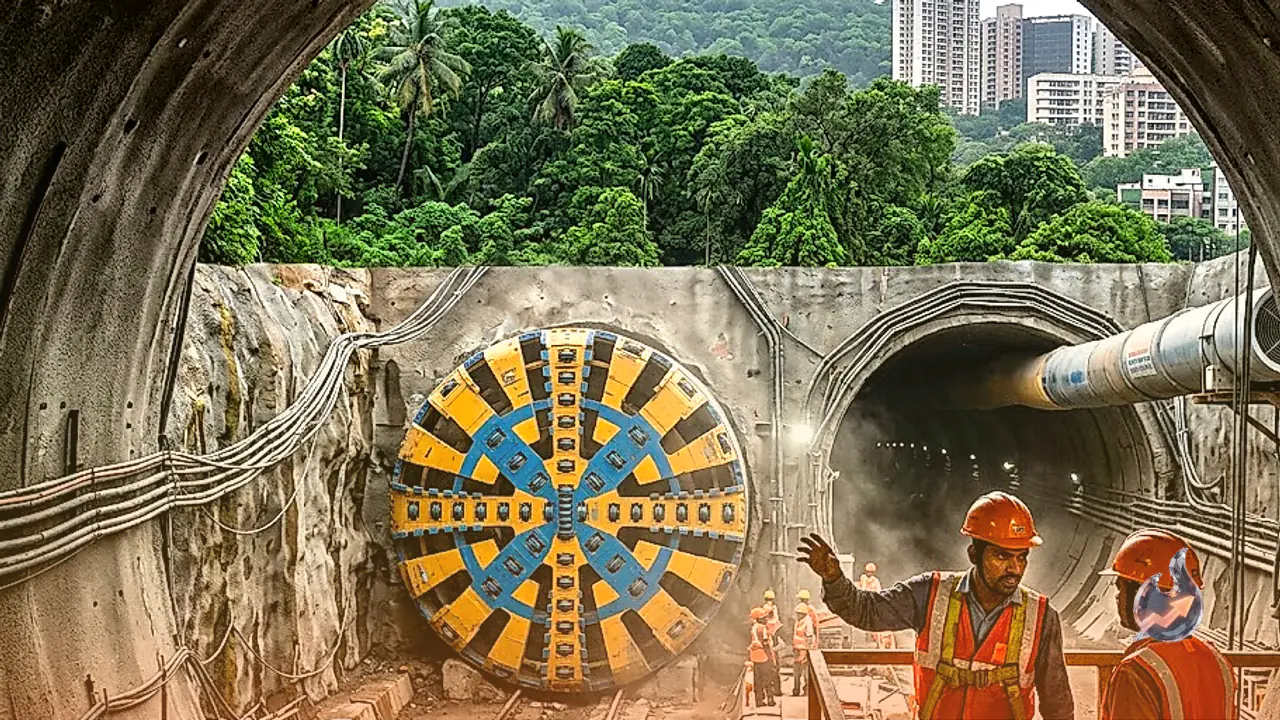
The Mumbai Metropolitan Region Development Authority has officially commenced the advanced phases of the Thane-Borivali twin tunnel project. Operations have scaled up significantly with the deployment of a specialized tunnel boring machine designated as TBM-2 Arjun, which is actively accelerating the excavation process. Once this engineering marvel is fully operational, transitioning between Thane and Borivali will become remarkably seamless. At present, navigating this route requires roughly sixty to ninety minutes, but the subterranean pathway will successfully compress the duration down to fifteen minutes flat. While the traditional surface route spans a distance exceeding twenty-six kilometres, the completed tunnel layout will shorten the operational transit span to approximately twelve kilometres.
Excavation Beneath the Sanjay Gandhi National Park
The construction path for the Thane-Borivali underground route cuts directly underneath the ecologically sensitive and historically significant Sanjay Gandhi National Park. Providing operational updates through the social media platform X, the Mumbai Metropolitan Region Development Authority noted that TBM-1, alternatively named Nayak, has been operating alongside Arjun to drive the excavation forward. Machine Nayak has already neared the completion of its primary boring objectives for the initial tube. Both heavy-duty boring systems are actively carving through a baseline stretch measuring 10.25 kilometres, contributing to an overall project length projected at approximately 11.84 kilometres. According to regional transit authorities, this engineering undertaking stands as the longest urban tunnel deployment ever attempted across the nation.
Mitigating Transit Delays and Fuel Consumption
Upon the full realization of the Thane-Borivali transit corridor, slashing travel durations to fifteen minutes will yield substantial operational efficiencies. Minimising hours spent idling in gridlocks naturally translates into massive preservation of automotive fuel resources. Compressing a ninety-minute vehicular ordeal into a brief quarter-hour window amounts to an unprecedented windfall for everyday motorists. Furthermore, this strategic corridor will establish a direct connection from the Ghodbunder area near Thane to the Western Express Highway, optimizing regional connectivity. The completed route is poised to play a transformative role in curbing vehicular emissions, conserving valuable fuel reserves, and expediting metropolitan mobility.
Deploying Advanced Boring Technology
TBM-2 Arjun has been specifically commissioned to carve out the parallel secondary tube designated for this infrastructure undertaking. Arjun is an urban-optimized boring system engineered explicitly to fracture through dense and unyielding geological strata. The heavy machinery is capable of shearing massive rock fragments to clear out the subterranean cavity efficiently. With primary excavation duties handled by machine Nayak on the first bore, simultaneous construction operations are currently underway across both parallel tubes.
Balancing Urban Expansion with Wildlife Preservation
The engineering alignment places the Thane-Borivali tunnel deep below the protected acreage of the Sanjay Gandhi National Park, an environmental asset renowned for its rich biodiversity. The sanctuary hosts thriving populations of indigenous wildlife, including leopards, bears, and wolves, creating a unique scenario where vehicular traffic moves silently underground while predators roam the surface undisturbed. Planners have engineered the subterranean pathway precisely to ensure that surface-level wildlife populations experience zero environmental disturbance despite heavy vehicular movement operating deep beneath their feet.
Engineering Deep Beneath the Surface
The infrastructure project is burrowing through solid earth at a depth reaching 320 metres below the Sanjay Gandhi National Park terrain. Executing continuous east-to-west excavation at such extreme depths presents formidable geotechnical challenges. Progress on the infrastructure initiative had experienced slower development phases previously due to reliance on a single operational boring unit. However, with TBM-2 Arjun actively contributing to the excavation workflow, the likelihood of expediting the final completion schedule has increased substantially.