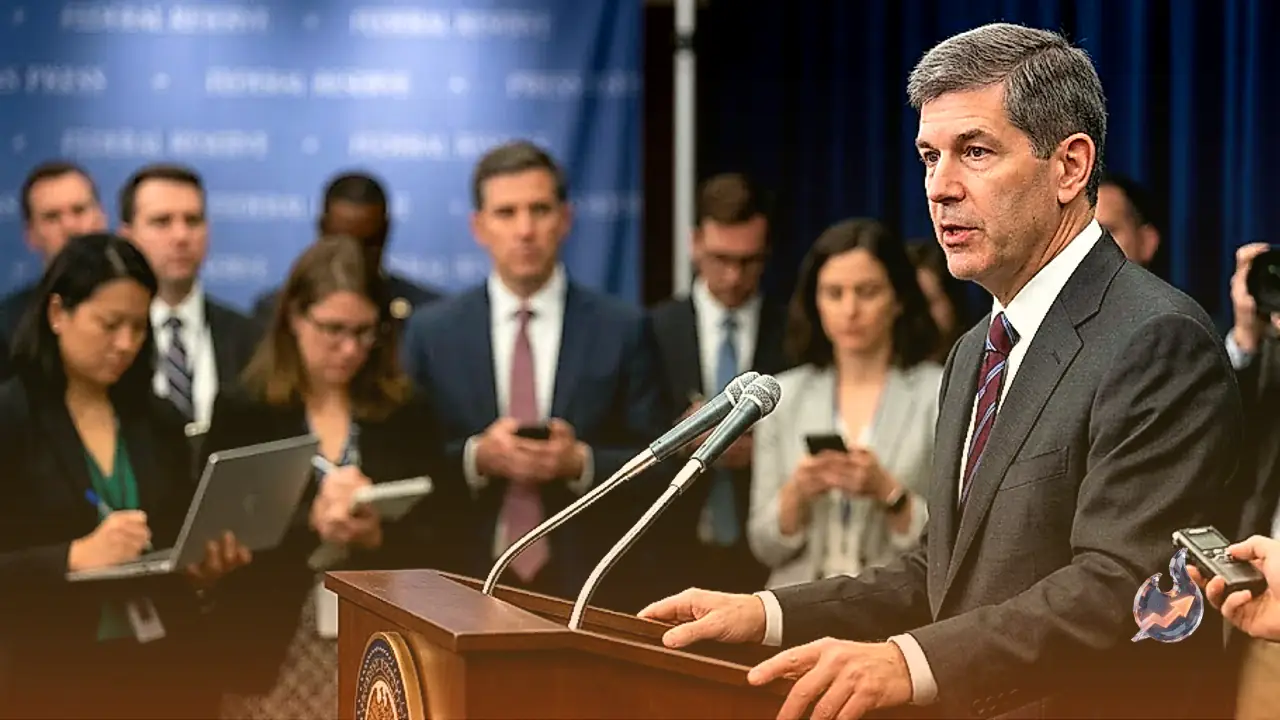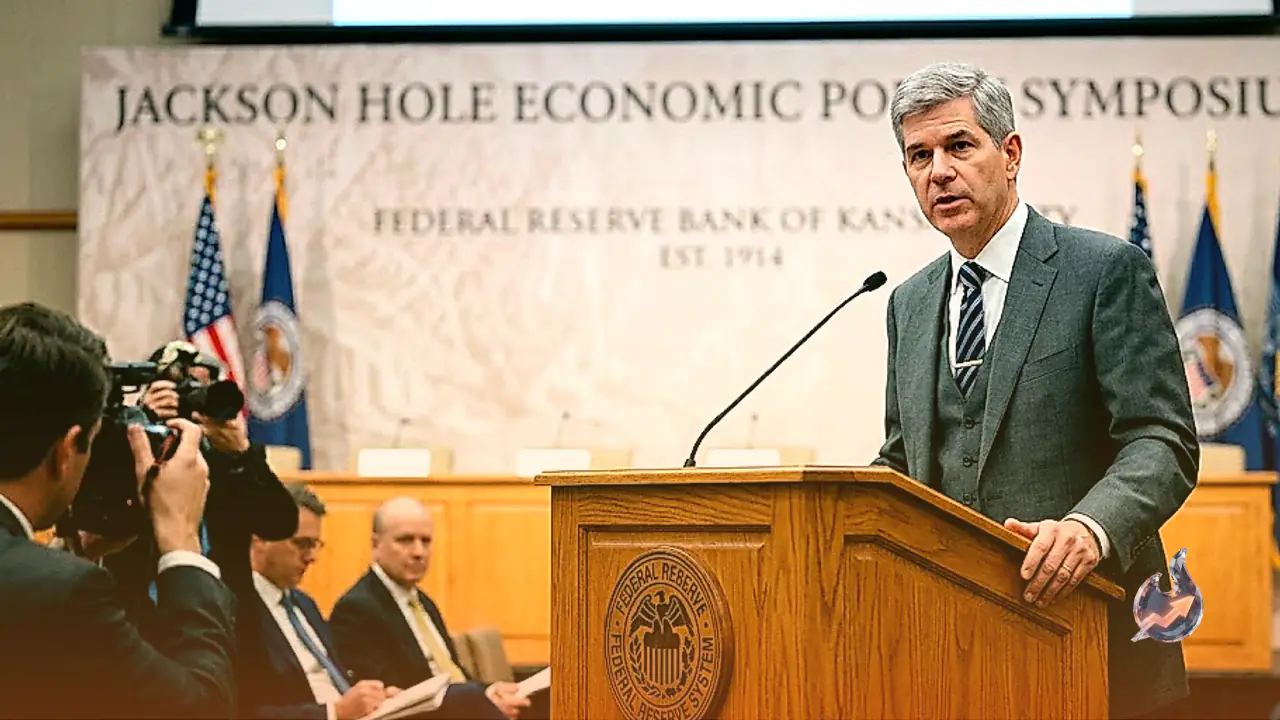
























The British Pound experienced renewed downside momentum against the US Dollar on Friday, with the GBP/USD currency pair receding toward the 1.3530 region as financial markets digested hawkish monetary policy commentary from Chair Warsh at the annual Jackson Hole Symposium. A resurgent Greenback, bolstered by rising benchmark US Treasury yields and shifting interest rate expectations, exerted broad selling pressure across major foreign exchange trading pairs. Institutional investors and market participants rapidly recalibrated their portfolio positioning as interest rate probability models flagged a significantly increased likelihood of a Federal Reserve policy tightening step at the upcoming September FOMC meeting, abruptly reversing prior market assumptions regarding potential monetary policy easing.
Warsh Signals Persistent Core Inflation Risks at Jackson Hole
In a highly anticipated address at the economic policy symposium in Jackson Hole, Warsh provided explicit guidance regarding his current monetary policy outlook and inflation assessment. Warsh had notably refrained from submitting a forecast dot in the Federal Reserve's Summary of Economic Projections (SEP) dot-plot during the June policy meeting, which made his formal public presentation at Jackson Hole a critical focal point for macro investors globally. While acknowledging that headline consumer inflation data over the summer months had shown some encouraging signs of moderation, Warsh highlighted that underlying core inflation metrics have failed to demonstrate the sustained disinflationary progress required by monetary authorities.
During his detailed presentation, Warsh emphasized that the central bank's official 2% Personal Consumption Expenditures (PCE) price index target remains firm, fixed, and non-negotiable. He observed that while aggregate consumer spending continues to reflect healthy economic resilience and domestic labor market conditions remain structurally stable, the broader indicators for price stability present a far more concerning outlook. Warsh stressed that monetary policy decision-makers must establish absolute confidence that inflation is trending back toward the 2% objective on a durable basis, warning that if inflation pressures persist, the central bank still has necessary work to do in adjusting interest rate settings.
Market Probabilities Shift Toward September Policy Tightening
Financial markets and fixed-income derivative instruments reacted swiftly to Warsh's hawkish policy signals. Quantitative data derived from Prime Terminal's interest rate probability tool demonstrated a sharp upward recalibration in money market expectations for monetary tightening. The implied probability of a 25-basis-point interest rate increase at the Fed's September meeting surged from 34% just a day prior to 43% following the speech. In the immediate trading reaction following Warsh's remarks, short-term money market pricing temporarily indicated odds as high as 50% for a September rate hike.
The sudden shift in rate hike probability provided powerful fundamental momentum for the US Dollar Index (DXY), which tracks the performance of the American currency against a basket of six major world currencies. The index advanced more than 0.38% to settle around 99.49. Simultaneously, US Treasury yields pushed higher across the curve as bond traders priced in a higher-for-longer policy trajectory. The benchmark 10-year US Treasury yield increased by nearly 1.5 basis points to reach 4.686%. This re-pricing in debt markets occurred alongside the release of the US Non-Farm Payroll (NFP) annual benchmark revision data, which reflected a downward adjustment of -79,000 jobs, but failed to undermine the Greenback's broad rally.
US Consumer Sentiment and Inflation Expectations Data
Macroeconomic data releases published alongside central bank communications provided further operational context for foreign exchange traders. The preliminary August University of Michigan (UoM) Consumer Sentiment index registered at 51.7, exceeding consensus Wall Street forecasts for a 51.0 reading. Although the figure beat estimates, it represented a moderate retreat compared to the sentiment index printed in July.
Within the internal components of the survey, short-term household inflation expectations recorded a modest improvement. The one-year forward inflation expectation figure was revised downward from 4.2% to 4.0%. In contrast, long-term inflation expectations over a five-year horizon held firm at 3.3%, aligning perfectly with economic forecasts. The combination of anchored longer-term inflation expectations and resilient consumer demand reinforced market expectations that the Federal Reserve possesses sufficient policy flexibility to maintain tight monetary conditions should core inflation remain sticky.
GBP/USD Technical Outlook and Critical Support Levels
With the United Kingdom domestic economic calendar devoid of high-tier economic announcements, Cable trading dynamics remained overwhelmingly governed by overall US Dollar movement and macroeconomic sentiment. The GBP/USD pair resumed its broader downward correction, approaching critical technical structural support zones.
On the upside, immediate technical resistance for Cable is located around the 1.3634 area, which corresponds to the breakdown region of a former rising trendline. A definitive daily close above 1.3634 would be required to alleviate short-term downside pressure and open technical space for a recovery attempt toward higher levels. Conversely, initial technical demand on subsequent pullbacks is expected near 1.3487. Beneath that level, a critical technical support zone aligns around 1.3424, anchored by a triple simple moving average cluster. Deeper structural support layers rest at 1.3397 and 1.3392, where prior trendlines reinforce the overarching bullish long-term framework.
According to live financial market data, GBP/USD (GBPUSD=X) is currently trading at 1.36, representing a 0.26% decline from its previous daily close within a 52-week trading range spanning 1.30 to 1.38. Technical indicators show a 14-day Relative Strength Index (RSI) at 55, placing momentum in neutral territory, while the Moving Average Convergence Divergence (MACD) line sits at 0.01 relative to its signal line of 0.01 with a histogram reading near 0.00. Key moving averages confirm an intact long-term structural uptrend, with the 20-day Exponential Moving Average (EMA) at 1.35, the 50-day EMA at 1.35, and the 200-day EMA at 1.34 displaying a golden cross configuration. Additional technical parameters include an Average Directional Index (ADX 14) reading of 31 indicating a clear trend, a Stochastic fast line at 43 versus a signal line of 64, and an Average True Range (ATR 14) of 0.01.
Broader FX Markets, Commodities, and Crypto Retreat
The widespread strength of the Greenback generated noticeable secondary effects across international currency pairs and global asset categories. EUR/USD accelerated its downward momentum, retreating to seven-day lows under the sub-1.1600 threshold as market participants repriced Eurozone interest rate differentials against an increasingly hawkish Federal Reserve baseline.
Commodity markets similarly felt the pressure of climbing Treasury yields and a stronger US Dollar. Spot Gold experienced intensified selling momentum, declining to weekly lows and testing its critical 200-day Simple Moving Average (SMA) near $4,530 per troy ounce. In energy trading, however, refined petroleum products demonstrated remarkable independent strength. The US diesel crack spread, which measures the market premium of ultra-low sulphur diesel futures over WTI crude oil, surged past $100 per barrel for the first time in history, recording an intraday peak slightly above $102.00 per barrel.
In global central banking activity, the Reserve Bank of New Zealand (RBNZ) is anticipated to execute a policy interest rate increase, with market focus centered on forward guidance commentary. Conversely, the Bank of Canada (BoC) is expected to maintain its policy benchmark rates unchanged in the near term.
Cryptocurrency markets mirrored the contraction in risk appetite seen in broader financial assets. Bitcoin (BTC) slid back below the $80,000 psychological threshold following an unsuccessful second attempt to break through overhead technical resistance between $81,000 and $82,000. Major alternative cryptocurrencies tracked Bitcoin lower, with Ethereum (ETH) sliding toward $2,500 and Ripple (XRP) pulling back toward key technical support around $1.40.