














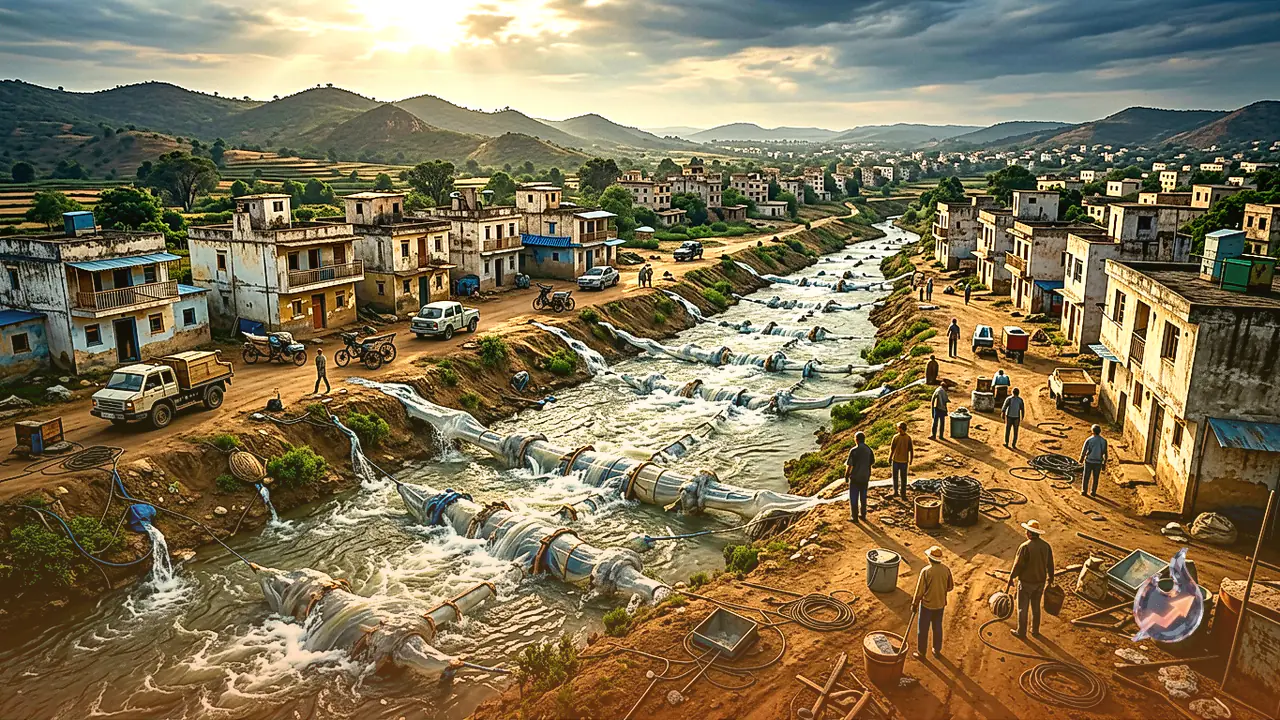

Jhunjhunu Municipal Council has finalized a comprehensive Detailed Project Report (DPR) valued at Rs 340.88 crore to extend modern underground sanitation infrastructure to every household across the municipality, including 10 newly annexed revenue villages. Pending formal administrative approval and budgetary allocation from the state government, the upcoming third phase of the town's sewerage expansion will entail laying 158 kilometers of new pipeline network. The primary objective of this massive urban overhaul is to achieve 100 percent sewage coverage across all residential and commercial pockets in Jhunjhunu, eliminating long-standing sanitation deficits.
Existing Infrastructure and Coverage Deficit
To date, Jhunjhunu has executed two dedicated phases of sewage network development. Under the first phase, a 194-kilometer main and feeder pipeline network was successfully constructed and commissioned. The second phase, which involves laying approximately 45 kilometers of additional sewerage lines, is currently undergoing execution on the ground. Despite these combined infrastructure efforts, nearly 55 percent of Jhunjhunu's total urban population remains unconnected to the centralized sewage system. Furthermore, following the recent territorial re-delimitation of the municipal council, 10 peripheral revenue villages were merged into the city limits, creating an urgent mandate to expand municipal sanitation services into these newly added localities.
Four New STPs and Pumping Stations Proposed
Under the technical framework outlined in the new DPR, the third sewage phase provides for the installation of four new Sewage Treatment Plants (STPs) across strategic urban locations. This includes two treatment facilities with an individual capacity of 2 MLD (million liters per day) and two smaller units rated at 1 MLD each. To ensure seamless fluid conveyance toward these treatment plants, the council will also construct two new sewage pumping stations. These pumping units are designed to prevent wastewater stagnation caused by topographical slopes or extended distances, maintaining uninterrupted flow throughout the 158-kilometer newly laid network.
Total Wastewater Processing Capacity to Touch 25 MLD
Once Phase 3 reaches completion, the total operational STP count in Jhunjhunu will rise to seven facilities, elevating the collective wastewater processing infrastructure to approximately 25 MLD. The town currently operates two major Phase 1 treatment facilities with processing capacities of 8.5 MLD and 7 MLD respectively. Meanwhile, a 3.7 MLD facility under Phase 2 is under active construction and is projected to be fully operational by December. According to official municipal estimates, Jhunjhunu produces roughly 18 MLD of municipal sewage and domestic greywater each day, whereas the expanded grid will establish a robust processing target of handling 24 MLD daily.
Managing Domestic Wastewater and Eco-Friendly Reuse
The operational scope of Phase 3 covers all forms of domestic wastewater generated from kitchens, bathrooms, and toilets, while keeping rainwater runoff completely segregated. Municipal Council Commissioner Rakesh Kumar Ranga explained that diverting household greywater directly into closed underground conduits will substantially lessen effluent load and overflow pressure on open street drains and municipal channels. To constructively utilize the recycled water, the municipal council has drafted a sustainability plan to construct an artificial lake in the Beed region, which will be filled using STP-treated water. Alongside this lake, a bio-diversity forest is proposed to be cultivated in the same zone, integrating treated wastewater into localized ecological conservation efforts.
Separate Rainwater Drainage and Budgetary Approval
To resolve monsoon waterlogging issues systematically, the municipal authority is developing a separate drainage master plan dedicated exclusively to stormwater management. Preliminary survey work for the drainage grid is already complete, and engineering designs are currently being finalized under the supervision of Commissioner Rakesh Kumar Ranga. This initiative stems directly from the State Budget 2025-26 announcement, which pledged comprehensive sewage and drainage expansion for major urban centers across Rajasthan. Following the submission of the Rs 340.88 crore DPR, the municipal administration awaits formal sanction and fund release from the state government to launch the tendering and construction processes.