




















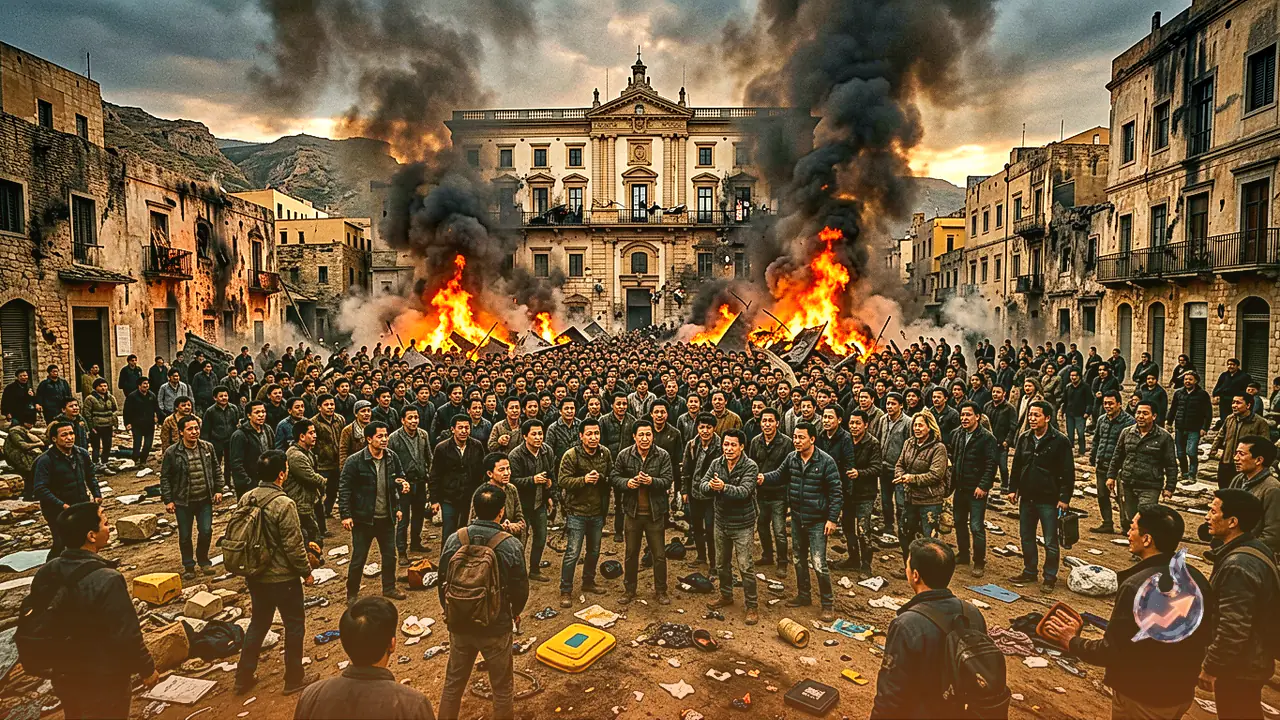

Severe civil unrest and violent clashes have erupted across the Spanish exclave city of Ceuta in North Africa, where deep-seated social friction between local residents and thousands of recently arrived migrants has spiraled into open confrontation. A month after an unprecedented maritime border crisis saw tens of thousands of individuals attempt to cross into Spanish territory from neighboring Morocco, local discontent has escalated from peaceful public demonstrations to direct acts of arson, street vigilantism, and physical clashes with law enforcement authorities. The deteriorating situation on the ground has placed immense pressure on local infrastructure, strained emergency humanitarian operations, and ignited a fierce political battle in Madrid over national security, immigration policy, and border control.
Humanitarian operations came to a sudden halt on Thursday when several dozen local protesters surrounded relief workers from the Red Cross, physically preventing them from distributing essential food packages and clean drinking water to stranded migrants. Following the confrontation, groups of local demonstrators targeted informal migrant encampments along Trampolín beach, which has served as the primary temporary shelter for hundreds of individuals living without basic amenities. Protesters set fire to the personal belongings, tents, and makeshift bedding of the migrants, causing panic along the shoreline and forcing riot police to intervene. The beach arson attacks quickly devolved into violent scuffles between local demonstrators and police personnel attempting to secure the area and restore public order.
Escalation of Street Clashes and Vigilante Action in Ceuta
The beach violence occurred just hours after local police arrested 12 migrants in connection with a violent attack on a military vehicle patrolling the city. According to law enforcement reports, the group targeted the military vehicle by hurling stones and heavy debris, shattering its windows and inflicting injuries on four military personnel inside. The incident triggered widespread outrage across the enclave, prompting reports of local vigilante groups taking to the streets to track down and confront migrants in residential neighborhoods. The volatile atmosphere has also endangered members of the press, with news crews, photojournalists, and camera operators reporting explicit verbal threats and physical intimidation while attempting to document the unfolding civil unrest.
The city currently accommodates several thousand migrants who remain stranded without permanent shelter, sleeping rough on public beaches, parks, and city sidewalks. Among those living in precarious conditions are a significant number of unaccompanied children who crossed the border during the mass entry event. Local residents have voiced growing fears regarding personal safety on public streets, while public administration officials warn that local municipal services, healthcare facilities, and social assistance programs are operating far beyond their maximum capacity.
Mass Border Crossing and the Crisis on the Moroccan Boundary
The current unrest is the direct aftermath of a massive border breach that occurred on July 30 and July 31, when an estimated 72,000 migrants crossed from Morocco into Ceuta within a 48-hour window. The overwhelming majority of the individuals attempted to bypass the physical border infrastructure by swimming around the coastal fences separating Moroccan territory from the Spanish exclave. According to official figures provided by the mayor of Ceuta, at least 100 people lost their lives at sea during the perilous mass crossing attempt. Although law enforcement and border authorities managed to return the vast majority of the arrivals to Morocco within hours of their reach, several thousand individuals managed to evade immediate repatriation and established informal camps across the city.
The persistent presence of thousands of destitute individuals sleeping in public spaces has heightened community anxiety. Tensions have been further exacerbated by central government proposals to relocate migrants from open beaches into converted public buildings, including community sports centers. The government initiative aims to establish organized processing centers where officials can verify legal documentation, assess asylum eligibility, and execute formal deportation orders for those who do not qualify for international protection. However, local residents and municipal leaders have strongly opposed the plan, arguing that establishing processing centers inside neighborhood facilities will bring the crisis directly into residential zones and exacerbate security risks for local families.
Political Fallout and Fiery Debates in Madrid
The ongoing crisis in North Africa has triggered a major political confrontation between Spain's central government and opposition political parties. Juan Jesús Vivas, the conservative mayor of Ceuta representing the People's Party, issued an urgent public appeal during a broadcast interview with Antena 3 television, emphasizing that the enclave is enduring unacceptable strain. Mayor Vivas stressed that the city has been under continuous pressure and asserted that its citizens possess a fundamental right to social normality. He warned national leaders that the dignity of Spain itself is currently at stake in Ceuta, calling for immediate and robust state intervention to protect the city's integrity and restore public order.
In response to mounting public criticism over its handling of the emergency, the socialist-led central government under Prime Minister Pedro Sánchez took decisive administrative action earlier this week by centralizing crisis management responsibilities. By assuming direct control over border operations and migrant relief, the national administration effectively bypassed local municipal authorities, responding to accusations from opposition lawmakers that state authorities had been unacceptably slow and indecisive in addressing the border breach. National officials have repeatedly appealed to the public for calm while pointing fingers at opposition political groups for intentionally inflaming social conflict.
Prime Minister Pedro Sánchez's administration has explicitly accused the conservative People's Party and the far-right Vox party of stoking xenophobic sentiments and exploiting public anxiety for partisan political gain. The political debate turned exceptionally bitter following remarks made shortly after the mass crossing by José María Figaredo, a member of Congress representing Vox. Figaredo stated publicly that the incoming migrants should be hunted down, one by one, a declaration that immediately prompted a formal judicial investigation into potential hate crimes. Spanish Interior Minister Fernando Grande-Marlaska addressed a congressional committee to condemn such statements, arguing before lawmakers that inflammatory rhetoric during national emergencies serves only to stigmatize vulnerable immigrants and deepen social division at a moment when national leaders must demonstrate statesmanship and institutional responsibility.
Conversely, representatives from opposition parties have turned the blame entirely back onto the national executive. Javier Celaya, who represents Ceuta in the Spanish Congress for the People's Party, delivered a scathing critique during congressional proceedings, accusing the central government of misplacing its sympathies. Celaya argued that national authorities were treating incoming illegal invaders as victims while ignoring the plight of the residents of Ceuta, whom he identified as the true victims of the crisis. Amid the escalating political warfare in Madrid, local politicians in Ceuta sought to project unity on the ground, with all political factions represented in the Ceuta local assembly coming together on Friday to sign a joint formal declaration explicitly condemning all forms of violence and civil disruption.
Geopolitical Strain and Sovereignty Disputes With Morocco
Beyond domestic political battles, the border crisis has reignited delicate geopolitical debates regarding international relations and territorial sovereignty in North Africa. Politicians from both right-wing opposition parties and far-left parliamentary factions have publicly accused the Moroccan government of orchestrating or permitting the mass border breach as a geopolitical tactic. Critics point out that Rabat has historically utilized border enforcement flexibility as a mechanism to exert political pressure on Madrid during diplomatic disagreements over North African regional policies.
However, Prime Minister Pedro Sánchez and the Socialist Party have rejected claims of official Moroccan complicity, placing the blame squarely on illegal human trafficking networks operating along the North African coast. The central government maintains that Moroccan authorities remain a reliable security partner, pointing out that Rabat cooperated closely with Spanish border security to facilitate the immediate return of tens of thousands of migrants shortly after they landed on Ceuta's shores. Nevertheless, the scale of the migration wave has placed the long-term status and political sovereignty of Spain's North African territories, Ceuta and Melilla, under renewed international scrutiny, particularly after Moroccan officials reiterated longstanding territorial claims over the two autonomous cities in recent weeks.
The territorial rhetoric from Rabat met immediate pushback from Spanish diplomatic leadership. Spanish Foreign Minister José Manuel Albares issued a firm declaration before a congressional committee, stating that he roundly rejected any assertions questioning Spanish sovereignty over its North African cities. Foreign Minister Albares emphasized to lawmakers that Spain's territorial integrity is entirely non-negotiable, asserting clearly that he has not discussed, does not discuss, and will never discuss the territorial integrity of Spain with Morocco or any other foreign power.