






















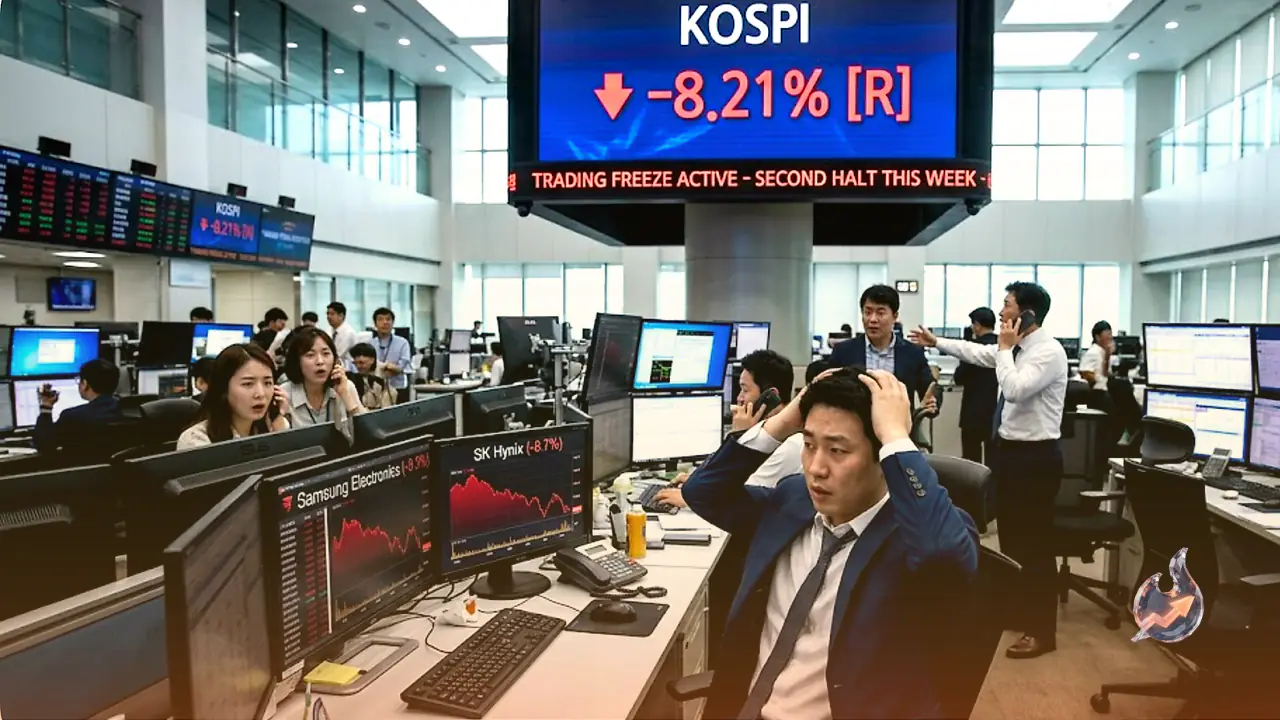

South Korea's main stock index, KOSPI, endured one of its sharpest single-day collapses in recent months on Friday, falling as much as 8.2% during intraday trading. The scale of the drop activated a Level 1 circuit breaker, forcing Korea Exchange to suspend all market activity for approximately 20 minutes. At the center of the crash were Samsung Electronics and SK Hynix, the country's dominant chipmakers, whose shares each shed more than 9%. Strikingly, this was the second time within the same week that KOSPI's volatility had grown severe enough to trigger a full trading halt.
Three Fears Behind the Selloff
A combination of anxieties drove the day's sharp decline. Investors have grown increasingly uncertain about whether the AI sector can sustain the elevated demand for semiconductor products that has been underpinning chipmaker valuations. Questions are mounting in parallel about the longevity of the current memory chip upcycle. On top of that, valuations across the broader technology space had climbed to stretched levels, leaving stocks exposed to any abrupt change in mood. AI-linked shares had surged sharply in recent weeks, and investors are now booking profits from those gains, a wave of selling that pulled the entire market lower with it.
The timing made the reversal all the more jarring. Just one day before Friday's collapse, the market had actually rallied strongly, buoyed by a positive outlook from Micron Technology and separate reports that SK Hynix was exploring a listing on an American exchange. Within 24 hours, that optimism had dissolved entirely, and heavy selling took hold across the board.
Foreign Investors Unloaded $1.7 Billion Before Noon
Foreign investors sold roughly $1.7 billion worth of Korean equities during morning trading alone on Friday. That extraordinary scale of net outflow amplified the pressure on an already fragile market. Because Samsung Electronics and SK Hynix together carry by far the largest weight in the KOSPI index, their simultaneous 9%-plus declines had an outsized and direct impact on the benchmark, dragging it to its 8.2% intraday low.
How Sidecars and Circuit Breakers Work
South Korea's equity markets rely on two distinct mechanisms to manage bouts of extreme volatility. The first is the sidecar, a tool that activates when swings in the futures market become unusually violent. A sidecar does not shut down the whole market; it temporarily pauses only algorithmic and program-driven trading, giving the market a brief window to stabilize before automated systems can accelerate a panic further.
The second mechanism, the circuit breaker, is a far more sweeping intervention. When triggered, all categories of trading across the entire stock market are brought to a complete halt for a fixed period. On Friday, after KOSPI had fallen more than 8%, a Level 1 circuit breaker was activated and all trading was suspended for about 20 minutes. The rationale is straightforward: give investors time to think clearly, break the momentum of panic-driven selling, and allow a degree of order to return to a disorderly market.
A Structural Flaw: Two Stocks, 60% of the Index
South Korea's stock market carries a well-known concentration risk with no easy fix. Roughly 60% of the KOSPI index's total weight is tied to just two companies, Samsung Electronics and SK Hynix. Whenever these two stocks move sharply in either direction, the entire benchmark has little choice but to follow, with scant cushioning from the rest of the index. Compounding this fragility, retail investors have poured large amounts into leveraged ETFs linked to these chip stocks. The daily rebalancing those funds require mechanically amplifies price swings in both directions, layering an additional source of volatility on top of whatever sentiment-driven selling is already happening. Together, these factors make the Korean market unusually reactive to any news touching the chip sector.
A Senior Strategist's Warning on the Memory Chip Cycle
Charu Chanana, Chief Investment Strategist at Saxo Markets, argues that demand for memory chips has not disappeared entirely, but that the character of the chip cycle is clearly shifting. Going forward, she says, the gains from the current upcycle are likely to become concentrated among only a select group of companies rather than distributed broadly across the sector. More critically, she warns that if the current robust phase of the memory chip market begins to lose momentum, the slowdown could reverberate across the entire AI supply chain. Investors appear to be pricing in this risk proactively, pulling back from chip-heavy positions before any concrete evidence of a slowdown has materialized. The market, in short, is beginning to discount a scenario that has not yet arrived.
What This Could Mean for Indian Markets
The reverberations from Seoul may reach Indian shores when markets open on Monday. The pattern is already established from earlier this same week: when KOSPI first posted a heavy decline, Indian equities and several other Asian bourses also fell in response. With a second, larger drop now on the record, investors in Indian stocks may want to approach Monday's open with caution and watch early-session sentiment carefully before making significant moves.