























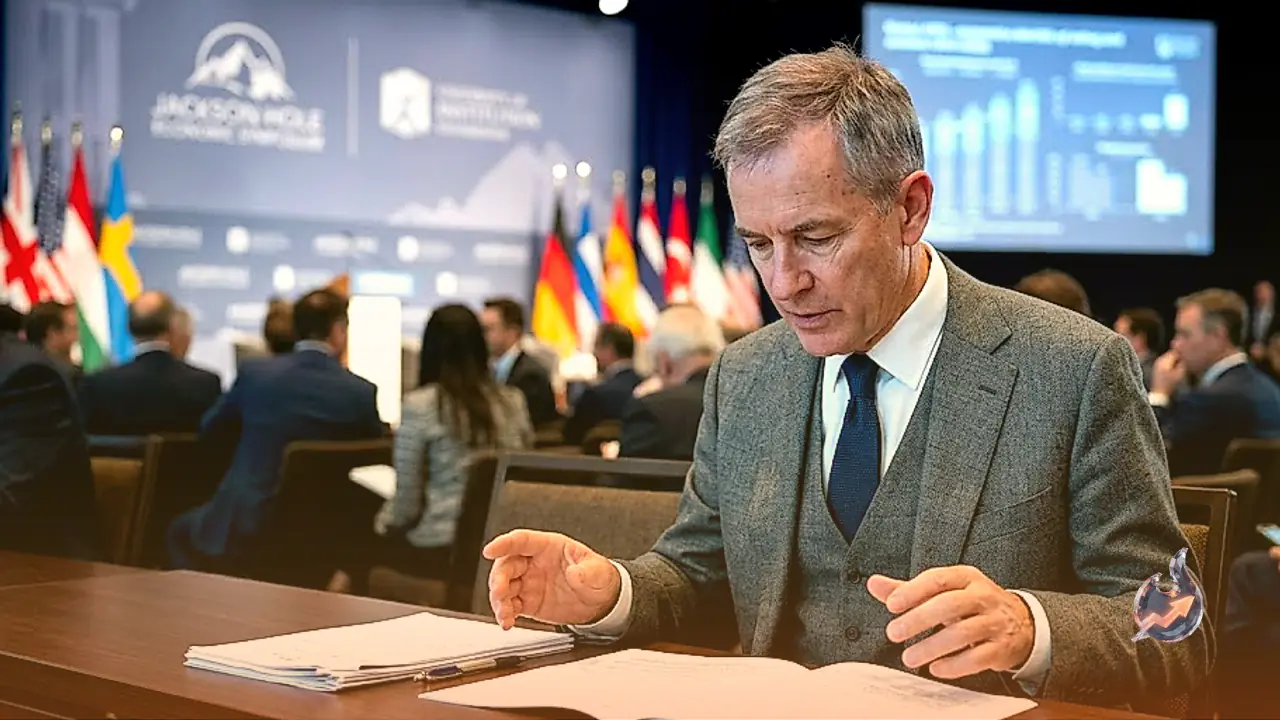

The Euro is remaining under visible downward pressure across global foreign exchange markets, dropping close to the 1.1640 zone as market participants react to intensifying rate-hike signals from Federal Reserve officials. The EUR/USD currency pair is currently pacing toward a 0.3% weekly decline, having traded around 1.1650 during Asian business hours. Investors and institutional traders worldwide are maintaining a laser focus on the annual central banking symposium at Jackson Hole, Wyoming, searching for crucial guidance regarding the future trajectory of US monetary policy.
Hawkish Federal Reserve Signals and Persistent Inflation Concerns
Recent macroeconomic data released from the United States highlighted that domestic price pressures remain stubbornly elevated well above the Federal Reserve’s official 2% target. In response to these lingering inflationary pressures, several Fed policymakers have publicly advocated for additional monetary tightening to break through price persistence. Speaking on CNBC, Kansas Fed President Jeffrey Schmidt stressed the severity of the challenge, remarking that inflation is "still sticky and we've got to continue to find ways to break through."
Echoing these hawkish sentiments, Cleveland Fed President Beth Hammack emphasized that it is "time to act," explicitly pointing toward further interest rate hikes. These stern official comments have reinforced expectations across financial markets that US borrowing costs may remain elevated for longer than previously anticipated. As a direct consequence, the US Dollar has gathered fresh momentum, placing continuous overhead pressure on the Euro and other major foreign currencies.
Jackson Hole Symposium 2026 and Kevin Warsh's Keynote Address
The highly anticipated Jackson Hole economic symposium is taking place from August 27 to August 29, bringing together leading central bankers, finance ministers, and academic economists from across the globe. The official theme for this year's conference is "Financial Innovation: Implications for Payments and Policy." Attention is uniquely concentrated on Friday's session, when Kevin Warsh is scheduled to deliver his first Jackson Hole address in his capacity as Federal Reserve Chair.
Market expectations regarding Warsh's speech extend far beyond a simple preview of whether the Federal Open Market Committee will raise or pause interest rates at its upcoming September policy meeting. Traders are eager to parse his remarks for broader strategic clues regarding the central bank's long-term inflation strategy. Although Warsh has traditionally been cautious about offering explicit forward guidance, the current macroeconomic climate is placing immense pressure on the Fed leadership to outline a decisive monetary trajectory for the remainder of the year.
Scotiabank FX Analysis and Dollar Index Technical Outlook
Foreign exchange strategists at Scotiabank view the recent strengthening of the Greenback as a corrective rally rather than the start of a fundamental structural trend. While acknowledging that historical precedence shows Jackson Hole speeches can trigger substantial repricing across financial markets, Scotiabank analysts highlighted an intriguing dynamic in current options pricing. Specifically, 1-week implied volatility measures are trading noticeably below recent historical averages, indicating that market participants may be underestimating the potential market-moving impact of Warsh's upcoming address.
From a technical chart perspective, Scotiabank experts maintain that the broader US Dollar Index (DXY) remains embedded within a firmly established long-term downtrend. Consequently, they interpret recent Dollar gains as temporary corrections against that underlying macro trend. Following a robust advance on Wednesday, near-term technical focus for the Dollar Index is expected to revert toward retesting the mid-99 area in the coming sessions as traders digest central bank rhetoric and prepare for upcoming monetary policy announcements.
Federal Reserve Framework: Dual Mandate and FOMC Policy Structure
Monetary policy within the United States is established and executed by the Federal Reserve. The central bank operates under a statutory Dual Mandate assigned by Congress: to foster maximum employment and maintain price stability across the economy. Adjusting the benchmark federal funds rate serves as the Fed's primary policy tool to achieve these dual objectives effectively.
When consumer prices rise too rapidly and push annual inflation past the Fed's official 2% threshold, policymakers raise interest rates. Higher policy rates increase borrowing costs throughout the economy, slowing consumer spending and corporate expansion. This dynamic typically enhances the attractiveness of the US Dollar (USD), as international investors seek higher yields available in US fixed-income assets. Conversely, if inflation falls below the 2% target or the national Unemployment Rate escalates to problematic levels, the Fed lowers interest rates to stimulate credit growth, a move that generally weighs heavily on the Greenback.
To determine these policy settings, the Federal Open Market Committee (FOMC) gathers for eight scheduled meetings throughout the year. The voting body of the FOMC consists of 12 officials: the 7 members of the Federal Reserve Board of Governors, the president of the Federal Reserve Bank of New York, and 4 of the remaining 11 regional Reserve Bank presidents who serve one-year terms on a rotating basis. Their collective decisions directly govern interest rate corridors and influence global capital flows across sovereign bond and currency markets.
Unconventional Policy Tools: Quantitative Easing Versus Quantitative Tightening
During severe financial dislocations or periods of severe disinflation, conventional short-term interest rate cuts may prove insufficient. Under such extraordinary circumstances, the Federal Reserve relies on non-standard monetary mechanisms, most notably Quantitative Easing (QE). QE represents an aggressive policy intervention designed to inject liquidity and unfreeze credit markets during acute economic crises, such as the 2008 Great Financial Crisis.
Through Quantitative Easing, the Fed expands its balance sheet by creating new Dollar reserves to purchase large quantities of high-grade government and agency bonds from private financial institutions. This expansion of money supply generally depresses the exchange value of the US Dollar in international foreign exchange markets. Conversely, Quantitative Tightening (QT) is the exact reverse mechanism. Under QT, the Fed stops purchasing new debt securities and ceases reinvesting the principal proceeds from maturing bonds. By allowing its bond portfolio to contract naturally over time, the Fed absorbs excess Dollar liquidity from the commercial banking system, which typically provides fundamental support to the US Dollar's exchange rate.
Cross-Currency Dynamics: GBP/USD Adjustments and Hawkish ECB Tone
Beyond the EUR/USD pair, key movements are also taking place across other major currency crosses. The British Pound (GBP) stabilized near the 1.3600 mark during Asian trading hours after enduring two consecutive sessions of losses. However, GBP upside potential remains constrained by recent declines in global Brent crude oil prices, which have helped alleviate immediate UK headline inflation concerns. In response, money market pricing has shifted, delaying expectations for the Bank of England's next interest rate increase from late 2026 into early 2027.
Meanwhile, the Euro has received underlying support from the European Central Bank’s hawkish monetary stance. Having logged modest gains in the preceding session, EUR/USD attempted to stabilize around 1.1650 in Asian trade. Nonetheless, upside potential for the common currency remains capped as traders weigh the ECB’s stance against hawkish commentary from Federal Reserve officials ahead of the Jackson Hole address. The interplay between ECB monetary firmness and Fed rate expectations will remain the central driver for the Euro moving forward.