























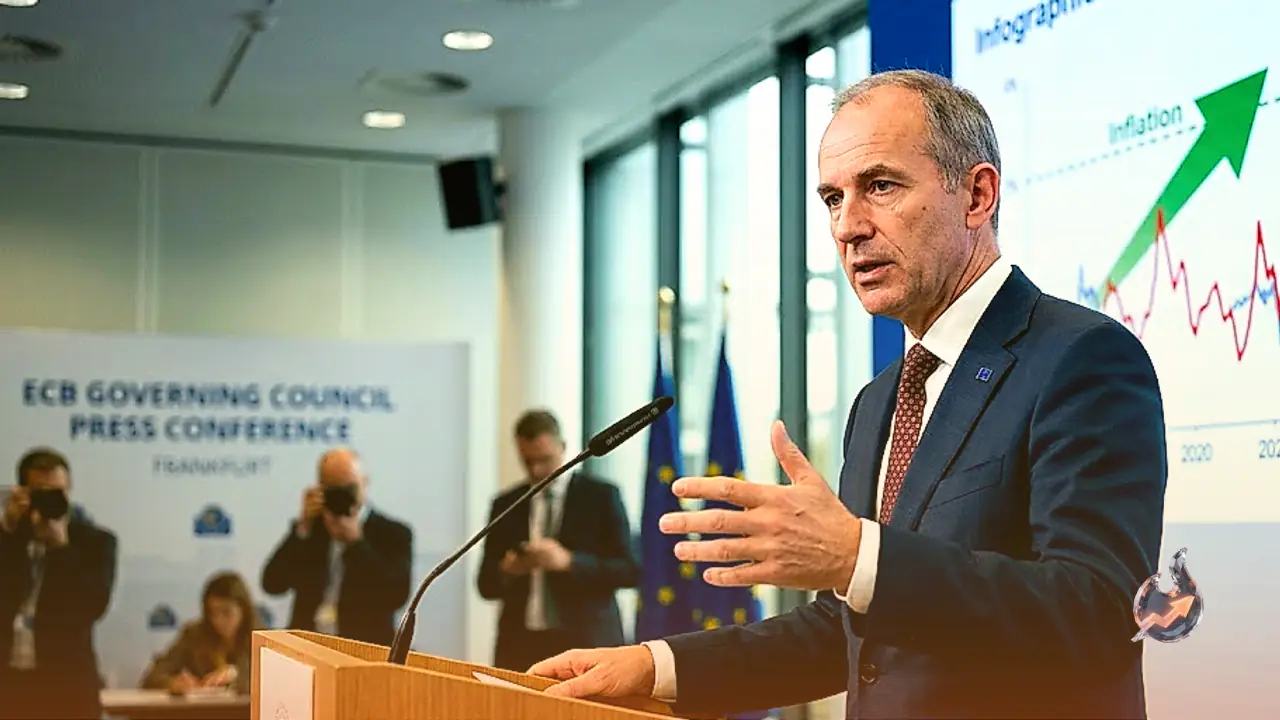

Central bank officials in the Eurozone have reaffirmed their commitment to maintaining price stability, even as global financial markets process high levels of macroeconomic uncertainty. Ante Žigman, a member of the European Central Bank Governing Council, emphasized that the central bank remains focused on ensuring that medium-term inflation stabilizes around its 2% target. However, Žigman noted that external shocks, particularly within the energy sector, introduce significant variability into the economic outlook. The full impact of recent energy price volatility will become clearer over the coming months, with the duration and intensity of these supply shocks acting as decisive factors for monetary policy choices.
ECB Reiterates Commitment to Price Stability
Addressing the path forward for monetary policy, Žigman highlighted that future interest rate decisions will strictly depend on incoming economic data and updated staff projections. The ECB Governing Council plans to analyze incoming metrics over the next several weeks to assess whether further adjustments to liquidity conditions or benchmark interest rates are warranted. The European Central Bank's primary mandate is to preserve price stability throughout the single currency block. To meet this objective, policy adjustments are made to either tame runaway price pressures or provide accommodation for sluggish economic activity. When inflation exceeds forecasts, the ECB is pushed to raise interest rates, which typically boosts foreign capital inflows and provides support to the exchange rate of the Euro.
The Structure and Policy Tools of the European Central Bank
Headquartered in Frankfurt, Germany, the European Central Bank functions as the central monetary authority for all 20 member states of the Eurozone. Monetary policy decisions are determined by the ECB Governing Council, which convenes eight times a year. This governing body comprises the governors of the national central banks of the Eurozone member nations alongside six permanent Executive Board members, including ECB President Christine Lagarde. Raising or lowering benchmark interest rates remains the primary instrument used by the council to manage credit conditions. While elevated borrowing costs make holding Euro-denominated assets more lucrative for international investors, lower rates are deployed when underlying growth requires monetary stimulus.
Economic Indicators, HICP, and the Four Major Eurozone Economies
Inflation in the Euro area is tracked primarily through the Harmonized Index of Consumer Prices, or HICP. A persistent rise in HICP figures above the ECB's explicit 2% annual benchmark creates expectations of tighter monetary policy. Beyond consumer prices, financial market participants closely monitor macroeconomic releases such as Gross Domestic Product growth, Manufacturing and Services Purchasing Managers Index figures, employment statistics, and consumer confidence surveys. Strong economic indicators generally bolster the single currency by attracting direct investment and granting central bankers leeway to raise rates. The economic performance of the Eurozone relies heavily on its four largest economies: Germany, France, Italy, and Spain. Together, these four countries generate approximately 75% of the total Gross Domestic Product of the Eurozone.
Global Currency Markets and Euro Trading Dynamics
Trade Balance data serves as another critical barometer for single currency valuation. The indicator measures the net difference between a region's export revenues and import expenditures over a given period. Strong global demand for Eurozone exports creates consistent demand for Euro liquidity in international foreign exchange markets, thereby exerting upward pressure on the currency's value. Conversely, a persistent trade deficit can weigh on the exchange rate. The Euro serves as the official currency for 20 European Union nations and stands as the second most heavily traded currency globally, behind the US Dollar. Historical trading data shows that in 2022, the Euro represented 31% of all global foreign exchange transactions, generating an average daily turnover exceeding $2.2 trillion.
Cross-Asset Movements Across Global Financial Markets
The EUR/USD currency pair holds the largest share of global foreign exchange trading, accounting for an estimated 30% of all market transactions. Other prominent Euro pairs include EUR/JPY at 4%, EUR/GBP at 3%, and EUR/AUD at 2%. In recent market sessions, EUR/USD managed to climb back above the 1.1400 handle, driven in part by broad-based weakness in the US Dollar. Similarly, GBP/USD built on recent gains to move above mid-1.3300 levels during Asian trading hours. In commodity markets, Gold (XAU/USD) traded near the $4,100 per ounce mark as investors remained cautious ahead of the upcoming Federal Open Market Committee meeting. Meanwhile, crude oil benchmark prices experienced downward pressure due to renewed hopes for a diplomatic resolution to the five-month conflict involving the United States and Iran. In cryptocurrency markets, Cardano (ADA) remained subdued around $0.165, while the Australian Dollar navigated heightened volatility linked to shifting monetary expectations.