
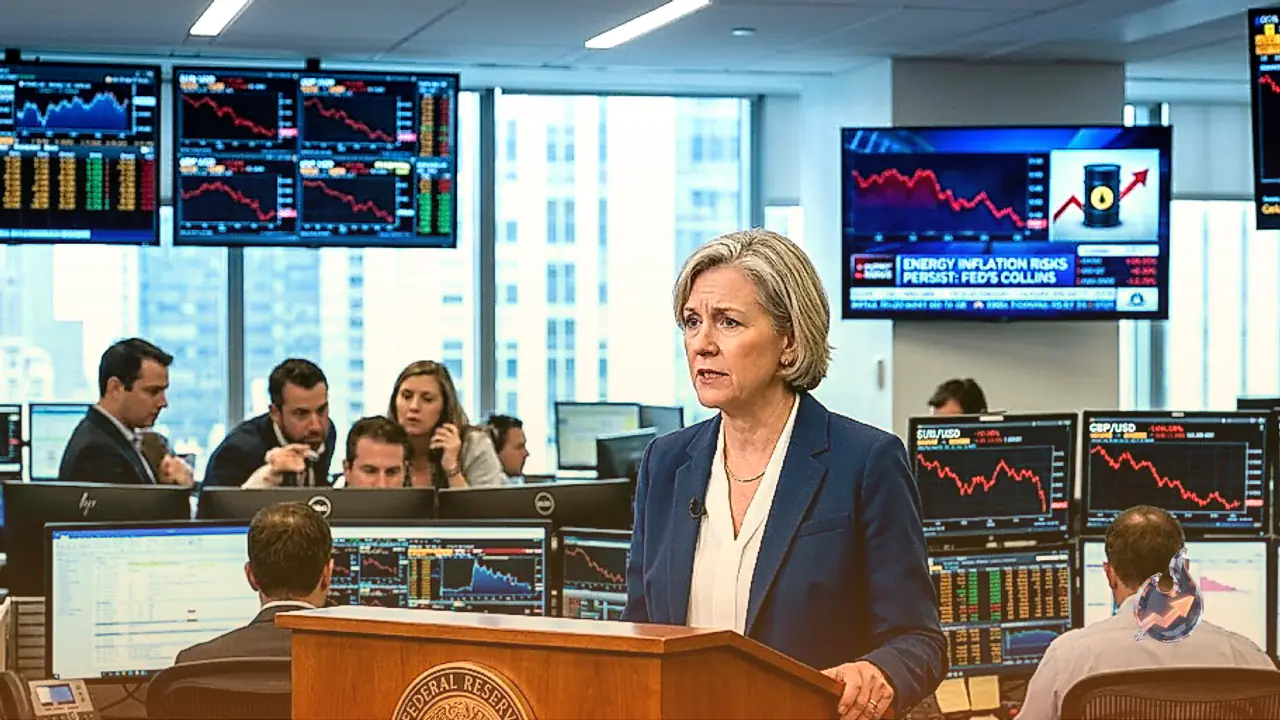























Uncertainty across international financial markets has reignited following cautious remarks from Federal Reserve official Collins regarding stubborn inflation dynamics and emerging supply hazards. Collins observed that ongoing geopolitical developments indicate that additional pressures could continue to build across the energy space, while noting that she has not yet witnessed the tangible inflation progress she had been hoping to observe. This hawkish perspective has underscored the possibility that US monetary authorities might weigh another interest rate increase, sending ripple effects through global exchange rates and commodity contracts.
The Federal Reserve Framework and Economic Mandates
Monetary policy within the United States is determined directly by the Federal Reserve. The central bank operates under a dual congressional mandate aimed at maintaining price stability while fostering conditions that support full employment across the domestic labor force. The primary mechanism employed to pursue these economic benchmarks is the routine recalibration of short-term interest rates.
When consumer and wholesale prices accelerate too rapidly, driving inflation above the central bank's stated 2 percent annual target, policymakers systematically raise the benchmark policy rate. Elevating these borrowing benchmarks increases credit expenses throughout commercial banking, housing, and corporate funding channels. Consequently, international capital flows gravitate toward the United States to capture higher risk-adjusted returns on dollar assets, generating persistent upward momentum for the US Dollar. Conversely, should inflation decelerate below the 2 percent target threshold or should the unemployment rate surge unexpectedly, monetary authorities generally enact rate reductions to spur consumer borrowing and capital expenditure, an adjustment that inherently places downward pressure on the Greenback.
Governance of the Federal Open Market Committee
Policy adjustments are finalized during eight scheduled committee conventions convened each calendar year. During these sessions, the Federal Open Market Committee conducts exhaustive examinations of domestic growth indicators, monetary transmission channels, and systemic vulnerabilities before settling on interest rate directives.
The voting body of the committee comprises twelve designated officials. These positions include all seven members seated on the Federal Reserve Board of Governors alongside the president of the Federal Reserve Bank of New York. The final four voting seats are occupied by regional Reserve Bank presidents chosen from the eleven remaining regional institutions, each serving an annual rotational term. This institutional composition ensures that diverse economic interests from different geographic jurisdictions contribute to unified monetary policy choices.
Crisis Interventions: Quantitative Easing Versus Tightening
During severe financial dislocations or when standard interest rate reductions reach their practical limits, the central bank deploys extraordinary balance-sheet programs. Prominent among these unconventional measures is Quantitative Easing, a mechanism through which the Federal Reserve directly expands credit availability within an impaired financial architecture.
As an emergency measure activated when conventional tools prove inadequate or when deflationary threats emerge, Quantitative Easing served as the core stabilization weapon during the 2008 Great Financial Crisis. The program involves the creation of additional currency reserves to execute large-scale purchases of high-grade fixed-income securities from banking institutions. Because this massive liquidity injection inflates the domestic money supply, it typically depreciates the exchange value of the US Dollar. In stark contrast, Quantitative Tightening represents the deliberate reversal of this expansion. Under tightening protocols, the Federal Reserve ceases acquiring new debt securities and allows maturing bond principal to run off without reinvestment. This absorption of systemic liquidity generally strengthens the fundamental valuation of the US Dollar against competing currencies.
Foreign Exchange Dynamics Across Major Dollar Pairs
The broader currency landscape has reflected firm demand for the Greenback in response to policy expectations, with the US Dollar demonstrating its most pronounced advance against the Canadian Dollar in recent sessions.
Concurrently, the AUD/USD currency cross encountered intense directional friction early in the week. After advancing to retest the 0.7140 resistance ceiling, the pair faced renewed selling pressure, retreating to seek technical support around the lower boundary of the 0.7100 handle ahead of the Asian market open. This pullback mirrored broad-based improvements in underlying institutional sentiment favoring the US Dollar.
Across Asian trading desks, the USD/JPY cross eased back beneath the 157.00 threshold, weighed down by localized yen resilience. Market participants remained on high alert regarding potential Ministry of Finance market interventions, especially following recent rate-check maneuvers conducted by the Bank of Japan. A scheduled Japanese market holiday, combined with escalating geopolitical frictions involving Russia, Ukraine, and broader Middle Eastern theaters, maintained defensive positioning among currency desks. Nevertheless, the stabilization of the broader dollar index contained deeper downside momentum for the currency pair.
Bank of Japan Rate Adjustments and Sovereign Debt Trends
In Tokyo, monetary authorities executed a notable policy shift as the Bank of Japan lifted its benchmark short-term interest rate target from 1.00 percent to 1.25 percent. The decision passed through a 7-2 majority vote, cementing another deliberate phase in the multi-month normalization of Japanese monetary conditions, entirely in line with market consensus.
As trading activity heads into the concluding weeks of the third quarter, global capital markets occupy a peculiar juncture marked by concurrent volatility and divergent trends. While equity index futures across European and American exchanges pointed toward higher openings, spot crude oil prices experienced ongoing softness. The primary focal point of institutional stress remained concentrated within sovereign fixed-income markets, where European and US benchmark yields broke higher late in previous trading after an initial round of volatility.
Precious Metals Retraction and Gold Levels
Commodity trading began with gold under distinct selling pressure, as bullion prices slipped toward the $4,350 per troy ounce zone. This corrective trajectory emerged despite broad-based yield declines across the US Treasury maturity curve. Although lower sovereign yields typically diminish the opportunity cost of holding non-yielding precious metals, the sheer momentum of the advancing US Dollar overshadowed debt-market trends, keeping spot gold defensive across international desks.