























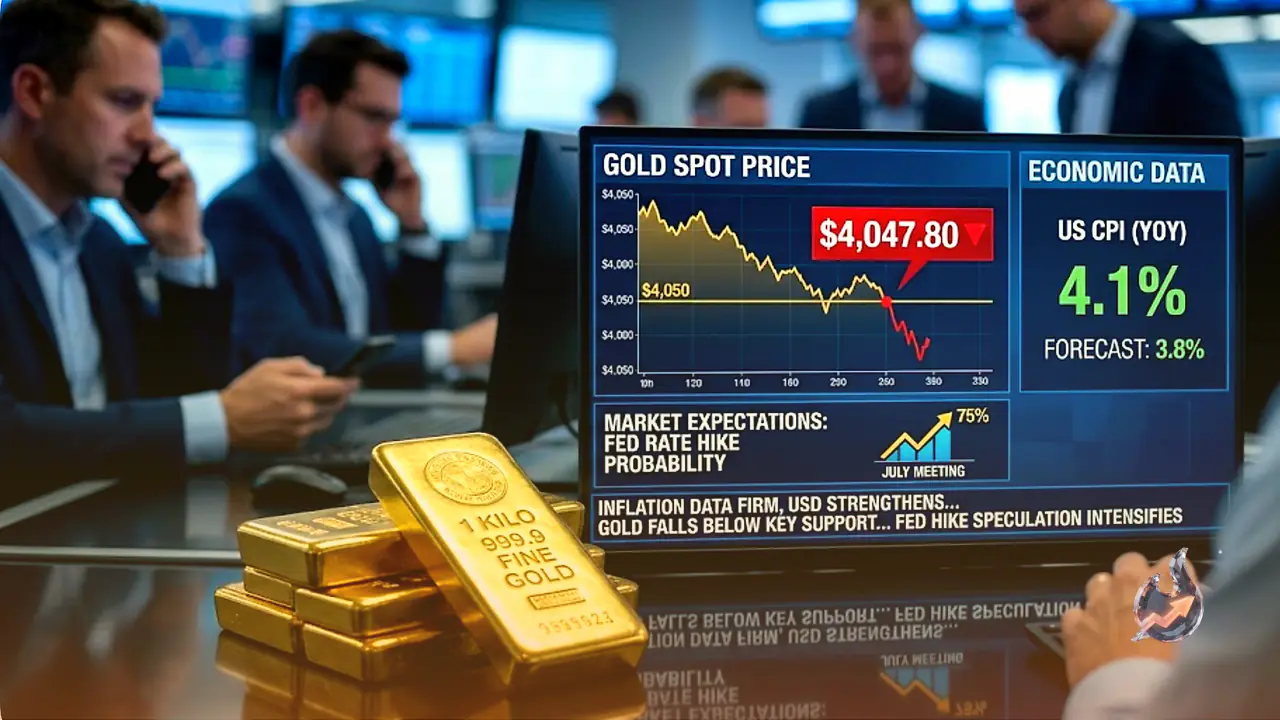

Gold slipped under the $4,050 mark after fresh US inflation figures landed on the hawkish side, reviving bets that the Federal Reserve could lift interest rates again. The data from the US Bureau of Economic Analysis arrived on Thursday and handed the dollar a reason to firm, leaving the metal on the back foot.
What the inflation data showed
The core Personal Consumption Expenditures (PCE) Price Index, the Fed's preferred gauge of price pressures, rose 3.4% year over year in May, up from 3.3% in April. That marked the strongest annual core reading since October 2023. The headline PCE figure ran even hotter, climbing to 4.1% year over year in May from 3.8% the month before. Both numbers matched what economists had penciled in.
Why it matters for gold
Inflation that refuses to cool strengthens the case for the Fed to keep policy tight, and the prospect of higher rates is unfriendly to a metal that pays no yield. With another increase back on the table, buyers are inclined to stay on the sidelines for now.
Middle East tensions in focus
Traders are also keeping a close watch on the Middle East. A ship was struck by an unknown projectile in the Strait of Hormuz, just hours after several freighters turned back while trying to cross the crucial waterway. Any flare-up in the region could stoke fresh worries about higher inflation, which would add to the pressure on gold.
Gold's role as a safe haven
Gold has held a special place throughout human history, long used as a store of value and a medium of exchange. Today, beyond its shine and its role in jewelry, the precious metal is widely regarded as a safe-haven asset, meaning it is seen as a sound investment during turbulent times. It is also treated as a hedge against inflation and against weakening currencies, since it does not rely on any particular issuer or government.
Central banks lead the buying
Central banks are the biggest holders of gold. To shore up their currencies in difficult times, they tend to diversify their reserves and buy the metal to bolster confidence in the economy and the currency, and large gold reserves can serve as proof of a country's solvency. According to World Gold Council data, central banks added 1,136 tonnes of gold worth around $70 billion to their reserves in 2022, the largest yearly purchase since records began. Central banks in emerging economies such as China, India and Turkey are rapidly building up their gold holdings.
What drives the price
Gold moves inversely to the US Dollar and US Treasuries, both of which are major reserve and safe-haven assets. When the Dollar weakens, gold tends to climb, allowing investors and central banks to diversify in turbulent times. It also runs counter to riskier assets: a rally in stocks usually weighs on gold, while sell-offs in riskier markets tend to favor it.
The price can swing for many reasons. Geopolitical instability or fears of a deep recession can send gold higher quickly given its safe-haven status. As a yield-less asset, it tends to rise when interest rates fall, while costlier money usually drags it down. Even so, most of the action depends on how the US Dollar behaves, since the metal is priced in dollars (XAU/USD). A strong Dollar keeps gold in check, while a weaker one tends to push prices up.