























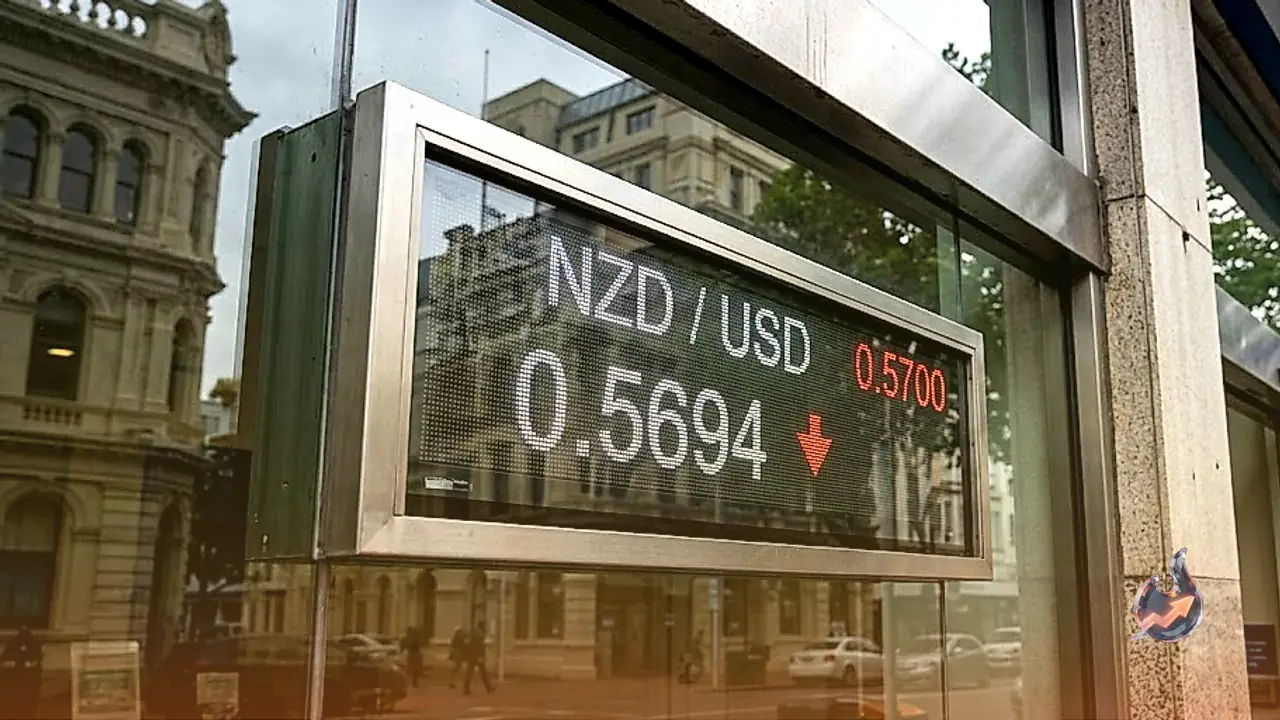

The New Zealand Dollar softened against the US Dollar during Wednesday's early Asian session, drifting to trade around 0.5680. Live market pricing indicates that the NZD/USD pair is currently changing hands at 0.5678, up 0.21 percent from its previous close of 0.5666. Despite this slight rebound, the broader near-term bias continues to lean bearish as the currency pair struggles to clear key overhead resistance. Swap market data reveals that investors have ramped up their expectations for an interest rate hike by the Reserve Bank of New Zealand, assigning an 80 percent probability to a policy tightening move at its upcoming gathering next week, yet the currency remains constrained beneath the 0.5700 mark.
Inflation Projections and Domestic Monetary Outlook
Economists anticipate that consumer price pressures in New Zealand likely moderated during the third quarter, though any relief could prove transitory. Rising crude oil costs are expected to drive a fresh acceleration in inflation during the final three months of the year, keeping the case for monetary tightening firmly in play. Projections indicate that the headline Consumer Price Index will show an annual increase of 3.8 percent in the third quarter, compared to 4.1 percent in the preceding quarter. On a sequential basis, third-quarter CPI is forecast to rise by 0.8 percent, stepping down from the 1.5 percent pace recorded in the second quarter.
Market strategists at Brown Brothers Harriman noted that the impending third-quarter data are expected to align closely with central bank projections. Headline CPI is expected to register at 0.8 percent quarter-on-quarter, matching the official projection and down from 1.5 percent in the prior period, while annual inflation is projected at 3.8 percent against an official projection of 3.9 percent and a prior reading of 4.1 percent. Analysts point out that inflation remaining above the official target supports the argument for additional policy rate hikes and provides underlying support for the Kiwi. Current pricing on the swaps curve reflects an 80 percent probability of a 25-basis-point increase taking the official cash rate to 3.00 percent on October 28.
The primary mandate of the Reserve Bank of New Zealand is to maintain medium-term inflation within a band of 1 percent to 3 percent, with an operational emphasis on holding it near the 2 percent midpoint. To steer the economy, the central bank adjusts its policy rate. Elevated inflation prompts rate hikes designed to curb aggregate demand, which simultaneously lifts domestic bond yields, enhances investment yield appeal, and supports the Kiwi. Conversely, lower benchmark rates diminish the currency's yield advantage. The evolving interest rate differential between Wellington and Washington remains a pivotal driver for the currency pair.
Federal Reserve Guidance and Broader Market Sentiment
Across the Pacific, investors scaled back their bets on a Federal Reserve rate hike in October following commentary from Chairman Kevin Warsh. Speaking at the International Monetary Fund's annual meetings in Bangkok, Warsh refrained from signaling a definitive direction for the upcoming Federal Open Market Committee meeting. He emphasized, however, that inflation running hotter than expected has not fundamentally altered his assessment of the United States economy.
Chairman Warsh conveyed a constructive yet prudent posture, reflected in an FXS Speechtracker evaluation of 5.6 out of 10, slightly softer than the historical baseline of 6.1 out of 10. His acknowledgment of remaining scarred by the Global Financial Crisis underscores a heightened sensitivity to systemic vulnerabilities, even as he commended structural economic expansion and an investment surge underpinned by sound policies. His reluctance to predetermine policy paths for the October and December meetings was accompanied by commentary viewing artificial intelligence both as a demand-catalyzing force and a tool to enhance economic data reliability. Planned regional field hearings and task force initiatives further demonstrate a central bank weighing upside growth potential against tail risks to broad financial stability.
Technical Setups and Indicator Profiles
Daily chart configurations place NZD/USD at 0.5681, preserving a negative near-term structure while the pair remains pinned under its 100-day simple moving average at 0.5774 and the upper Bollinger Band boundary at 0.5691. This overhead technical ceiling continues to cap upside attempts, whereas the middle Bollinger Band around 0.5631 serves as immediate support. The Relative Strength Index stands at 51.7, indicating a transition into neutral momentum territory rather than a decisive shift toward bullish strength.
According to live technical indicators, the 14-period RSI sits at 51, while the MACD histogram holds flat at 0.00 with line readings at -0.00 against a -0.00 signal line, displaying minor bullish histogram divergence. Exponential moving averages stand at 0.5655 for the 20-day, 0.5721 for the 50-day, and 0.5797 for the 200-day. The 50-day simple moving average is positioned at 0.5768, well below the 200-day SMA at 0.5838, confirming a death-cross pattern within an extended macro downtrend. Bollinger Bands (20,2) span from 0.5576 to 0.5686, centering at 0.5631. Trend strength remains pronounced, with the 14-period ADX reading at 49, while the stochastic fast line reaches 84 against a signal of 81. Over the past 52 weeks, the trading range has stretched between 0.5567 and 0.6093. Key intraday levels reflect a central pivot of 0.5681, overhead resistance targets at 0.5685 (R1) and 0.5693 (R2), and floor supports at 0.5673 (S1) and 0.5668 (S2), alongside 20-day parameters anchored near 0.5567 support and 0.5698 resistance.
For buyers attempting a recovery, primary resistance emerges at the upper Bollinger Band at 0.5691, followed by the significant barrier of the 100-day SMA at 0.5774. A failure to reclaim this moving average preserves the broader downward tilt. On pullbacks, prompt support rests at the middle Bollinger Band at 0.5631, below which sellers would target the lower Bollinger Band boundary at 0.5572.
Fundamental Drivers of the Kiwi
The New Zealand Dollar, affectionately called the Kiwi, is a prominent fixture in foreign exchange trading. Its international valuation reflects domestic economic vitality and monetary decisions, alongside unique structural dependencies. China stands as New Zealand's dominant trade counterpart; consequently, shifts in Chinese economic activity ripple directly into the Kiwi. Softer demand or economic cooling in China dampens export volumes, applying downward pressure on the currency. Furthermore, dairy commodities represent the country's foremost export category, meaning international dairy auction prices heavily dictate national export revenues and exchange-rate trends.
Broad economic performance metrics, encompassing employment levels, gross domestic product expansion, and consumer sentiment, provide the bedrock for the currency's valuation. Robust expansion attracts international capital inflows and frequently prompts the Reserve Bank of New Zealand to tighten policy during inflationary episodes. As a recognized commodity currency, the Kiwi prospers during risk-seeking market environments when global investors embrace growth opportunities. Conversely, episodes of geopolitical turbulence or financial market distress induce capital flight toward traditional safe havens, leaving the currency vulnerable to broad liquidation.
Movements Across Global Currency and Commodity Markets
Wider financial markets reflected divergent trends across the Asian session. The Australian Dollar (AUD/USD) extended its upward trajectory for a fourth consecutive day, holding above 0.7000 to trade at three-week peaks. Hawkish rhetoric from Reserve Bank of Australia Deputy Governor Andrew Hauser, alongside domestic inflation concerns, underpinned the Australian currency, although advances were tempered by greenback demand stemming from geopolitical tension between Washington and Tehran.
Concurrently, the USD/JPY pair found dip-buying interest but remained confined within an established range near 158.50. Lingering ambiguity regarding the timing of the Bank of Japan's next rate adjustment kept Yen buyers cautious. While crude price fluctuations and related inflation concerns bolstered the greenback, market vigilance surrounding possible foreign exchange interventions by Japanese authorities restrained steeper Yen declines.
In commodities, gold prices remained subdued for a fourth straight trading day, hovering near weekly lows as market participants hesitated to expand short exposure without a sustained breach beneath 4,100 dollars per ounce. Energy-fueled inflation concerns kept expectations of Fed tightening alive, supporting the greenback at the expense of non-yielding assets. Nevertheless, unverified reports of diplomatic contacts between the United States and Iran helped check excessive gains in the safe-haven dollar, providing a floor for bullion. Market attention is also turning toward the United Kingdom Office for National Statistics, which is slated to publish September Consumer Price Index figures alongside Producer Price Index and retail sales data on Wednesday at 06:00 GMT.