























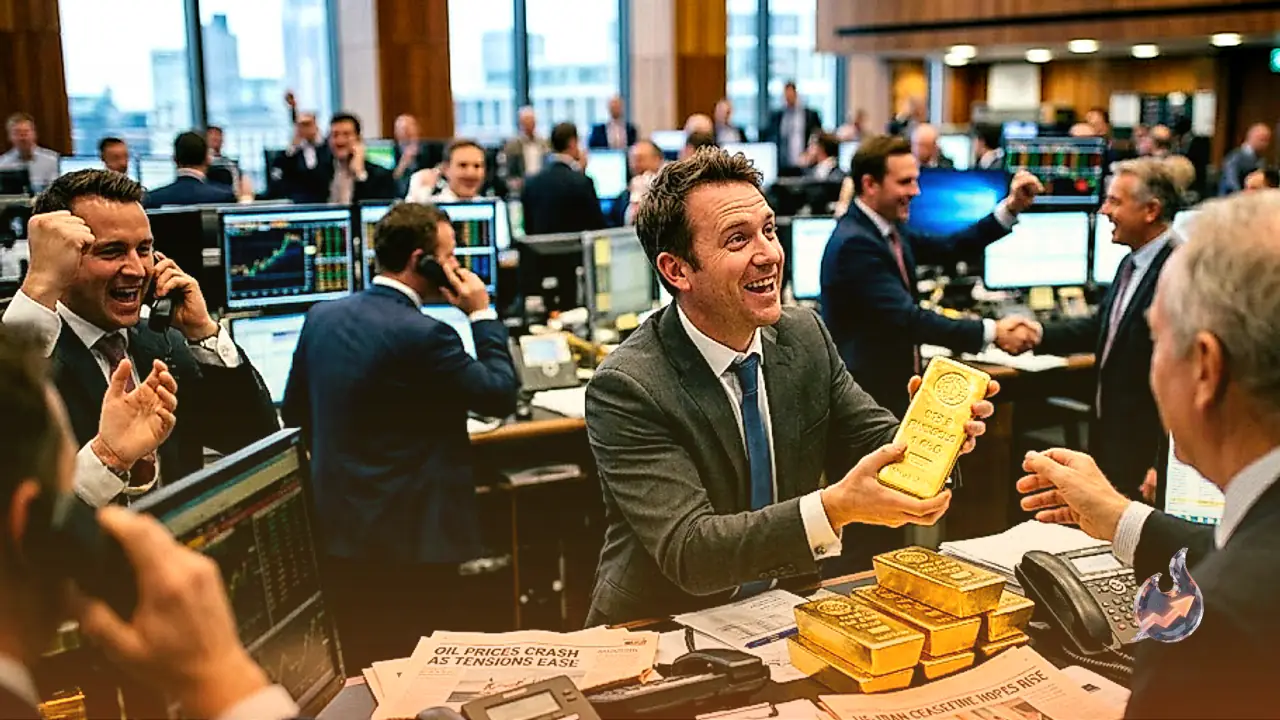

Safe haven demand and shifting macroeconomic expectations pushed gold prices above the $4,100 threshold during Monday's opening trades. The upward momentum in the precious metal comes as crude oil prices retreated significantly, relieving pressure on global inflation expectations and reducing speculation surrounding aggressive interest rate hikes by the US Federal Reserve. A key catalyst behind this market shift is a sudden pause in military engagements between the United States and Iran, which has fostered optimism for potential diplomatic negotiations after months of heightened geopolitical uncertainty.
Diplomatic Reprieve and Strategic Restraint in the Middle East
The geopolitical atmosphere experienced a noticeable cooling late Friday after the United States decided to suspend its two-week bombing campaign directed against Iranian targets. Responding to this move, Tehran refrained from launching retaliatory strikes against Washington's allies across the Middle East for a second consecutive night. Addressing the situation, US Ambassador to the United Nations Mike Waltz pointed out that while American military assets remain fully prepared and locked and loaded, President Donald Trump intends to create strategic space for prospective diplomatic discussions.
This diplomatic posture was further reflected in statements from senior Iranian leadership. A senior official in Tehran reaffirmed that Iran's official defense doctrine remains centered on an attack for attack framework. Consequently, as long as American military strikes remain halted, Iranian forces will similarly hold back their military operations in the region. This temporary cessation of hostilities has led investors to recalculate risk premiums across energy and financial markets, dragging crude oil prices down and simultaneously lowering near term inflation projections.
Central Bank Policies and the Impending FOMC Decision
Financial markets are currently preparing for a crucial week dominated by major central bank announcements. The US Federal Reserve's Federal Open Market Committee (FOMC) is set to convene for a pivotal monetary policy meeting, with investors closely inspecting every statement for signals regarding future benchmark interest rate trajectories. Alongside the Fed, upcoming monetary policy decisions from the Bank of England (BoE) and the Bank of Japan (BoJ) are expected to generate substantial price action across global financial instruments.
Because gold is a yield-less asset that produces no interest dividends, its market value is heavily influenced by global interest rate environments. Lower interest rate expectations typically enhance the appeal of holding physical bullion compared to yield-bearing alternative assets. Conversely, higher borrowing costs generally exert downward pressure on the metal. With reduced crude oil prices taking the heat off headline inflation numbers, market participants have tempered their bets on aggressive central bank rate hikes, creating a favorable environment for gold to build on its recent gains.
Gold's Historical Significance and Central Bank Reserve Buys
Throughout human history, gold has served as a foundational store of value and a trusted medium of monetary exchange. In modern financial markets, beyond its ornamental appeal in jewelry manufacturing, the precious metal is universally recognized as a premiere safe-haven asset. Investors systematically turn to bullion during periods of economic distress, systemic turmoil, or elevated geopolitical conflict. Furthermore, because gold does not depend on the creditworthiness or fiscal backing of any individual government or issuing institution, it functions as an essential hedge against currency depreciation and systemic inflation.
Central banks globally represent the single largest group of gold holders. During volatile macroeconomic conditions, monetary authorities actively purchase bullion to diversify national reserves and fortify public confidence in their domestic currency and economic stability. A substantial gold reserve serves as an explicit indicator of a nation's sovereign solvency and financial endurance. Historical data compiled by the World Gold Council underscores this trend: in 2022, central banks added a staggering 1,136 tonnes of gold to their official reserves, valued at approximately $70 billion. This massive accumulation marked the highest single year of institutional gold buying since record keeping began, driven prominently by rapid reserve expansion across emerging market economies including China, India, and Turkey.
Market Dynamics and Inverse Correlations
The pricing mechanics of gold (XAU/USD) are deeply linked to the behavior of the US Dollar and US Treasury yields. As two of the primary global reserve and safe-haven instruments, the US Dollar and gold maintain a well established inverse relationship. When the Greenback depreciates against major international currencies, gold becomes relatively cheaper for foreign buyers, driving demand and pushing dollar denominated metal prices upward. Conversely, a resilient US Dollar acts as a restrictive cap on bullion prices.
Gold also exhibits an inverse correlation with higher risk financial assets, particularly equity markets. Strong rallies in stock markets generally siphon capital away from precious metals, whereas broad based equity sell-offs push investors back toward safe-haven assets. However, in the current trading environment, a weakening US Dollar, which pulled back from Friday's one-month peak, has provided sustained support for bullion, allowing it to capitalise on the broader market shift away from energy related inflation risks.
Foreign Exchange Overview: EUR/USD, GBP/USD, and AUD/USD
The broader currency markets have reflected these shifting macroeconomic dynamics through notable fluctuations across major pairs
- EUR/USD: The European single currency opened Monday's trading session with a modest bullish gap, climbing back above the 1.1400 handle during Asian market hours. The pair's upward trajectory was largely driven by broad weakness in the US Dollar, as growing optimism surrounding a potential diplomatic resolution to the five-month US-Iran conflict reduced defensive dollar buying.
- GBP/USD: Following a sharp downturn on Thursday, the British Pound maintained small gains above the 1.3300 level during Friday's American trading session. Sterling found fundamental backing in stronger than expected UK Retail Sales data and solid July PMI economic indicators. Nevertheless, substantial upside movement remained constrained as traders maintained a cautious posture amidst ongoing Middle Eastern tensions. Meanwhile, US July PMI data produced minimal impact on spot pricing.
- AUD/USD: The Australian Dollar experienced dramatic volatility throughout the first half of the year, soaring to a four-year peak before undergoing a sharp technical correction. As the currency enters the second half of the year, its fundamental trajectory is enveloped in uncertainty. Renewed hostilities across the Middle East have blurred the inflation outlook, creating conflicting expectations regarding future interest rate adjustments by the Reserve Bank of Australia.
As market participants digest the interplay between diplomatic developments, crude oil fluctuations, and impending central bank announcements, gold and major foreign exchange pairs remain highly sensitive to incoming economic data and official geopolitical statements.