





















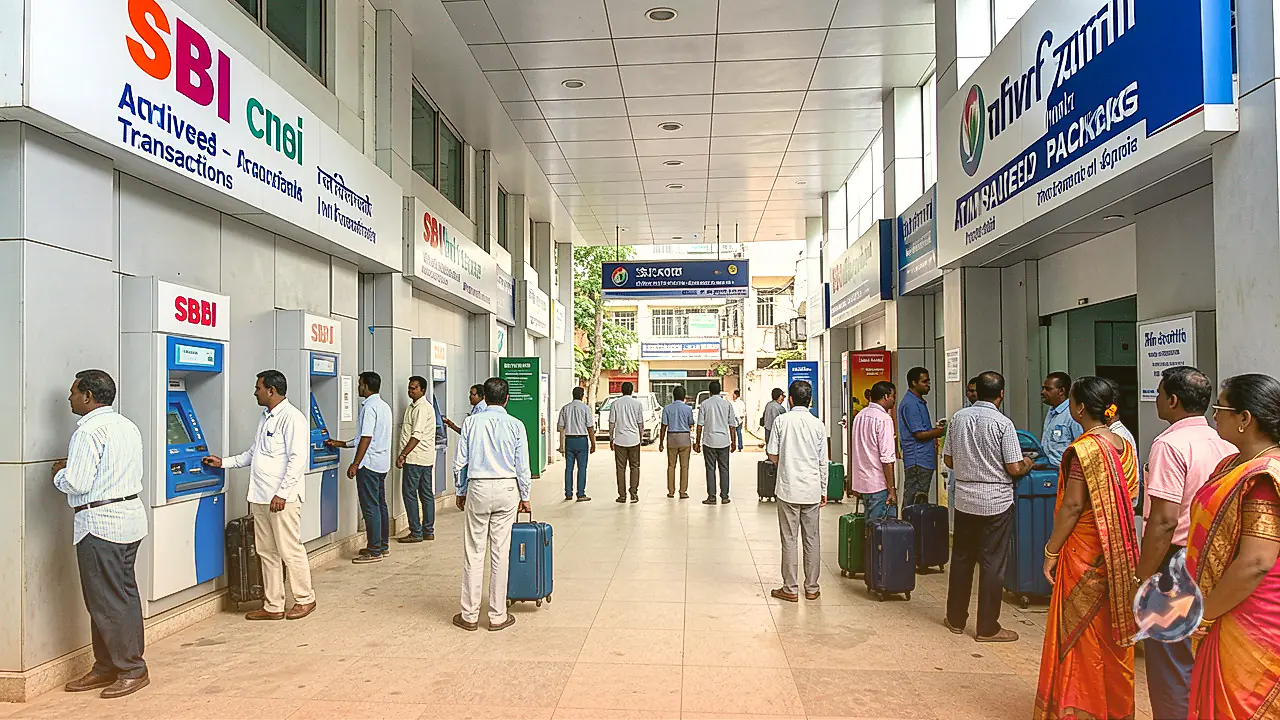

State Bank of India has altered the transaction terms for its salary package account holders, lowering the quota of complimentary monthly usage at automated teller machines and automated deposit-cum-withdrawal machines run by other lenders. Under the framework taking effect on October 1, eligible customers using their SBI debit cards at outside machines can carry out only five free transactions each month, down from the earlier threshold of 10. Once this quota is exhausted, subsequent operations will incur designated service charges.
All Salary Package Variants Covered Across Centres
The revised ceiling applies across every variant of the SBI Salary Package Account irrespective of branch location or centre. Crucially, the limit encompasses both financial and non-financial activities conducted at rival machines. Cash withdrawals are counted alongside balance enquiries and mini statement requests within the same pool of five free operations. Once an account holder reaches this five-transaction mark in a calendar month, any further attempt to withdraw funds or inspect account details at an outside terminal will trigger fee deductions.
Fee Structure Beyond the Free Monthly Allowance
Customers exhausting their five complimentary monthly opportunities at outside automated teller machines and deposit-cum-withdrawal terminals will face specific tariffs. For financial activities, primarily cash withdrawals, the bank levies a fee of Rs. 23 plus applicable GST per transaction. For non-financial operations, such as checking ledger balances or generating mini statements, the charge is set at Rs. 11 plus GST. These fees apply immediately on the sixth transaction onward during any billing cycle.
Progressive Tightening from Unlimited to Five Usages
This revision continues a broader contraction of off-network automated teller machine benefits for corporate and institutional payroll clients. Account holders in this category once operated under an unlimited free transaction model at non-SBI terminals. The bank subsequently phased out unrestricted access by instituting a cap of 10 free transactions alongside revised pricing in December. The latest step down from 10 to five further restricts how often salaried employees can rely on outside cash dispensers without taking on ancillary expenses.
No Changes to SBI Network Usage or Regular Savings Limits
The new restriction is strictly confined to transactions performed with SBI debit cards at outside banking terminals. At SBI's own proprietary network of cash dispensers and deposit-cum-withdrawal units, salary package account holders retain their entitlement to unlimited free transactions under prevailing guidelines. Furthermore, standard transaction limits governing ordinary SBI savings bank accounts have not seen revisions in this update. Tariffs applicable to cardless cash withdrawals across both SBI and third-party automated terminals also remain identical to previous terms.
Distinct Regulations for Basic Savings Bank Deposit Accounts
Different operational rules govern Basic Savings Bank Deposit accounts within the institution. Aadhaar-enabled Payment System transactions form part of the relevant transaction thresholds, where usage exceeding the prescribed limit draws charges ranging between Rs. 15 and Rs. 23 plus GST, contingent on the specific operation and account classification. For Basic Savings Bank Deposit holders, withdrawals beyond the permitted allowance may incur an expense of Rs. 15 plus GST, contrasting with the Rs. 23 plus GST fee levied on salary account holders for excess financial transactions at external machines. Specific free quotas for basic accounts require verification against official bank guidelines.
Strategies to Prevent Unnecessary Service Charges
Salary package clients can insulate themselves from unexpected deductions by structuring cash withdrawals efficiently and logging their monthly visits to outside terminals. Prioritising SBI's extensive in-house network remains an effective safeguard, as proprietary units continue to deliver unconstrained free transactions under current rules. Additionally, shifting everyday balance verification and routine payments onto digital payment channels, including UPI and mobile banking applications, eliminates the need for peripheral automated teller machine visits.