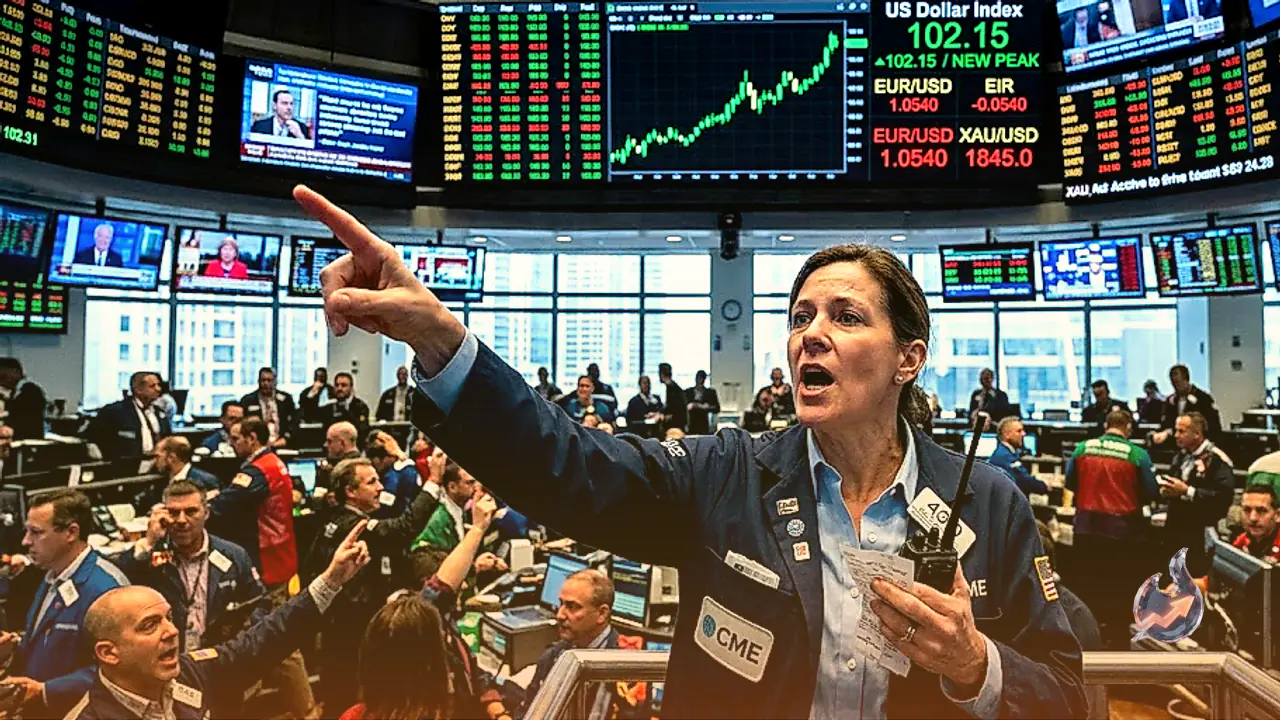

























Factory activity across the United States softened slightly during September, with headline growth trailing market projections. The Institute for Supply Management manufacturing purchasing managers index retreated to 54.5 in September, failing to match broad consensus estimates. In spite of the mild pullback in top-line factory momentum, the broader greenback rallied across international foreign exchange desks, driving the US Dollar Index within touching distance of the key 102.00 threshold. Because the benchmark reading remained comfortably above the 50.0 dividing line, the data confirms that industrial production continues to expand, even as the pace of growth moderated from prior months.
Employment and Factory Orders Strengthen While Input Costs Surge
An examination of the survey sub-indices reveals that underlying factory fundamentals retain solid traction regardless of the headline slowdown. The employment index advanced from 51.2 to 52.7, signaling that manufacturing payrolls remain in healthy territory and hiring appetite has not unraveled. In parallel, the new orders gauge progressed from 53.7 in the prior print to 55.3. Factory cost pressures, however, re-emerged as a prominent concern. The prices paid index, widely tracked as a barometer of incoming inflation, leaped from 71.1 to 77.9, demonstrating an aggressive run-up in raw materials and procurement expenses.
Susan Spence, MBA, Chair of the Institute for Supply Management Manufacturing Business Survey Committee, highlighted that the broader economy sustained expansion for the 23rd consecutive month. Spence pointed out that the new orders index recorded its ninth straight month of expansion following four consecutive contractionary readings, reaching 55.3 percent and rising 1.6 percentage points above the August level of 53.7 percent. Meanwhile, the production index settled at 56.7 percent in September, reflecting a drop of 1.6 percentage points compared to the 58.3 percent marked in August. Spence also observed that the prices index remained firmly in expansionary territory at 77.9 percent, posting a substantial jump of 6.8 percentage points relative to August reading of 71.1 percent.
US Dollar Index Nears 102 as Global Currencies Retreat
Broad-based purchasing interest propelled the greenback upward on Thursday, pushing the US Dollar Index to levels just shy of the pivotal 102.00 barrier for the first time since April 2025. This resurgence exerted heavy pressure across major foreign currency pairs. In Asian trading hours, the Australian Dollar consolidated close to a two-month low against the American currency, navigating around the mid-0.6900s. While softer US PCE figures pared back speculation regarding an October rate increase by the Federal Reserve, mounting inflation concerns stemming from crude oil kept Treasury yields elevated. Australia reported that its trade balance surplus contracted sharply in August to AUD495M, though the development generated minimal price action across AUD/USD.
Simultaneously, USD/JPY held near the ceiling of its weekly band above 158.00 during Thursday Asian trading. Elevated sovereign bond yields in the United States, underpinned by energy price pressures despite milder PCE data, continued to feed dollar bids. The geopolitical standoff between the United States and Iran added further momentum to safe-haven dollar allocations, sustaining the currency pair at elevated levels. This pervasive strength in the dollar effectively counterbalanced hawkish policy expectations surrounding the Bank of Japan alongside persistent risks of Japanese currency intervention.
GDP Dynamics, Rising Interest Rates, and Pressure on Gold
Gross Domestic Product serves as the primary benchmark evaluating national economic growth over a specific reporting timeframe, typically structured on a quarterly basis. The most dependable evaluations compare GDP directly against the preceding quarter, such as Q2 of 2023 versus Q1 of 2023, or against the parallel quarter from the prior year, such as Q2 of 2023 versus Q2 of 2022. By contrast, annualized quarterly calculations project a single quarter growth rate forward across the full calendar year. Such projections can distort underlying trends whenever temporary shocks influence a quarter but lack lasting durability, as demonstrated during the initial quarter of 2020 when the onset of the covid pandemic triggered an abrupt plunge in economic growth.
Robust GDP releases generally bolster a nation currency because an expanding economy produces more exportable goods and services while drawing greater inflows of foreign capital. Conversely, shrinking economic output typically weighs on domestic valuations. As commercial activity accelerates, household and business spending climbs, inevitably fueling consumer price inflation. Central banks respond by lifting benchmark borrowing costs to curb price pressures. Those elevated policy rates stimulate international capital inflows seeking yield, which drives the local currency higher.
Higher interest rate cycles triggered by expanding GDP and persistent inflation alter the risk profile of non-yielding bullion. Elevated yields increase the opportunity cost of maintaining capital in gold as opposed to earning risk-free yields in cash deposits. Consequently, accelerating GDP expansion and higher borrowing costs historically represent a bearish dynamic for bullion valuations. On Thursday, gold struggled to find direction as a rising dollar and soaring US Treasury yields capped upward momentum. Spot gold, traded under XAU/USD, changed hands around $4,167, posting a modest gain of 0.26% on the session while working hard to preserve its early recovery gains.
Crypto Assets Stall as Rate Hike Expectations Shift to Pause
The firm tone across fixed income yields and the greenback echoed across digital token markets. Bitcoin moved inside a defined channel anchored by support at $82,500 and overhead resistance near $85,000. Ethereum remained under consistent selling pressure, changing hands below $2,700 while leaning on immediate support at $2,600. Concurrently, Ripple surrendered the pivotal $1.50 threshold.
Market participants have overhauled their outlook regarding the Federal Reserve policy path. Only one week earlier, traders assigned the highest probability to an interest rate hike arriving at the October meeting. However, softer readings on inflation paired with cautious remarks delivered by monetary authorities have prompted investors to view a policy pause as the primary course of action. Even so, the sharp acceleration in manufacturing input prices keeps inflation risk front and center for policymakers.