























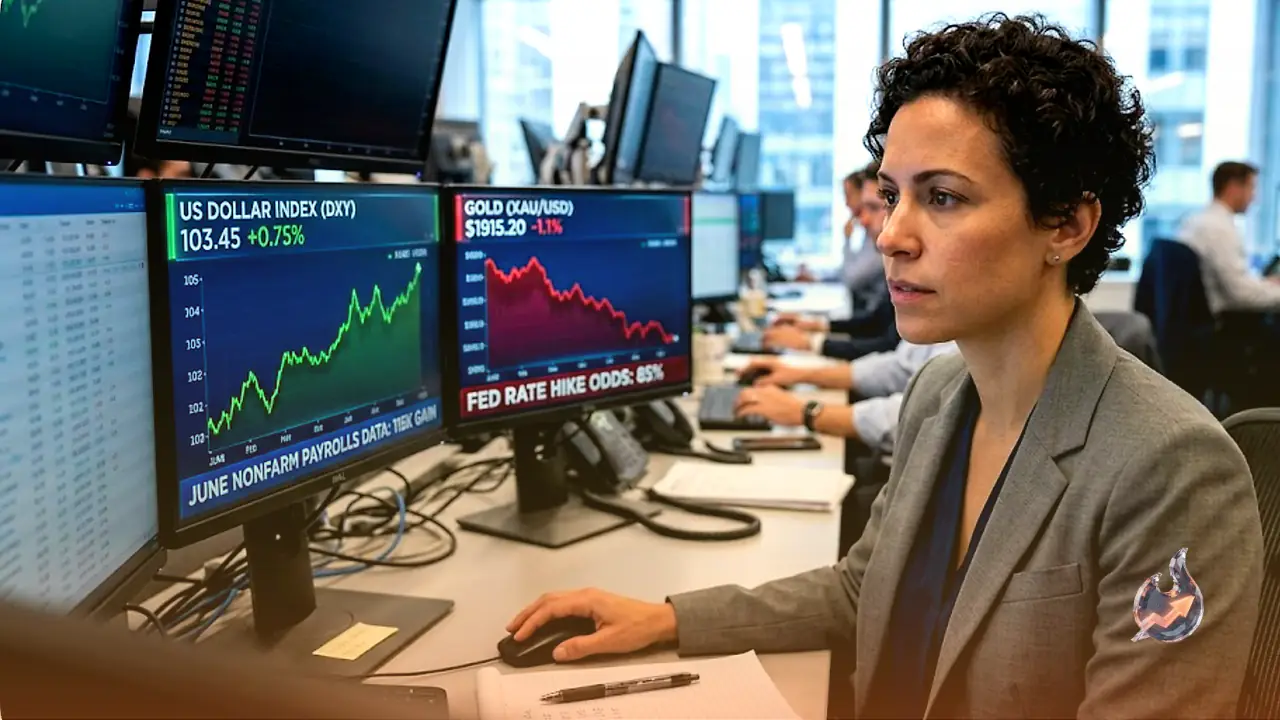

Currency traders are bracing for the US June jobs report, due from the Bureau of Labor Statistics on Thursday at 12:30 GMT, and the setup this time is unusual. Normally the Nonfarm Payrolls (NFP) release is the one number capable of shaking every corner of the market. Yet with investors fixated on stubborn inflation, only a genuinely weak reading looks likely to knock the US Dollar off its perch. A soft-but-not-disastrous print would probably do little to change the story the market has been telling itself, that the Federal Reserve is edging closer to tightening again.
What the June payrolls are expected to show
The consensus points to a gain of 110K jobs in June, which would follow three straight months of surprisingly firm hiring. The Unemployment Rate is forecast to hold at 4.3%, and annual wage growth, tracked through the change in Average Hourly Earnings (AHE), is seen ticking up to 3.5% from 3.4% in May. Faster wage growth is exactly the sort of detail that keeps inflation hawks on edge, because it feeds straight into the price pressures the Fed is trying to tame.
Why some analysts expect a cooler number
Not everyone is convinced the headline will be that strong. TD Securities analysts think hiring slowed more than the market is pricing.
"We expect June payrolls to moderate to 80k (55k private, 25k government) after strong early-2026 gains. Job growth broadened beyond healthcare, led by trade/transport and leisure, but should cool this month. Local governments may stay firm on World Cup effects. We see the Unemployment Rate edging down to 4.2% as participation dips. AHE likely moderated to 0.2% m/m (3.5% y/y)," they wrote.
Early data pointed the same way. Automatic Data Processing (ADP) said on Wednesday that private employers added 98K jobs in June. That came after a 122K rise in May and undershot the 113K the market had penciled in. National Bank of Canada Senior Economist Jocelyn Paquet is also below consensus, forecasting a 90K increase in payrolls.
Why this jobs report matters so much
America's monthly jobs report is widely treated as the single most important economic indicator for forex traders. Released on the first Friday after the month it covers, the change in the number of positions is closely tied to how the broader economy is performing and is watched carefully by policymakers. Full employment is one of the Federal Reserve's mandates, and it factors labor market developments into its policy decisions, which in turn moves currencies. Despite the many leading indicators that shape estimates, Nonfarm Payrolls has a habit of surprising markets and triggering sharp volatility. When the actual figure beats the consensus, the Dollar tends to rally.
A hawkish Fed and rising rate-hike odds
Even though crude Oil prices have slipped back to levels last seen before the US-Iran conflict, investors remain worried that global inflation is proving sticky, largely because AI-driven hardware demand is pushing up the cost of consumer electronics. As a result, the US Dollar has been outperforming its major rivals, buoyed by growing expectations for tighter Fed policy.
In a CNBC interview on Tuesday, Cleveland Fed President Beth Hammack struck a moderately hawkish tone, scoring 6.4/10 on the FXS Speechtracker. That reads slightly softer than the historical average of 7/10, but it still signals a tightening bias. By stressing that the job market is "right around full employment" and that growth "looks good," while warning that "inflation is still too high" and that "rate hikes may need to be considered," she made clear a willingness to tighten policy despite worries about the wider economy.
According to the CME FedWatch Tool, markets are now pricing in roughly a 34% chance that the Fed lifts rates by 25 basis points (bps) as soon as July, up from just 6% in early June. On top of that, the odds of at least two rate increases by the end of 2026 now sit slightly above 40%.
What it means for the Dollar and EUR/USD
On the flip side, a badly disappointing print below 70K could trigger an upward correction in the pair. Even then, a durable bullish reversal is unlikely unless Fed policymakers change their tune and put more weight on labor market conditions than on the inflation outlook.
Technically, the near-term picture for EUR/USD does not look oversold and suggests the bearish bias is still intact. The Relative Strength Index (RSI) on the daily chart remains below 40 after climbing out of oversold territory, and the pair trades slightly above the lower arm of the Bollinger Band. On the downside, 1.1320-1.1280 (the lower arm of the Bollinger Band, a static level) forms the first support, ahead of 1.1160 and then the psychological 1.1000 mark. Looking higher, strong resistance sits in the 1.1485-1.1500 region (the 20-day Simple Moving Average, a round level), followed by 1.1600 (a round level and the 50-day SMA) and 1.1650-1.1660 (the 200-day SMA, a descending trend line and the 100-day SMA).
How the other markets are trading
GBP/USD gained ground toward 1.3290 during Thursday's Asian hours. The British Pound firmed against the US Dollar after Andy Burnham, seen as the UK's likely next Prime Minister, eased market nerves by pledging strict fiscal discipline. The US June Nonfarm Payrolls will take center stage later in the day.
EUR/USD edged higher in the Asian session but lacked bullish conviction, with traders keenly awaiting the crucial NFP report. Spot prices were hovering around 1.1385, close to the weekly low touched on Wednesday.
Gold attracted fresh buyers in the Asian session, following the previous day's volatile swings and a late pullback from an over one-week high. Softer-than-expected US data on Wednesday nudged the US Dollar lower, which supported the metal for a second straight day. Live figures put Gold at around $4,073, up 0.11% from the previous close of $4,068. Momentum still looks weak, though, with its 14-day RSI near 38 and the price trading below its key moving averages. Over the past year Gold has swung between $3,264 and $5,586, and a strong NFP print could pile fresh pressure on it.
Ripple and Stellar extended their recovery as improving sentiment lent support. XRP traded above $1.05 while XLM climbed past $0.199. Traders should stay cautious, since mixed on-chain and derivatives data point to only a modest bullish bias, and any further upside likely depends on sustained buying momentum.
The bigger picture: central bank independence
This month's number carries more weight than usual, because the Fed is shifting away from a forecasting framework and toward one built on current data and rebuilding credibility. Warsh's hawkish opening stance has drawn skepticism, but the market is not dismissing the idea that if he is serious about restoring credibility, he could line up enough hawkish votes, and if June's NFP runs hot, a move at the July FOMC could be in play.
When it comes to central bank independence, most of the attention has landed on Donald Trump's pressure on the Federal Reserve. But a similar, and for now quieter, story appears to be unfolding on the other side of the Pacific, where Japan's government may be testing the Bank of Japan's independence.
What Nonfarm Payrolls actually are
Nonfarm Payrolls form part of the US Bureau of Labor Statistics' monthly jobs report. The NFP component specifically measures the change in the number of people employed in the US during the previous month, excluding the farming industry.
The figure can shape Federal Reserve decisions by showing how well the Fed is meeting its mandate of fostering full employment and 2% inflation. A relatively high NFP reading means more people are working, earning more and probably spending more. A relatively low result, on the other hand, can signal that people are struggling to find work. The Fed will typically raise interest rates to fight high inflation caused by low unemployment, and cut them to revive a stagnant labor market.
Nonfarm Payrolls generally have a positive correlation with the US Dollar. That means when the figures come in higher than expected, the Dollar tends to rally, and the reverse when they fall short. NFP influences the Dollar through its effect on inflation, monetary policy expectations and interest rates. A higher NFP usually implies the Federal Reserve will be tighter with policy, which supports the Dollar.
Nonfarm Payrolls are generally negatively correlated with the price of Gold. A higher-than-expected reading tends to weigh on Gold, and vice versa. A higher NFP usually lifts the Dollar, and like most major commodities, Gold is priced in Dollars, so a stronger Dollar means fewer of them are needed to buy an ounce. Higher interest rates, which typically accompany stronger payrolls, also make Gold less attractive as an investment compared with holding cash, which at least earns interest.
It is worth remembering that Nonfarm Payrolls is only one piece of a much larger jobs report and can be overshadowed by the other components. Sometimes NFP comes in higher than forecast, but Average Weekly Earnings undershoot, and the market brushes aside the potentially inflationary headline while reading the drop in earnings as deflationary. The Participation Rate and Average Weekly Hours can also sway the reaction, but only in rare episodes like the "Great Resignation" or the Global Financial Crisis.