























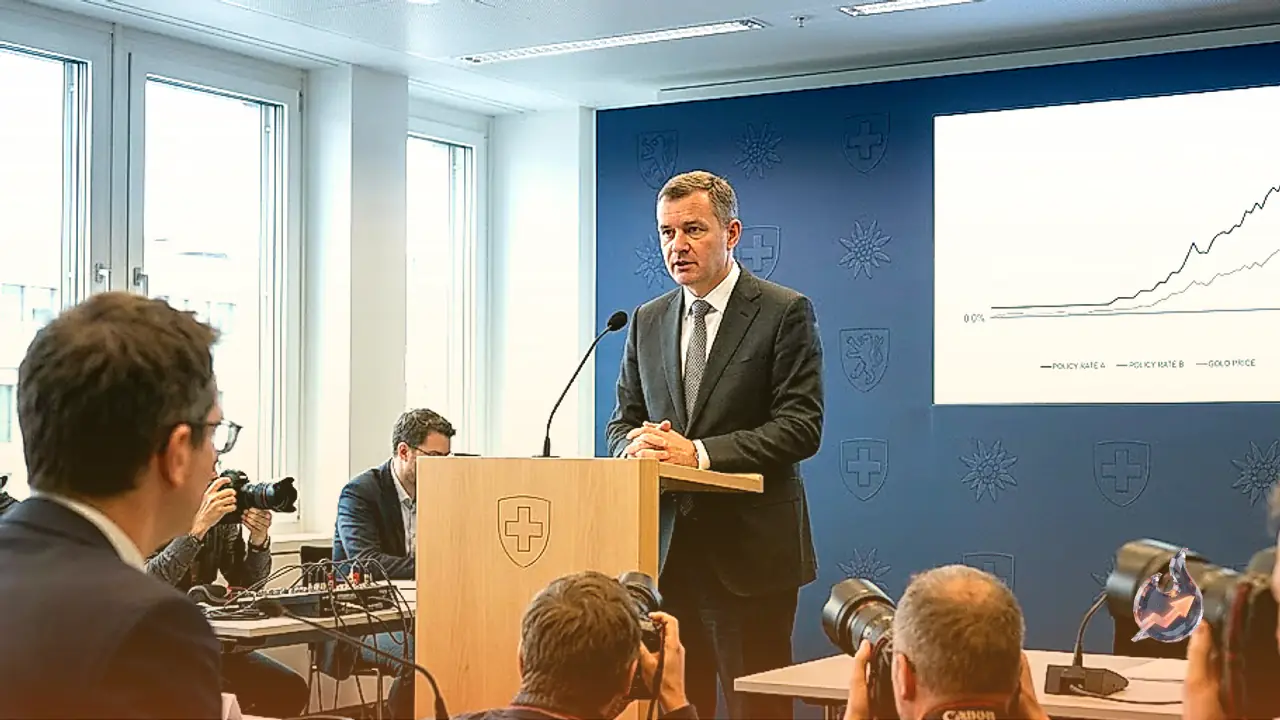

Monetary policy settings in Switzerland are poised to remain remarkably steady despite broader economic shifts across international markets. Charlotte de Montpellier, an economist at ING, anticipates that the Swiss National Bank will leave its benchmark policy rate unchanged at 0% in its upcoming Thursday decision and keep it on hold across the coming quarters. Although Swiss gross domestic product growth has delivered an upside surprise, price pressures in the domestic economy remain notably subdued. The combination of stronger economic expansion and a marginally softer Swiss Franc has not triggered inflation risks, affording policymakers ample room to preserve their accommodative stance.
Stability Seen in Swiss Monetary Policy Stance
Prevailing indicators suggest little justification for the Swiss National Bank to adjust its key interest rate at this stage. Expectations point to the central bank maintaining the rate at 0% on Thursday and extending that pause over the quarters ahead, particularly if worldwide energy prices retreat as projected. Consequently, the Swiss monetary authority is positioned to stand apart from peer central banks by running a considerably more accommodative regime. This divergence is supported by an unusually mild domestic inflationary climate, which has benefited substantially from a structurally strong currency that shields the economy from imported price spikes.
Foreign Exchange Interventions and Franc Dynamics
Alongside maintaining the policy rate at 0%, the central bank is expected to retain its targeted framework for foreign exchange interventions. So long as domestic consumer price pressures remain modest and the Franc stays robust without appreciating at an extreme pace, the Swiss National Bank can safely sustain its loose policy trajectory compared with global counterparts. This measured stability provides balanced conditions for Swiss enterprise, avoiding the need for disruptive tightening cycles.
Bank of Japan Lifts Rates to 1.25% While Yen Weakens
In contrast to the steady path in Europe, monetary normalization made significant progress in East Asia. The Bank of Japan raised its short-term interest rate target from 1.00% to 1.25% following a 7-2 vote, delivering an outcome that aligned closely with widespread market forecasts built up over recent weeks. Governor Kazuo Ueda stated that the policy phase had changed. Nevertheless, the Japanese Yen failed to capitalize on the hike and Ueda's hawkish rhetoric, instead resuming its downward trend during Friday's European trading hours to approach 158.00 against the US Dollar and establish two-week lows. Sentiment on the currency was dragged down by the two unexpected dissenting votes registered against the rate increase.
Australian Dollar Gains Momentum Against the Greenback
Across the Pacific, the currency pair linking the Australian Dollar and the US Dollar showed positive momentum for a second consecutive session, maintaining ground above 0.7100 during Friday's Asian trading window. A pullback in US bond yields constrained Dollar buyers. Simultaneously, hawkish remarks delivered by Reserve Bank of Australia Governor Bullock fueled expectations of further monetary tightening, giving firm support to the Australian currency. Nonetheless, broader gains remained capped because hawkish policy expectations surrounding the Federal Reserve, coupled with ongoing geopolitical uncertainties, limited downside for the greenback.
Gold Holds Strong Performance Near $4,370 per Ounce
Precious metals preserved the positive trajectory established during the latter half of the trading week. Gold traded with notable strength around the $4,370 per troy ounce region on Friday. The upward movement in the yellow metal was aided by softer crude oil prices, which helped buyers counter the persistent resilience of the US Dollar and advancing US Treasury yields across various maturities. The diverging actions of major central banks and shifting commodity trends continue to shape investor asset allocation across international desks.