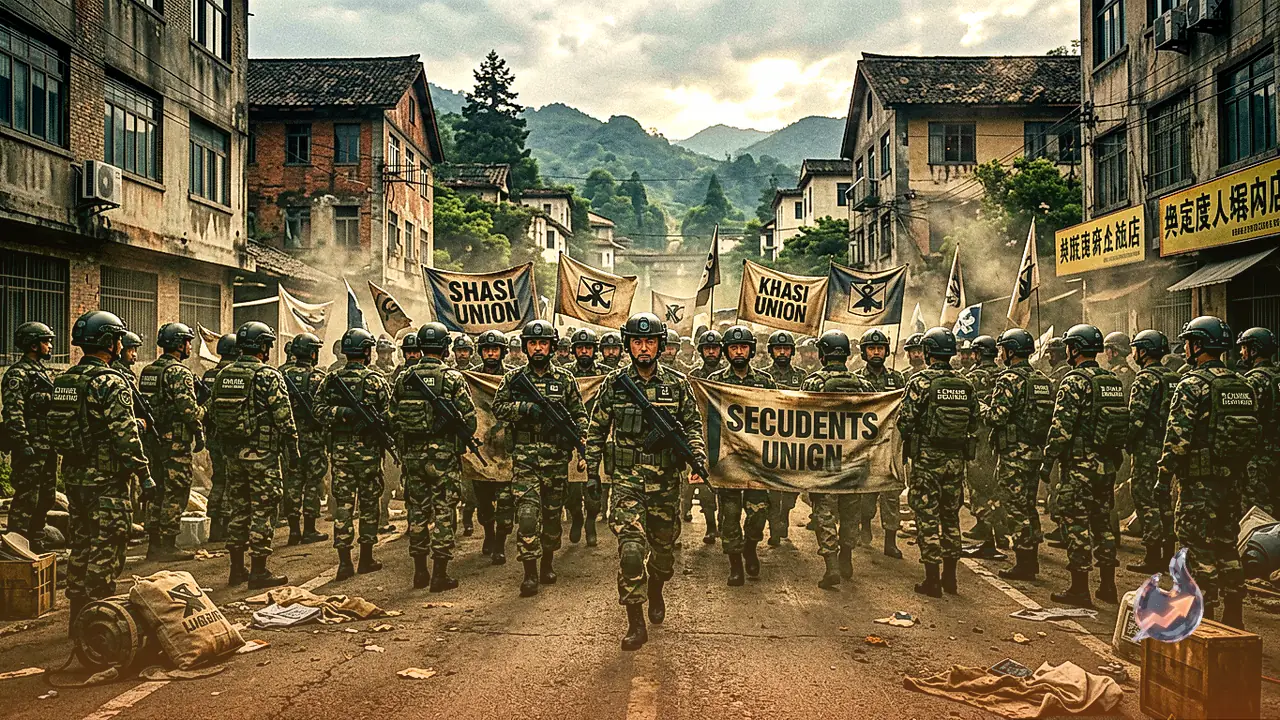




















The Meghalaya High Court has taken a strict view of the police investigation into the outbreak of violence and widespread property damage during a recent bike rally in Shillong. A division bench comprising Chief Justice Tevati Mohite Dere and Justice W Diengdoh voiced strong concerns over the narrow scope of police action, specifically questioning why only four leaders of the Khasi Students' Union (KSU) have been apprehended so far despite allegations that a substantial mob was involved in the rampage. Hearing a suo motu public interest litigation, the bench directed authorities to identify every individual involved in the unrest and establish their specific criminal liability.
High Court Scrutinizes Pace and Scope of Probe
During the proceedings, the bench expressed dissatisfaction with the pace of the ongoing probe and emphasized that legal accountability must extend to every perpetrator of mob violence. State law enforcement informed the court that a total of 22 First Information Reports (FIRs) have been registered across multiple jurisdictions in connection with the rally incidents. However, the bench questioned why custodial action remained limited to just four organizational leaders when widespread lawlessness had occurred across several neighborhoods.
Distribution of FIRs and Forensic Evidence Gathered
Providing a detailed breakdown of the legal proceedings, police officials informed the court that of the 22 registered FIRs, 4 were lodged at Shillong Sadar police station, 9 at Rynjah, 7 at Mawlai, and 1 each at Laitumkhrah and Lumdiengjri police stations. Investigating agencies have seized two vehicles allegedly utilized during the violence. Furthermore, forensic teams are analyzing digital data extracted from 8 seized mobile phones and reviewing surveillance footage gathered from CCTV cameras across 27 distinct locations to trace remaining suspects.
Preventive Failures and Compliance with Supreme Court Mandates
The High Court probed deeper into potential administrative lapses, inquiring whether adequate precautionary measures were deployed once conditions set by the district administration for the rally were breached. The justices asked whether the entire procession had been continuously video recorded from its point of origin and demanded details regarding the immediate operational response of police forces when property attacks and physical assaults were reported. Critically, the bench asked state authorities whether they had complied with the binding anti-mob violence guidelines established by the Supreme Court of India in the landmark case of Tehseen S Poonawalla v Union of India.
Top Law Enforcement Officials Ordered to Appear on September 7
Stressing that selective action will not suffice, the High Court instructed the Inspector General of Police supervising the Special Investigation Team (SIT) to integrate the court's observations into the ongoing inquiry. The court issued explicit directions ordering the supervising IGP, the Superintendent of Police for East Khasi Hills, and the Officers-in-Charge of the Shillong Sadar and Lumdiengjri police stations to appear in person before the bench on September 7. The officers must submit a detailed status report documenting comprehensive progress in identifying and prosecuting all individuals responsible for the violence.