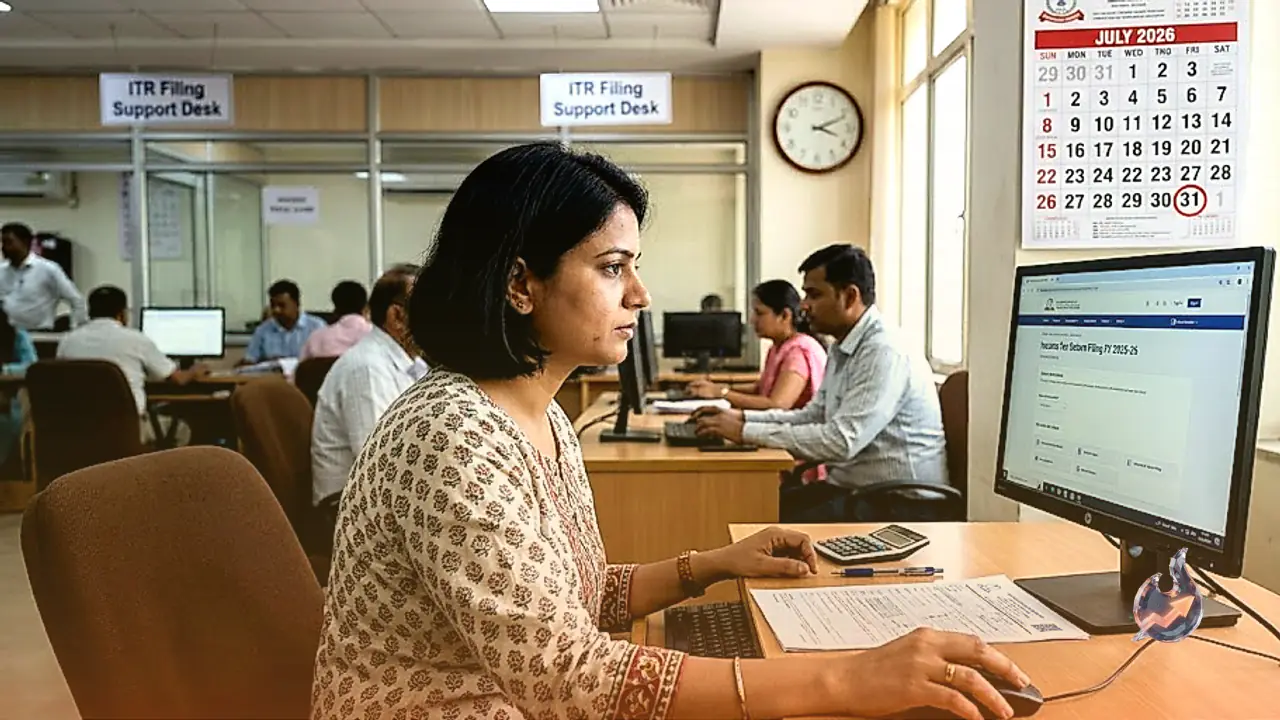
























The deadline for filing the Income Tax Return (ITR) for Assessment Year 2026-27 (Fiscal Year 2025-26) is fast approaching. Salaried individuals and other non-audit taxpayers must complete their tax filing on or before July 31, 2026. Taxpayers who have not yet submitted their returns are advised to complete the process promptly to avoid last-minute portal congestion and financial penalties.
Why July 31, 2026 Matters for Individual Taxpayers
Under the Income Tax Act, July 31, 2026 is the designated deadline for regular taxpayers whose accounts do not require an audit. Taxpayers whose business accounts are subject to mandatory audit have a separate, extended deadline. For standard filers, missing the July 31 deadline limits filing options and triggers financial consequences, including monetary penalties and the potential loss of specific tax benefits such as carrying forward certain losses.
Penalties and Interest Charges Under Section 234F and Section 234A
Filing an ITR after July 31, 2026 incurs statutory penalties under Section 234F of the Income Tax Act. Returns submitted between August 1 and December 31, 2026 attract a late fee scaled according to total income. Taxpayers with an annual total income exceeding Rs 5 lakh are subject to a late fee of Rs 5,000. For individuals with total income up to Rs 5 lakh, the reduced late fee is Rs 1,000.
In addition to the late filing fee, Section 234A imposes interest on any unpaid tax liability. Interest is calculated at the rate of 1 percent per month or part of a month, accruing from August 1, 2026 until the date the return is actually filed and verified. Delaying filing increases the cumulative interest payable on unpaid taxes.
Complete 10-Step Guide to Filing Your ITR Online
Taxpayers can complete the electronic filing process on the income tax e-filing portal by following these 10 steps
1. Access the official income tax e-filing portal at incometax.gov.in and log in using your Permanent Account Number (PAN) as the user ID.
2. After logging in, navigate to the 'e-File' menu, select 'Income Tax Returns', and click on 'File Income Tax Return.'
3. Select the applicable assessment year, which is AY 2026-27 for the current filing cycle.
4. Choose your filing status, which is typically 'Individual' for standard taxpayers.
5. Select the appropriate ITR form based on your income streams. Salaried individuals with single-source salary income generally use ITR-1, whereas taxpayers with capital gains, business income, or multiple property streams require ITR-2 or ITR-3.
6. Review the pre-filled data populated by the portal using information from Form 16, Form 26AS, and the Annual Information Statement (AIS). Cross-check these pre-populated entries against your personal income and tax records.
7. Enter or verify all income details, claims for deductions under sections such as 80C and 80D, and details of advance tax or TDS already deposited.
8. Proceed to compute your overall tax liability or check the calculated refund amount generated by the portal system.
9. Submit the completed return form and initiate the verification step using Aadhaar OTP, net banking, or electronic verification code (EVC).
10. Remember that an unverified return is deemed invalid and treated as not filed under income tax laws. Completing verification immediately is essential.
Filing Belated Returns After July 31 Deadline
If a taxpayer fails to file by July 31, 2026, the law allows the submission of a belated return up to December 31, 2026. However, submitting a belated return requires mandatory payment of the applicable Section 234F late fee along with Section 234A interest accumulated from August 1, 2026 onwards.