


















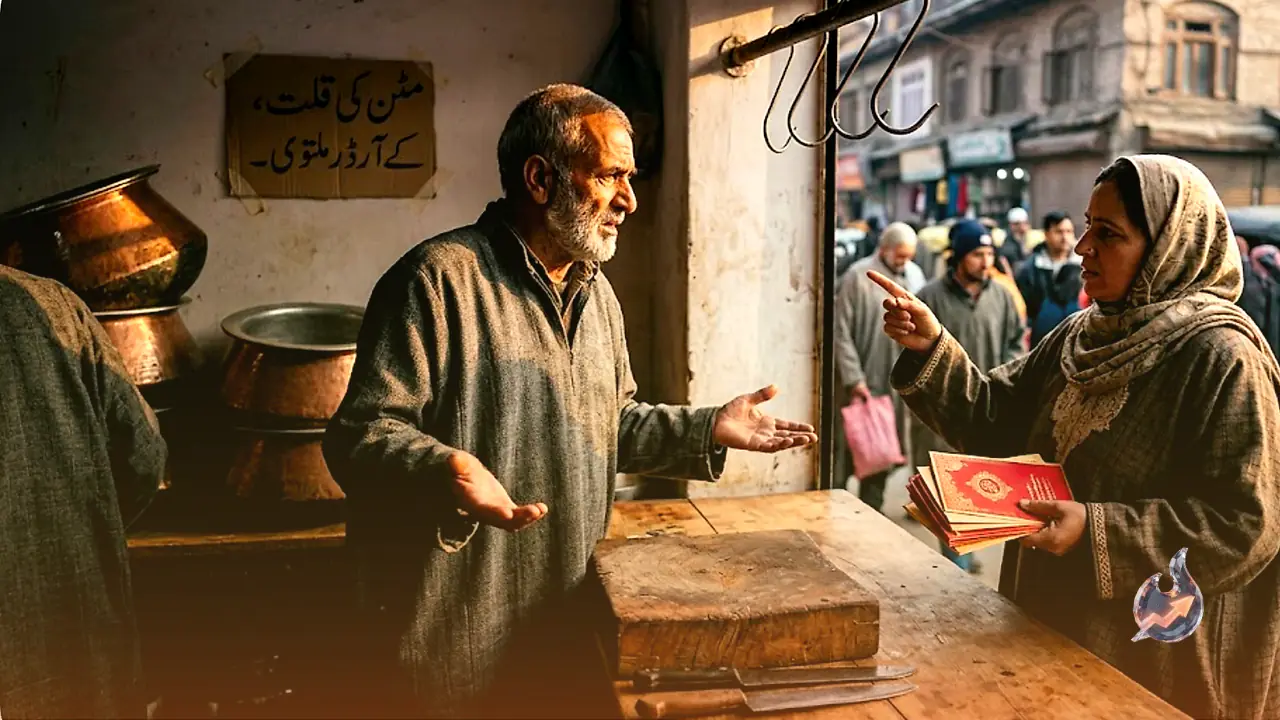

Families across Kashmir who were deep into wedding preparations have suddenly hit a snag over mutton. The trouble traces back to a decision by the Punjab government to raise fees on vehicles transporting animals, a move that has directly disrupted the flow of sheep into Kashmir. As a result, several families have stopped distributing wedding invitation cards altogether, while others have pushed their ceremonies back by a few days. Many are simply hoping the mutton supply normalises soon.
In Srinagar, numerous households have weddings scheduled in the coming weeks, but the mutton shortage has thrown their plans into disarray. In Kashmir, mutton isn't just food, it's central to wedding rituals and feasts, so the shortage is hitting families right where their preparations matter most.
Punjab's new fee at the root of the crisis
Mutton traders say every truck carrying sheep across the Punjab border is now being charged up to Rs 25,000. Earlier, that figure stood at just Rs 5,000. The sharp jump has rattled the entire supply chain, and in several places the flow of mutton into the market has visibly slowed, shrinking availability.
Prices climb, weddings take the hit
The dispute has had a direct effect on prices. Mutton has gone from Rs 700 per kilogram to Rs 750 per kilogram. For one or two kilos, that gap looks minor, but weddings typically require 200 to 400 kilograms of mutton at once. At that scale, the same modest-looking price difference turns into a burden of several thousand rupees, straining ordinary family budgets.
The Wazwan spread is shrinking too
The crisis has struck right as Kashmir's wedding season, which runs from April to October, is in full swing. It has also affected Wazwan, the traditional Kashmiri feast built around not one but several mutton dishes. With supply running low, the number of dishes on offer is shrinking, leaving guests with a spread that looks noticeably thinner than usual.
Jammu and Kashmir calls the levy arbitrary
The Jammu and Kashmir government has called Punjab's fee illegal and arbitrary. Chief Minister Omar Abdullah wrote to Punjab Chief Minister Bhagwant Mann on the matter, demanding that vehicles carrying animals be allowed unhindered movement. Omar Abdullah also said these vehicles are merely using the highway, so there is no justification for such a levy.
Mehraj-ud-Din Ganai, general secretary of the Kashmir Mutton Dealers Association, said sheep markets have remained shut for nine straight days. He noted that it is wedding season, but traders are left with no choice and simply cannot keep up with supply.
Why meat matters so much in Kashmir
Around 90 percent of people in Kashmir are non-vegetarian, and mutton consumption here is the highest anywhere in the country. More than 600 lakh kilograms of mutton are consumed in Kashmir every year, with over half of that supply coming from sheep sourced in Haryana, Delhi and Rajasthan. On an ordinary day, 40 to 50 trucks, carrying roughly 8,000 sheep, arrive in Kashmir. During the wedding season, that number rises to 60 to 70 trucks, or about 11,000 sheep.
Punjab's side of the story
The Punjab government maintains this isn't a new tax at all but an animal mandi fee. Officials claim some traders have been moving animals out without following due process, causing a loss of revenue for the state. Jammu and Kashmir traders counter that Punjab is merely a transit state through which the animals pass, and so should not be levying any tax in the first place.
What happens next
A meeting between Punjab and Jammu and Kashmir officials is expected soon to try and resolve the standoff. The Punjab government is set to issue a formal response after that meeting, one that Kashmir's mutton traders and wedding-bound families alike are watching closely.