



















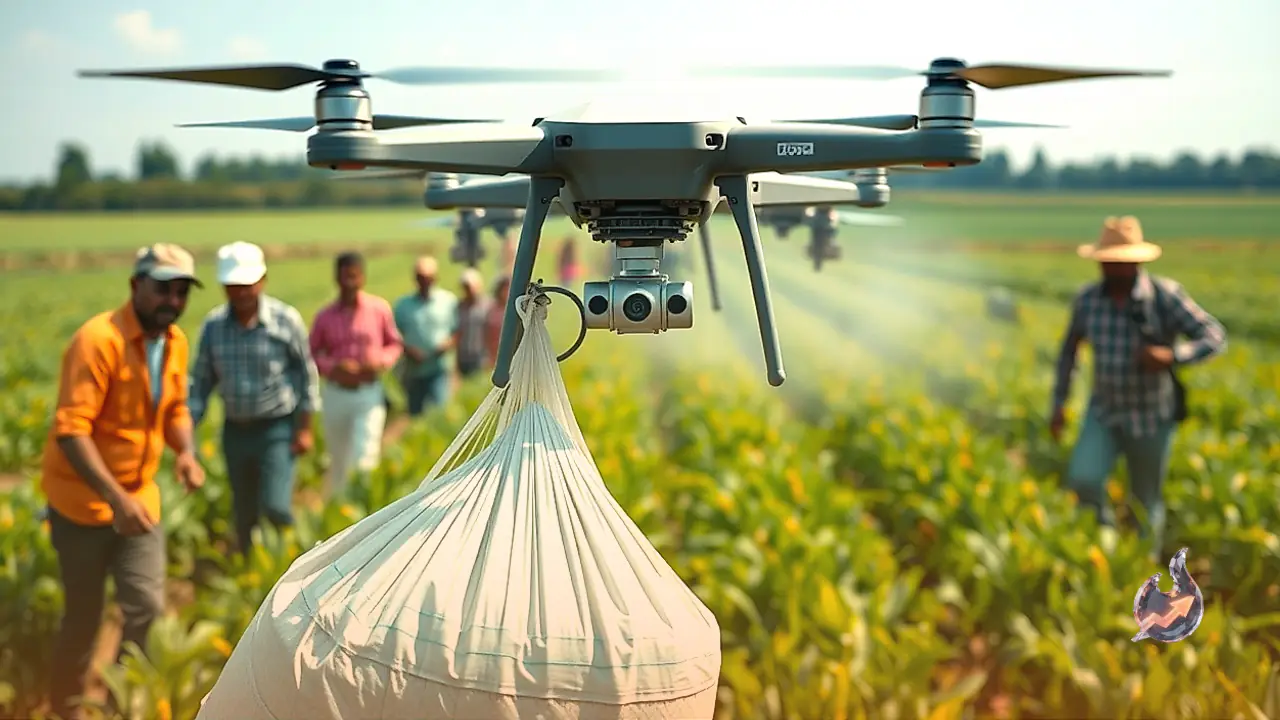

Traditional agricultural practices are steadily making way for advanced machinery to reduce manual labor and optimize productivity. Indian farming, which once relied entirely on oxen and wooden plows, has transitioned into an era of mechanization where tasks taking hours are completed in minutes. Historically, spreading fertilizer and chemical treatments across crops involved manual broadcasting by hand or using cumbersome hand-operated backpack sprayers. These older methods required demanding physical labor, faced constant labor shortages, consumed excessive water, and often resulted in uneven application. To resolve these challenges, unmanned aerial vehicles known as agricultural drones are being integrated into field management. During the Kisan Swarojgar Mela organized at the Jehanabad district headquarters, Amrit Raj, startup founder of Netbrig Agriculture Drone Service, outlined how this aerial spraying technology works and how farmers can access state subsidies.
Speed and Resource Efficiency in Field Applications
The deployment of agricultural drones simplifies field maintenance by executing spray tasks at high speed. A job that once required multiple farm laborers several hours to finish is now concluded within minutes, offering a major advantage for large agricultural holdings. Operating smoothly over standing crops, the drone can spray fertilizers across an entire one-acre field in just 10 minutes. Alongside significant time savings, water conservation is a central benefit of this precision approach. Conventional spraying demands large volumes of water, whereas the agricultural drone accomplishes a thorough spray across an entire acre using only 10 liters of water.
Subsidized Spraying Services via the Plant Protection Department
Farmers who do not own a drone can still hire aerial spraying services for their crops at subsidized rates under a scheme managed by the Plant Protection Department. Amrit Raj explained that the official rate for spraying fertilizer over one acre of farmland using an agricultural drone is set at 419 rupees. Upon formal application, the government provides a 50 percent subsidy on this rate. With the 50 percent discount applied, the net cost for the farmer drops to just 210 rupees per acre. The entire spraying cycle for one acre requires between 5 and 7 minutes and utilizes 10 liters of water. Furthermore, this mechanized aerial method is fully compatible with modern liquid inputs, including nano urea and DAP.
Purchasing Agricultural Drones at a 40 Percent Subsidy
For growers with extensive acreage or rural entrepreneurs seeking to provide custom spraying services, the scheme provides financial assistance for equipment purchases. A standard agricultural drone carries a retail price of 10,00,000 rupees. Under the subsidy framework, buyers receive 40 percent assistance. Consequently, after deducting the government subsidy, eligible farmers can acquire the 10,00,000 rupee drone for a final price of 6,00,000 rupees. This financial support lowers the entry barrier for adopting advanced precision farming tools in rural districts.
Step-by-Step Application Workflow on the DBT Portal
Availing either the subsidized drone purchase or the on-field spraying service requires a valid farmer registration ID. Applicants must log into the designated DBT portal and select the Plant Protection Department from the list of services. After selecting the relevant scheme, the farmer fills out the required application details and submits a formal affidavit. Once the digital submission is processed and confirmed, the authorized operating team visits the farmer's land with the equipment to carry out the aerial fertilizer spraying directly on the target crop.