




















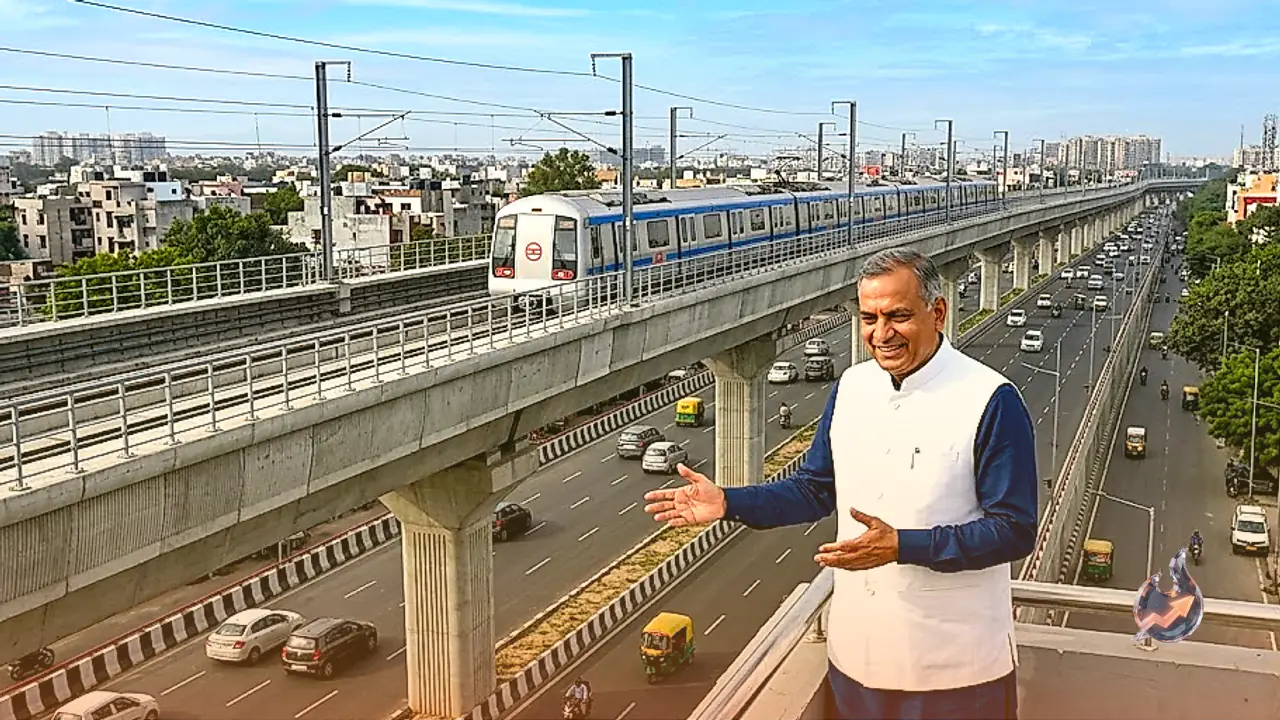

Delhi's notorious traffic snarls in the North-East district are about to witness a permanent and innovative solution. The national capital is gearing up to launch its very first integrated double-decker flyover by December of this year. This ambitious engineering marvel is designed to maximize limited urban space and overall transit efficiency by running a high-speed metro train corridor on the upper deck, while everyday commuter vehicles drive on the flyover directly below it. The Delhi government has recently given the final green signal for a revised project budget of 291 crore rupees, ensuring that the final construction phases proceed smoothly without any financial roadblocks.
Rapid Construction Progress Along Wazirabad Road
Chief Minister Rekha Gupta provided a detailed and optimistic update on the project during a recent press conference, confirming that work on the vital 1.40-kilometer stretch along Wazirabad Road is currently moving at a rapid pace. According to the Chief Minister, roughly 88 percent of the heavy construction work has already been successfully wrapped up. Out of the 80 total deck slabs planned to support the massive elevated structure, 74 have been successfully cast, cured, and positioned into place. Furthermore, the installation of crucial structural safety elements, including heavy-duty crash barriers and complex expansion joints, is nearing absolute completion. While the mega-project did encounter some temporary roadblocks earlier due to specific technical challenges and pending administrative permissions across different departments, the authorities have now aggressively accelerated the pace of work to confidently meet the year-end deadline.
An Engineering Feat Transforming Urban Transport
This first-of-its-kind infrastructure initiative in the bustling city is being executed jointly by the Public Works Department and the Delhi Metro Rail Corporation. Building a dual-purpose framework requires exceptional engineering precision, seamlessly combining the constant heavy vehicular loads of highway traffic with the high-speed transit requirements and structural vibrations of a modern metro system. The comprehensive development plan does not stop at erecting concrete pillars. The agencies are also executing a complete overhaul of the surrounding civic amenities on the ground. Teams are laying down fresh road surfaces and constructing much safer, elevated footpaths for local pedestrians. In addition, they are actively installing advanced underground drainage networks, modern street lighting systems, sustainable rainwater harvesting units, and clear, contemporary road signage to guarantee a completely seamless driving experience.
Ending Traffic Woes For Yamuna Vihar And Bhajanpura
The most immediate beneficiaries of this towering elevated corridor will be the tens of thousands of daily commuters passing through the Yamuna Vihar and Bhajanpura areas, which currently suffer from severely debilitating traffic bottlenecks every single morning and evening. Once the integrated flyover officially opens to the public, traffic experts estimate that 65 to 70 percent of the total vehicular volume will be instantly diverted onto the elevated route. This massive shift will leave the ground-level roads mostly free for local neighborhood traffic, effectively putting a permanent end to the frustrating daily jams. Commuters travelling the long route from Gokulpuri all the way to the Signature Bridge can finally look forward to a completely signal-free, uninterrupted journey.
Faster Clearances For Essential Government Services
Beyond upgrading physical urban infrastructure, the state government is also completely overhauling its administrative machinery to serve ordinary citizens much better. Chief Minister Rekha Gupta highlighted that the administration remains highly focused on making everyday public services faster, more accessible, and entirely transparent. Following a rigorous and comprehensive review process, government authorities have successfully streamlined 95 essential public services spanning across 18 different civil departments. Furthermore, the mandatory processing time for 84 key public services has been significantly reduced by bringing them under a newly implemented, highly efficient single window clearance system, which aims to save city residents both valuable time and unnecessary effort when interacting with government offices.