





















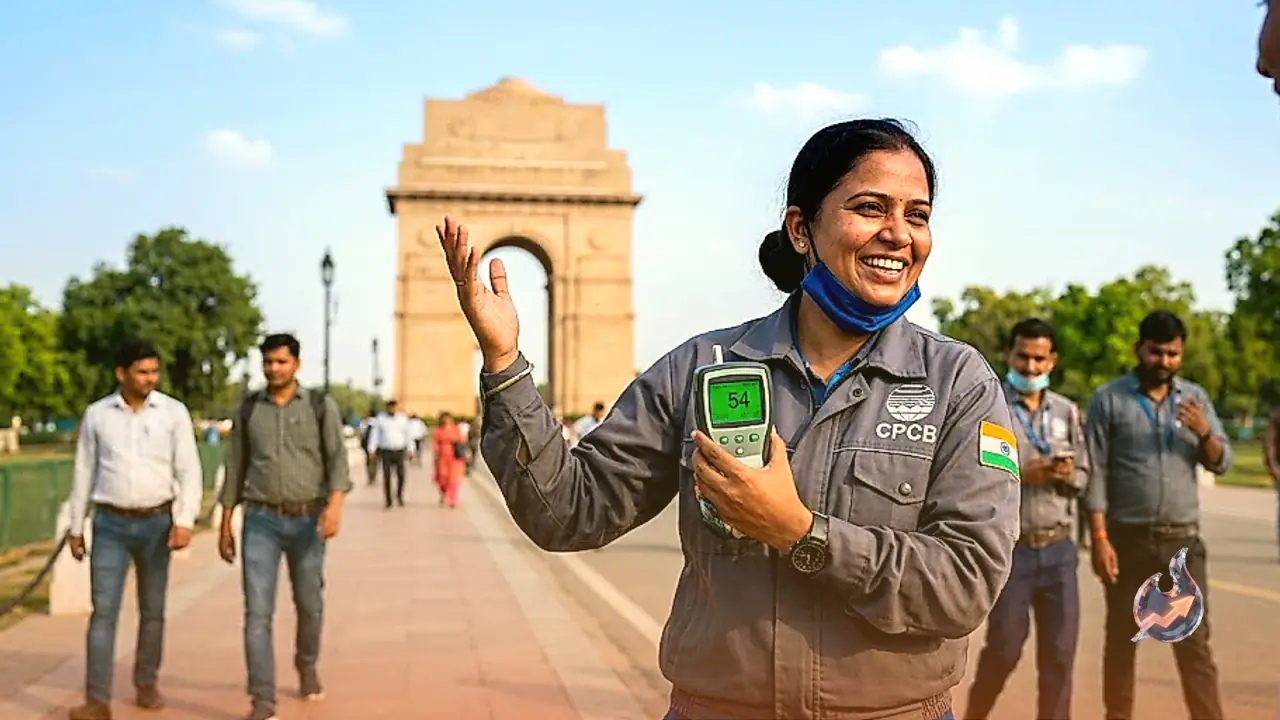

Delhi, a city infamous during winters for hazardous smog and severe air pollution, has secured a position in the Clean Air Survey 2026 that might seem surprising at first glance. The national capital claimed the 21st spot in the category of cities with a population exceeding one million. In this ranking, Delhi managed to outpace several major urban centers including Srinagar, Bengaluru, Mumbai, Chennai, and Kolkata.
Union Environment Ministry Releases New Rankings
According to the Clean Air Survey 2026 released by the Union Environment Ministry on Monday, Delhi scored 172 points, securing the 21st position jointly with Visakhapatnam. Meanwhile, Srinagar secured the 26th rank with 162.6 points, and Bengaluru landed at the 32nd spot with 152.6 points.
Why Delhi Rank Improved Despite High AQI
It is natural to wonder how Delhi, which is frequently counted among India's most polluted major cities with its winter AQI often crossing the 400 mark into the severe category and sometimes even surpassing 450, managed to rank ahead of cities generally considered much cleaner. The answer lies in the methodology of the survey. The Clean Air Survey does not solely measure how clean a city's air currently is; rather, it evaluates the efforts made by urban administrations to reduce air pollution and the implementation of those measures.
Parameters Evaluated in the Clean Air Survey
Points in the survey are awarded based on various proactive steps such as controlling road dust, municipal solid waste management, curbing vehicular emissions, regulating industrial pollution, managing construction and demolition debris, and raising public awareness. This means that a city with relatively poor air quality can still climb the rankings by implementing better policies and control measures against pollution. Therefore, Delhi's 21st rank should not be directly interpreted as an indicator that its air has become cleaner than that of Srinagar or Bengaluru.
Lucknow Claims the Top Spot, Surpassing Indore
In the category of cities with over ten lakh population, Uttar Pradesh's capital Lucknow secured the number one position. Lucknow scored 198 points, edging out Indore by a narrow margin. Indore secured the second spot with 197 points, while Madhya Pradesh's Jabalpur stood at the third position with 195 points. Bhopal and Agra both scored 192 points each, sharing the fourth position. Although Indore has consistently been ranked among India's cleanest cities for eight consecutive years, the Swachh Survekshan and the Clean Air Survey operate on different criteria, meaning the two rankings cannot be equated.
Which Major Cities Did Delhi Leave Behind?
Delhi's ranking was better than several major metropolitan areas. Patna secured the 16th rank with 178 points, while Hyderabad stood at the 19th position. Following Delhi, Visakhapatnam also shared the 21st spot. Mumbai followed at the 28th position with 160.8 points, Bengaluru at 32nd, Chennai at 35th, and Kolkata at 38th. Thus, Delhi's ranking surpassed Mumbai, Bengaluru, Chennai, and Kolkata, though Patna and Hyderabad remained ahead of it.
Improvement Compared to the Previous Year
This ranking also highlights an improvement for Delhi compared to the previous year. In the Clean Air Survey 2025, the capital stood at the 32nd position with a final score of 157.3. In the 2026 survey, Delhi's score rose to 172, pushing its rank up to the 21st position. In other words, Delhi climbed 11 spots within a single year. However, despite this progress, the capital's actual air quality remains a daunting challenge.
PM2.5 and PM10 Levels Still Well Above Standards
The central government had declared 2025 as the best year for Delhi since 2018, excluding the COVID-19 pandemic-affected year of 2020. Despite this, the annual average PM10 level in Delhi was recorded at 198 micrograms per cubic meter, and PM2.5 at 97 micrograms per cubic meter. These figures are significantly higher than the national annual standards. India's annual standard for PM10 is 60 micrograms per cubic meter and for PM2.5 it is 40 micrograms per cubic meter. This indicates that while Delhi's ranking has improved, the capital is still a long way from eradicating its pollution crisis.
Winter Air Quality Worsens Once Again
During the 2025-26 winter season, Delhi's air deteriorated rapidly once more. In January 2026, as pollution reached extremely critical levels, authorities were forced to invoke Stage IV of the Graded Response Action Plan, known as GRAP. This situation demonstrates that Delhi's pollution problem cannot be understood solely through average numbers or a single ranking. Multiple factors simultaneously impact the national capital, including weather conditions, stubble burning smoke, vehicular emissions, industrial pollution, construction activities, and road dust.
The Real Test Ahead for Delhi
Delhi's 21st ranking certainly points toward improvements in pollution control measures. However, it cannot be taken as proof that the capital's air has become clean. Perhaps the biggest takeaway from this ranking is that Delhi has managed to score higher points for its efforts to combat pollution, but the ultimate test of providing breathable air to Delhi residents still lies ahead. While a rise in rankings can offer some relief where winter AQI routinely hits 400 and above, true success will only be achieved when Delhi's air quality consistently nears national standards.