




















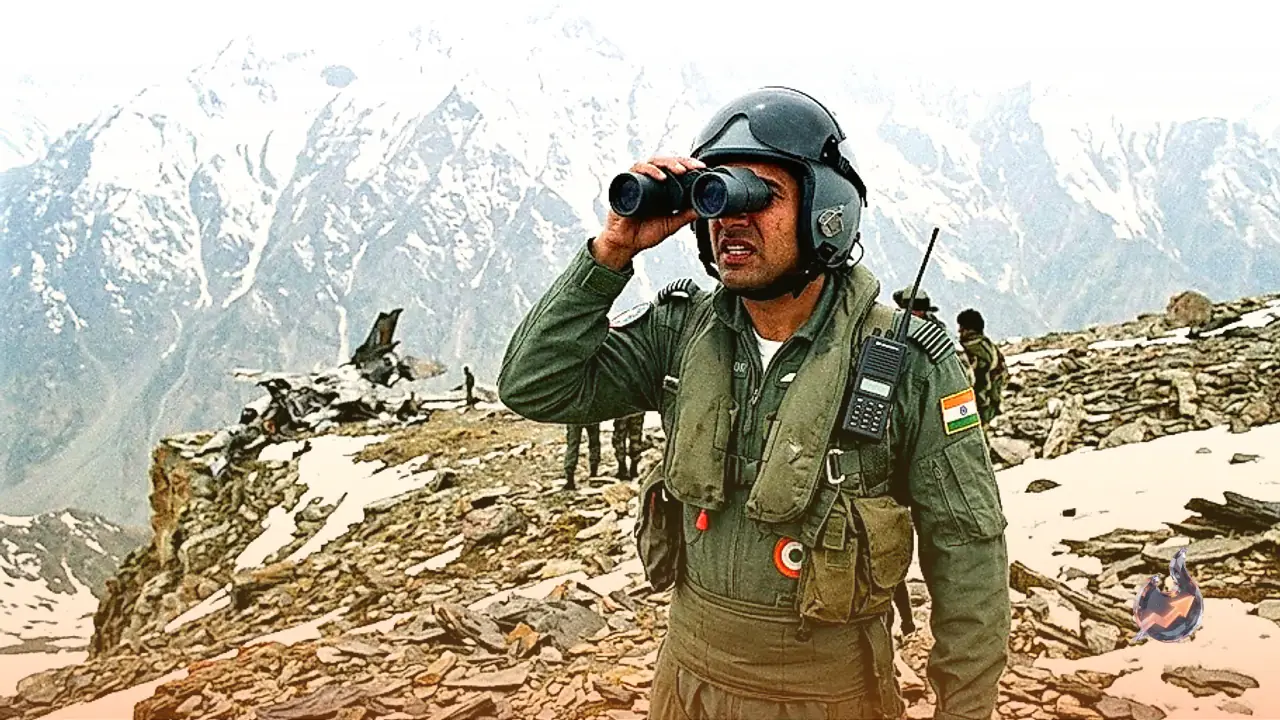

In the final days of May 1999, as the Kargil War escalated across the treacherous heights of Ladakh, the Indian Air Force launched Operation Safed Sagar. This air campaign was designed to support ground troops and flush out enemy infiltrators who had occupied strategic positions along the Line of Control. Amidst the fierce aerial and ground combat, the extraordinary bravery of two Indian Air Force officers, Squadron Leader Ajay Ahuja and Flight Lieutenant K. Nachiketa, became etched into military history as a enduring testament to valor and comradeship.
Early Life and Illustrious Career of Sqn Ldr Ajay Ahuja
Born on May 22, 1963, in Kota, Rajasthan, Ajay Ahuja demonstrated exceptional leadership and academic capability from his early youth. After completing his foundational education, he earned admission to the National Defence Academy (NDA), where he underwent rigorous officer training. On June 14, 1985, he was commissioned as a fighter pilot into the Indian Air Force.
Over a distinguished 14-year career, Ahuja logged over 1,000 flying hours and mastered frontline fighter jets, including the MiG-21 and MiG-23. Recognized for his instructional brilliance, he served as a qualified flying instructor. At the outbreak of the 1999 Kargil conflict, Squadron Leader Ahuja was serving as the Flight Commander of the prestigious No. 17 Squadron, known as the 'Golden Arrows', based out of Bathinda.
The Critical Mission of May 27, 1999 over Batalik
On May 27, 1999, Squadron Leader Ajay Ahuja led a critical photo-reconnaissance mission over the Batalik sector. His objective was to capture high-resolution imagery of enemy positions and missile threats near Muntho Dhalo to aid Indian ground artillery and air strikes.
Simultaneously, a strike package consisting of four fighter aircraft took off from the Srinagar airbase to target enemy supply depots in the same sector. Among them was 26-year-old Flight Lieutenant K. Nachiketa, flying a MiG-27 fighter-bomber. Nachiketa was tasked with conducting a low-level rocket attack on a major enemy ammunition dump situated at an altitude of 15,000 feet.
Engine Flameout and Emergency Ejection over Muntho Dhalo
During his attack run over Muntho Dhalo, as Nachiketa fired his rockets into the target area, his MiG-27 suffered a catastrophic engine flameout. Because the MiG-27 was a single-engine aircraft, immediate in-flight relight attempts failed. The aircraft rapidly lost altitude over rugged, snow-covered terrain.
Realizing that his plane was seconds away from impacting the mountainside, Nachiketa initiated an emergency ejection at 15,000 feet. He descended by parachute into extremely hostile, enemy-controlled territory, landing alone on a frozen ridge armed only with his sidearm.
Ajay Ahuja's Heroic Search and Ultimate Sacrifice
Upon receiving radio transmission that Nachiketa had ejected near enemy lines, Squadron Leader Ajay Ahuja immediately altered his mission profile. Disregarding the severe danger posed by enemy surface-to-air missile threats in the valley, Ahuja redirected his MiG-21 toward the crash zone to pinpoint Nachiketa's location and coordinate rescue efforts.
Ahuja identified the probable crash site and ordered his wingman to return safely to base while he remained overhead to maintain visual contact. Moments later, a shoulder-fired Stinger surface-to-air missile launched by enemy forces struck Ahuja's MiG-21. Forced to eject, Ahuja landed safely on the ground via parachute but was captured by enemy troops. In violation of international Geneva conventions, he was brutally executed in captivity. He was 36 years old. For his extraordinary devotion to duty and supreme sacrifice, Squadron Leader Ajay Ahuja was posthumously decorated with the Vir Chakra.
Nachiketa's Ground Capture and Standoff
On the ground, Flight Lieutenant Nachiketa found himself isolated in sub-zero terrain with only a 9mm pistol and 16 rounds of ammunition. Within minutes, a patrol of 5 to 6 enemy soldiers approached his position. Refusing to surrender without resistance, Nachiketa opened fire, exhausting his first magazine of 8 rounds.
As he attempted to reload his second magazine, an enemy soldier closed the distance and thrust the barrel of an AK-47 directly into Nachiketa's mouth. At that critical moment, the platoon commander, Captain Qamar of the 5th Northern Light Infantry, intervened and ordered the soldier not to pull the trigger. Captain Qamar administered basic first aid to Nachiketa before transferring him into military custody. Captain Qamar was later killed in subsequent combat action during the war.
Eight Days of Captivity and Interrogation
Nachiketa was held in enemy captivity for eight harrowing days. Initially subjected to soft interrogation at field camps, he was later transferred to specialized Inter-Services Intelligence (ISI) units in Islamabad and Rawalpindi after refusing to divulge military details.
During his detention, he faced severe physical, mental, and sleep-deprivation torture, including exposure to high-voltage lighting and denial of food and rest. Despite the extreme duress, Nachiketa maintained absolute operational secrecy. Following diplomatic pressure, he was eventually released to Red Cross officials and returned safely to India. He later retired from the Indian Air Force with the rank of Group Captain.
A Legacy Preserved in Military History
The actions of Squadron Leader Ajay Ahuja and Group Captain K. Nachiketa remain a cornerstone of Indian Air Force history. Their story has been featured in military literature such as 'Wings of Valor' and recently portrayed in screen dramatizations titled 'Operation Safed Sagar', where actor Siddharth portrays Squadron Leader Ahuja. Their heroism continues to serve as an enduring symbol of courage and sacrifice under fire.