






















The Indian Navy is executing a major strategic shift in its long-term naval aviation blueprint to strengthen maritime security and maintain operational dominance across critical oceanic passages. As the navy prepares to induct the naval variant of Rafale fighter jets alongside its existing fleet of sea-launched BrahMos cruise missiles, securing a robust carrier platform has become a top operational priority. Currently, the navy operates two aircraft carriers: INS Vikramaditya and the indigenously constructed INS Vikrant. The plan to build a second Indigenous Aircraft Carrier (IAC-2) aims to give India a permanent three-carrier fleet. Recent strategic evaluations indicate that the navy has recalibrated the design parameters for IAC-2, prioritizing practical operational availability and timely commissioning over extremely complex supercarrier ambitions.
Shifting from a 65,000-Ton Supercarrier to a 45,000-Ton Enhanced Design
For nearly a decade, the IAC-2 project was envisioned as a massive 65,000-ton supercarrier class designated as INS Vishal. That concept was intended to push the boundaries of Indian naval power projection with a large air wing capability. However, detailed reviews involving budgetary allocations, technical complexity, construction timelines, and pressing defense modernization needs prompted a shift in strategy. Instead of pursuing the 65,000-ton supercarrier, the navy is now focusing on a roughly 45,000-ton carrier that functions as an Enhanced Vikrant. The primary objective is to secure a reliable two-carrier operational availability across both eastern and western seaboard theaters without waiting through decades of complex development cycles.
Ensuring Continuous Carrier Operations in the Arabian Sea and Bay of Bengal
Maintaining an active carrier presence in both the Arabian Sea and the Bay of Bengal is vital for India's strategic defense posture. While INS Vikramaditya remains a cornerstone of current naval aviation, its aging hull and machinery will naturally require increased maintenance cycles and dockyard overhauls in the coming years. Relying solely on two carriers can create operational gaps when one ship enters refit. By building IAC-2 as a refined iteration of INS Vikrant, the navy ensures a smooth transition and continuous deployment capability. Having three carriers in total guarantees that at least two strike groups remain fully operational at all times while the third undergoes scheduled maintenance.
Retaining STOBAR Operations Over Complex CATOBAR and EMALS Technologies
The original INS Vishal design explored the inclusion of Catapult Assisted Take-Off Barrier Arrested Recovery (CATOBAR) technology, alongside discussions around Electromagnetic Aircraft Launch System (EMALS) and nuclear propulsion to support 55 to 60 aircraft. Developing or acquiring these systems simultaneously presented severe technical and financial risks. Consequently, the proposed IAC-2 will likely retain the Short Take-Off Arrested Recovery (STOBAR) system used on INS Vikrant. Utilizing STOBAR eliminates the risks of integrating untested catapult mechanisms. Moreover, it allows Indian shipyards to leverage existing supply chains, specialized infrastructure, and engineering expertise developed during INS Vikrant's construction, significantly accelerating project timelines and keeping costs manageable.
Transforming IAC-2 into a Manned-Unmanned Aviation Hub
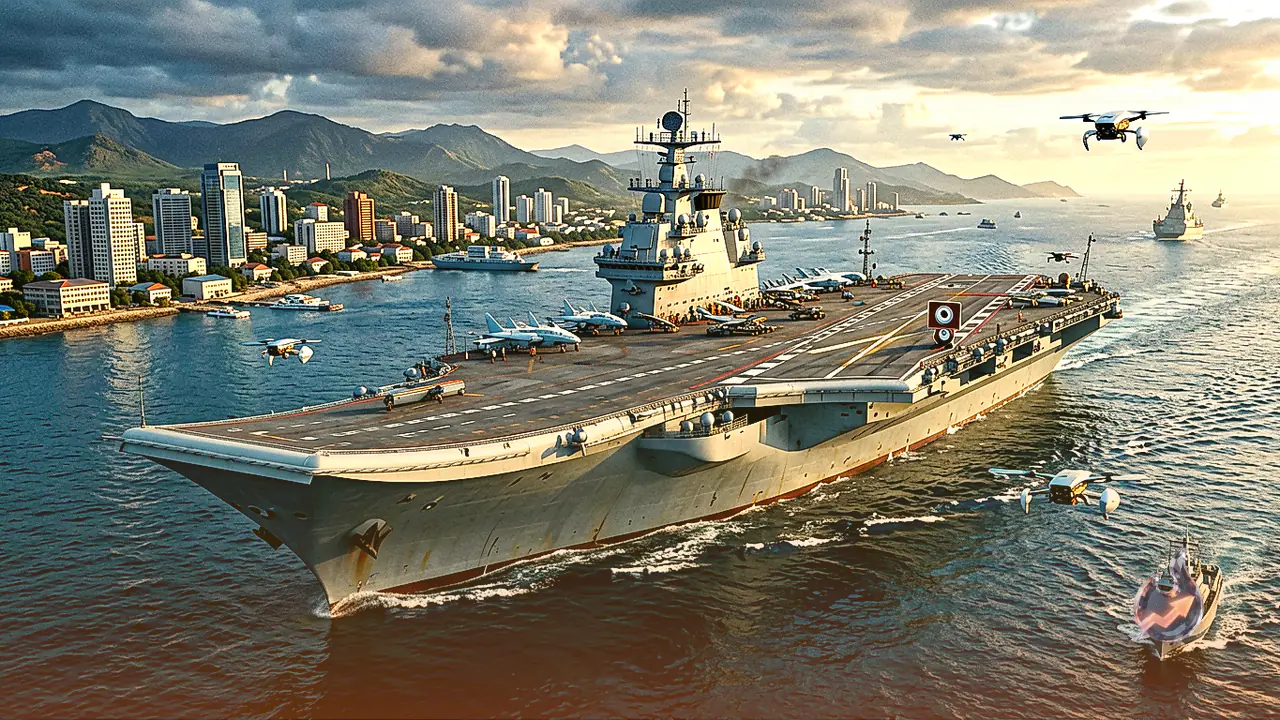
The most innovative evolutionary step in the modified IAC-2 plan lies in its prospective air wing composition rather than hull dimensions or launch gear. Instead of focusing exclusively on increasing the count of manned fighter aircraft, the navy plans to integrate unmanned platforms into core carrier operations. The future carrier layout will accommodate Unmanned Combat Aerial Vehicles (UCAV), loyal wingman concepts, long-endurance Intelligence, Surveillance, and Reconnaissance (ISR) drones, and swarm drone systems. This transition converts the vessel from a conventional fighter launchpad into a multi-dimensional aviation hub. Long-endurance ISR drones can execute persistent surveillance hundreds of kilometers out, UCAVs can conduct high-risk precision strikes to safeguard human pilots, loyal wingmen will augment manned fighter sensor suites, and swarm drones will fulfill electronic warfare, reconnaissance, and decoy roles.
Strategic Impact in the Indian Ocean Region and Long-Term Carrier Outlook
In the rapidly changing geopolitical environment of the Indian Ocean Region, marked by Anti-Access/Area-Denial (A2/AD) challenges and expanded long-range maritime monitoring, carrier effectiveness is no longer measured solely by jet capacity. Integrated sensor networks, electronic warfare suites, and manned-unmanned teaming represent the core of future maritime combat capability. Designing IAC-2 from inception to handle unmanned operations marks a significant technological leap for the Indian Navy, enhancing mission flexibility and operational reach. This strategic pivot does not imply that India has permanently discarded the concept of a CATOBAR supercarrier like INS Vishal. Once domestic capabilities in catapult operations, EMALS, and advanced naval aviation mature further, the supercarrier vision may be revisited. For now, the navy's focus remains clear: delivering a practical, indigenous, and technologically advanced carrier on an optimized schedule.