






















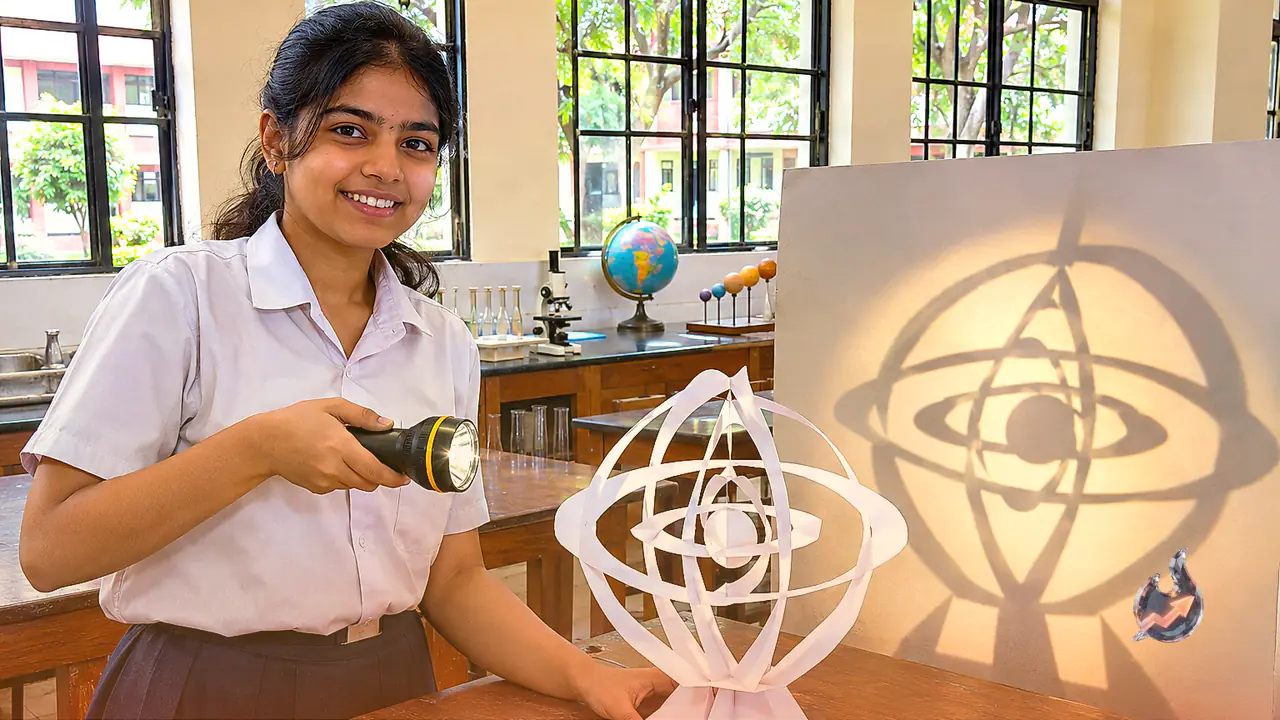

Students at JVM Shyamli School in Jharkhand's capital city, Ranchi, have demonstrated remarkable ingenuity by developing a distinctive 4D model. A student named Priya designed this creative project without relying on any expensive machinery, high-tech laboratories, or costly equipment. Instead, she brought this scientific concept to life using merely a basic sheet of paper and an ordinary torch, catching everyone's attention with her innovative approach.
The Mechanism Behind the Project
Explaining the technical side of the creation, Priya noted that while she built a fundamental 3D structure, she projected it in a manner that transforms the visual output into a 4D representation. Using a pipe, she constructed a 3D cube structure and placed a plain sheet of paper in front of it. When a torch or light source is shone onto this 3D framework, the resulting projection or shadow appearing on the paper exhibits four-dimensional characteristics, rooted deeply in established scientific principles.
Scientific Foundations of the Model
This academic project draws its foundation from core physics concepts, including Newton's laws and the theory of relativity. While standard physical space consists of three dimensions encompassing length, width, and height—making it impossible to physically manufacture a direct four-dimensional object—this projection technique reveals time as the visible fourth dimension. The model provides a tangible way to visualize how time behaves across the vast expanse of the cosmos.
Mapping Cosmic Time Variations
Time does not flow uniformly across the entire universe, as certain regions experience extremely rapid time progression while other areas witness much slower temporal shifts. Visualizing and mapping these variations alongside the structure of the cosmos has traditionally been challenging. With this 4D projection framework now readily accessible, analyzing the complex dynamics of the universe and its temporal shifts becomes significantly more manageable.
Applications in Astronomy and Space Research
Detailing the practical utility of her invention, Priya highlights its extensive potential across astronomy and space exploration. Astronomical calculations rely heavily on the positioning and baseline attributes of celestial bodies. Furthermore, when satellites are launched into space, precise mapping of time and spatial parameters ensures accurate operations. This innovative approach opens up avenues for deeper research into how time functions throughout the universe, paving the way for valuable new discoveries.