

















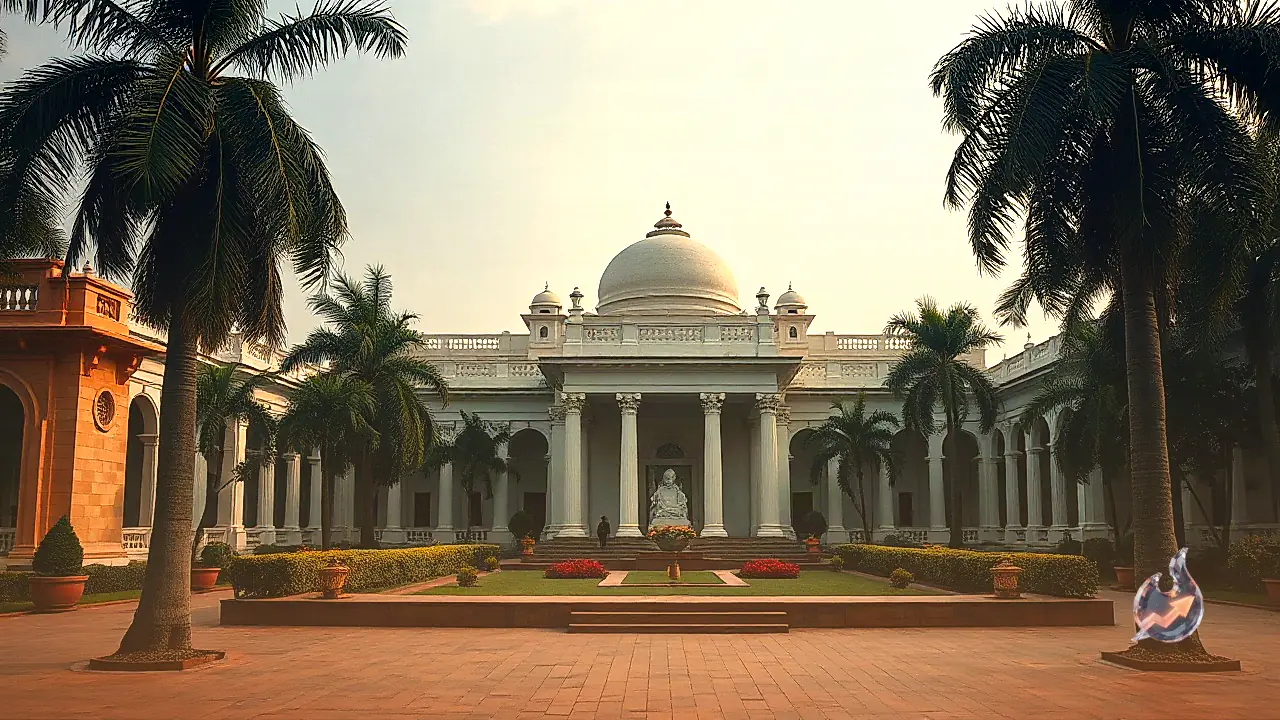

Located at 5, Tees January Marg in New Delhi, Gandhi Smriti stands as a profound physical testament to a crucial turning point in modern Indian history. Formerly known as Birla House, this expansive estate bore witness to the concluding chapter of Mahatma Gandhi's life, serving as his residence for his final 144 days. Gandhi stayed on the premises from September 9, 1947, until his assassination on January 30, 1948. Preserved today as a dedicated national memorial, the site offers visitors an unfiltered encounter with the surroundings, artifacts, and quiet spaces where historical events unfolded.
The Entrance Statue and a Message of Peace
Upon stepping inside Gandhi Smriti, visitors are immediately greeted by a striking sculptural ensemble. The statue depicts Mahatma Gandhi flanked by a young boy and a young girl holding a dove, symbolizing enduring peace and harmony. Below the sculpture, Gandhi's timeless maxim, My Life is My Message, is inscribed. This visual introduction immediately establishes the reflective tone of the site, prompting visitors to engage with his philosophy and austere commitments before exploring the rest of the memorial grounds.
The Preserved Room Reflecting Rigorous Simplicity
Among the most emotionally evocative spaces in the memorial is the modest room where Gandhi lived during his residency. Maintained precisely as it was left in late January 1948, the room showcases his stark minimalism. A plain mattress rests on the floor beside a low wooden desk, illustrating his humble daily routines. Visitors can view his personal effects preserved behind glass, including his spectacles, walking stick, dining utensils such as a knife, fork, and spoon, and a copy of the Gita that he read regularly. The preservation allows the room to remain a personal living quarter rather than a sterile museum exhibit, showing the tactile reality of his everyday discipline.
Chronicles of the Final 144 Days in Photography
A substantial section of Gandhi Smriti is dedicated to documenting the specific events of those final 144 days. The corridor leading toward his living quarters features detailed documentation regarding his peace missions and ultimate sacrifice. Beyond the gallery, an extensive photographic exhibition charts day-by-day occurrences between September 9, 1947, and January 30, 1948. Accompanied by firsthand eyewitness accounts, the exhibition provides critical historical context, enabling observers to understand the tense communal atmosphere and societal challenges prevailing in Delhi and across the newly independent nation during that era.
The Prayer Ground, Sandstone Bench, and the Martyr's Column
The open-air prayer ground represents an integral landmark within the five-acre estate. Gandhi held regular evening prayer meetings here, interacting directly with people from diverse walks of life. Near this gathering spot sits a weathered red sandstone bench. According to official archival documentation, Gandhi sat on this specific bench during evening assemblies and discussions with visitors.
Directly along the pathway leading through the grounds stands the Martyr's Column. This commemorative monument precisely identifies the spot where Gandhi was assassinated on the evening of January 30, 1948. A dedicated perimeter surrounds the column, offering visitors a quiet area to pay homage and reflect on his final moments.
Multimedia Exhibitions and the Transition to a National Memorial
Gandhi Smriti functions as a comprehensive museum housing paintings, sculptures, murals, and archival treasures detailing Gandhi's transition from childhood to becoming the Mahatma. Alongside traditional displays, the site incorporates a modern multimedia exhibition titled Gandhi. Utilizing contemporary interactive technology, this installation presents his core principles of truth and nonviolence through engaging digital formats tailored for newer generations.
The five-acre compound of the former Birla House was officially acquired by the Government of India in 1971 to be transformed into a permanent national memorial. It opened its doors to the public on August 15, 1973. Walking the footstep-marked path that Gandhi took toward the prayer ground right up to the Martyr's Column offers visitors an intimate, tactile connection to the closing moments of his life and legacy.