























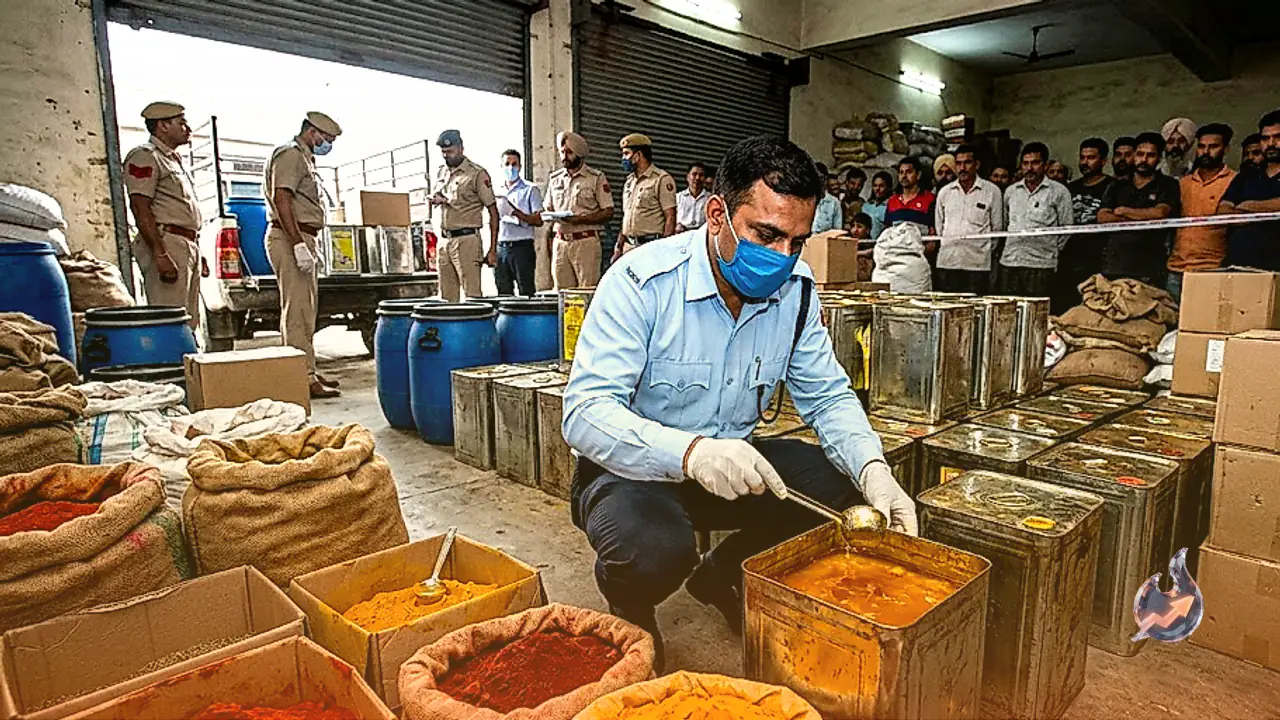

Growing concerns surrounding the safety and purity of essential kitchen staples have intensified following widespread law enforcement raids targeting counterfeit food manufacturing units across India. Authorities have dismantled sophisticated illicit syndicates producing fake ghee, adulterated turmeric, synthetic red chilli powder, and dyed cumin. Recent operations conducted across Gujarat, Punjab, Uttar Pradesh, and Telangana led to the seizure of tens of thousands of liters of chemical-infused ghee and tons of hazardous spices formulated using industrial dyes, rice flour, and wood sawdust.
Seizure of 30,000 Liters of Fake Ghee and Chinese Chemicals in Ahmedabad
In Gujarat, a joint team from the Food and Drug Administration (FDA) and local police raided a manufacturing unit in Ahmedabad, seizing 30,000 liters of counterfeit ghee. Investigators revealed that the facility converted palmolein oil into fake clarified butter by blending it with specialized chemical additives. Authorities also confiscated 50,000 liters of imported Chinese chemicals specifically formulated to alter the texture, aroma, and appearance of palmolein oil, making it visually indistinguishable from genuine cow or buffalo ghee.
The sophistication of the operation surprised FDA officials, as initial field testing equipment failed to differentiate the fake product from real ghee due to identical fat content readings. Deputy Inspector General (DIG) of Police for the Gandhinagar Range, Virendra Singh Yadav, stated that the seized counterfeit ghee carried a market value of Rs 1.75 crore. In addition, toxic chemicals worth Rs 78 lakh—capable of causing severe, potentially fatal health complications in humans—were recovered from the site. Investigations established that the facility owner had been arrested two years prior for operating a similar fake ghee scheme. After securing bail, he resumed operations, expanding his distribution network across Gujarat, Punjab, Rajasthan, and Maharashtra.
Ludhiana Warehouse Linked to Gujarat Counterfeit Ghee Ring
The investigation in Ahmedabad quickly uncovered inter-state links leading to Punjab, where law enforcement officials raided a storage warehouse in Ludhiana and recovered 3,000 liters of counterfeit ghee. The raid followed intelligence indicating that a local vendor was supplying pure cow ghee at an unusually low price of Rs 450 per kilogram.
Upon questioning, the warehouse proprietor admitted to procuring the inventory directly from the manufacturing unit in Ahmedabad, claiming to be unaware of its synthetic composition. Police officials emphasized that authentic cow ghee cannot be produced or sold at Rs 450 per kilogram. The entire stock was confiscated, and samples were dispatched to the state food testing laboratory for comprehensive chemical analysis.
Dye, Rice Powder, and Sawdust Used in Kanpur Fake Spice Unit
In Uttar Pradesh, food safety authorities exposed a major spice adulteration factory in Kanpur operating with hazardous industrial inputs. Inspectors seized 2,000 kilograms of counterfeit turmeric that contained no actual turmeric root. The fake spice was produced by grinding low-quality rice into powder and adding synthetic chemical colors to emulate natural turmeric.
The facility also manufactured adulterated red chilli powder using toxic red dyes and produced fake coriander powder by coloring wood sawdust. The Food Department confiscated the entire inventory of counterfeit spices, valued at Rs 5,86,000, which was prepared for market distribution.
Hyderabad Police Target Chemical-Dyed Spices with Culpable Homicide Charges
In Telangana, enforcement agencies raided three retail establishments in Hyderabad, recovering large quantities of polished cloves and cumin. Operators used textile-grade chemical dyes—normally reserved for coloring fabrics—to impart a fresh appearance to stale or substandard spices.
Hyderabad Police conducted a public demonstration showing the physical differences between authentic and chemically treated spices to aid consumer awareness. Marking a stern enforcement stance, the Hyderabad Police Commissioner announced that individuals involved in food adulteration using dangerous chemicals would face criminal prosecution under charges of culpable homicide not amounting to murder.
Parliamentary Data Highlights Gaps in Food Adulteration Convictions
The pervasive nature of food adulteration across India is highlighted by official data presented in Parliament. Over a five-year period, authorities tested 8,86,000 food samples nationwide, finding that over 20 percent failed quality tests due to adulteration or safety violations.
However, enforcement statistics reveal significant gaps in deterrence. More than 75 percent of food adulteration cases resulted solely in financial penalties, while convictions were secured in only 3 percent of cases. This legal leniency allows repeat offenders to resume illegal operations after posting bail or paying fines. The latest busts follow a major operation by the Food Safety and Standards Authority of India (FSSAI), which dismantled a fake ghee ring in Delhi and Haryana, seizing over 6,500 liters of adulterated product.