



















Progress on the foundational energy architecture for India's premier high-speed rail initiative has reached an important benchmark in southern Gujarat. Located in the Navsari district, the initial traction substation at Bilimora is now approaching full operational readiness. To maintain the continuous movement of high-speed passenger services along the 508-kilometer route linking Mumbai and Ahmedabad, engineers are setting up an integrated web of 14 traction substations, with Bilimora serving as the inaugural unit to near completion.
Current Status of Installation and Testing at Bilimora
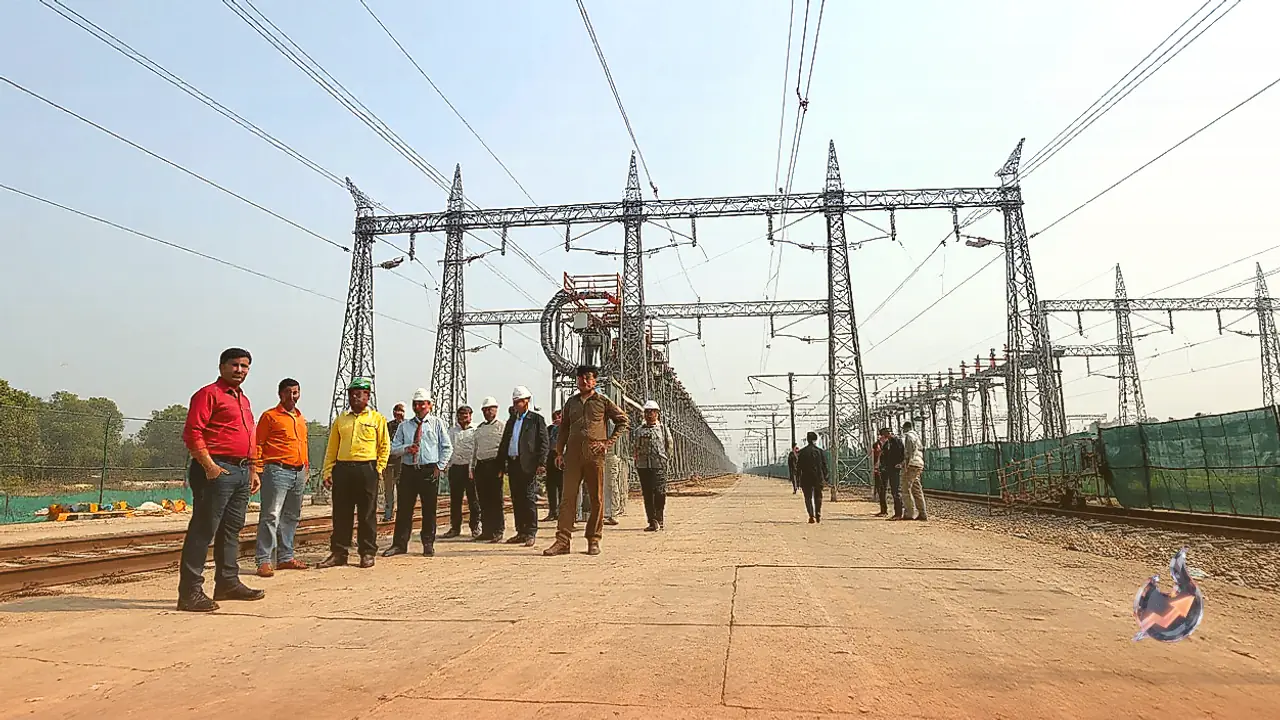
Covering a plot of roughly 18,000 square meters, the Bilimora facility has wrapped up the bulk of its primary civil structures. Site operations have shifted toward technical verification, systems testing, and final commissioning. Specialized housing units have already received circuit breakers, control panels, changeover switches, and large power transformers. Furthermore, structural field requirements across the yard, including the erection of all overhead gantry beams and metal towers, are fully finished as engineers prepare to energize the equipment.
Network Distribution Across Gujarat and Maharashtra
The electrified rail corridor will draw from 14 dedicated traction points divided across the two participating states, allocating 9 facilities to Gujarat and 5 to Maharashtra. The Maharashtra alignment covers strategic sites at Mumbai, Thane, Virar, Boisar, and the dedicated Thane Depot. Meanwhile, the Gujarat segment extends electricity feeding points through Vapi in Valsad district, alongside Bilimora, Surat, Bharuch, Vadodara, Anand, Mehmedabad, Ahmedabad, and the Sabarmati Depot. This coordinated distribution ensures balanced electrical loads and eliminates single points of failure across the broad regional route.
Power Distribution Mechanism via 2×25 kV System
Electricity feeding the Gujarat section originates from the Gujarat Energy Transmission Corporation Limited (GETCO) 220 kV Ambetha grid substation. Incoming power will undergo stepping down and precise regulation inside the trackside substations using a dedicated 2×25 kV traction power system. Regulated energy flows directly out to the overhead equipment lines suspended directly above the tracks. High-speed rolling stock equipped with pantographs will maintain physical sliding contact with these catenary wires, drawing the high wattage necessary to achieve and sustain modern bullet train velocity.
Continuous Supervision from Central Control Facility
A central operations facility will manage the entire electrification layout through real-time telemetry and remote supervision. Technicians will continuously observe grid stability, load balancing, and circuit safety to prevent operational bottlenecks or unexpected service interruptions. Spanning 508 kilometers between urban nodes in Maharashtra and Gujarat, this 14-node electrical array forms the core powering backbone essential for launching and operating the nation's high-speed rail journey.