






















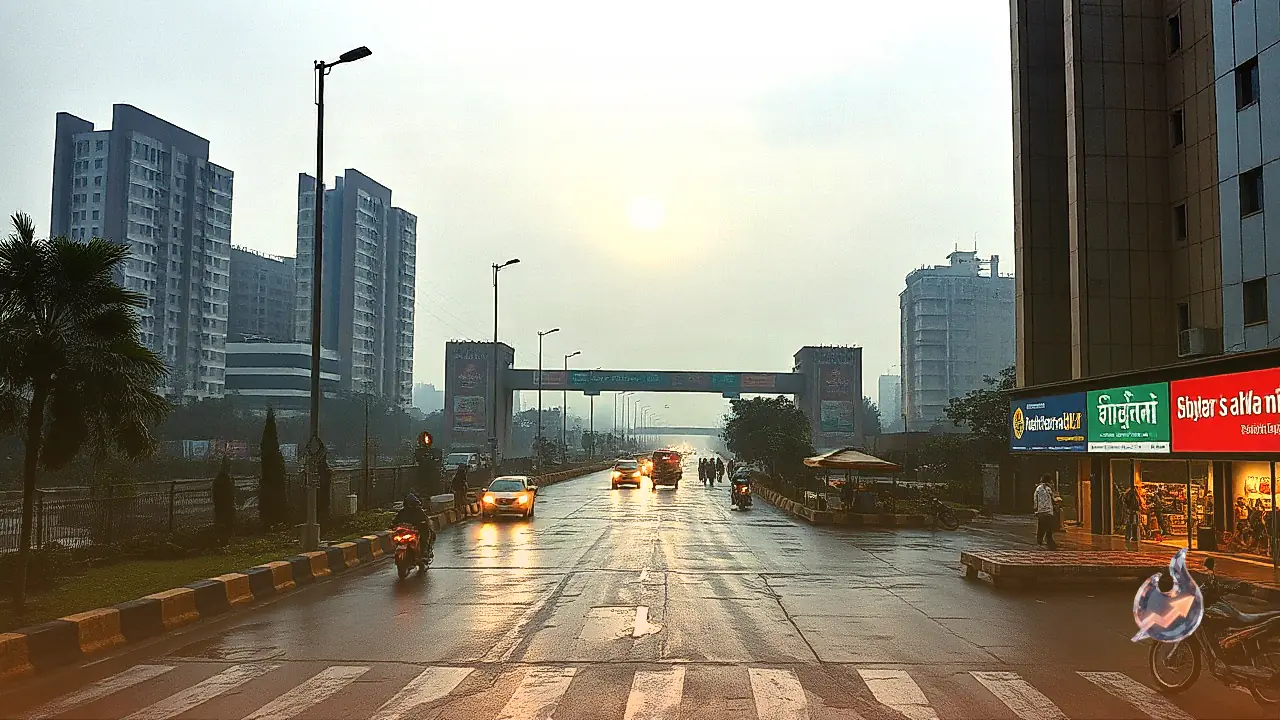

Air pollution has returned swiftly across the National Capital Region following the cessation of monsoon rain, creating severe respiratory discomfort for residents well before the end of September. The sudden accumulation of suspended particles in the atmosphere has spiked pollution levels across multiple cities. Interestingly, satellite urban hubs such as Greater Noida and Gurugram are witnessing even higher pollution concentrations than the heart of Delhi, leaving people struggling with heavy breathing and irritation.
Greater Noida Records Severe Spikes Across Institutional Sectors
Data released by the Central Pollution Control Board indicates that a thick blanket of haze enveloped the National Capital Region almost immediately after precipitation stopped. On September 21, Greater Noida recorded an overall AQI hovering near 300. The situation was particularly alarming in the Knowledge Park-5 vicinity, where the air quality index jumped to 330, officially placing the locality in the 'very poor' air category. Knowledge Park-3 was not far behind, logging an index of 209 in the 'poor' bracket. These numbers reflect significant health hazards, especially for vulnerable individuals dealing with pre-existing pulmonary vulnerabilities.
Dry Conditions and Clear Skies Elevate Delhi Pollution Readings
According to the latest meteorological projections from the India Meteorological Department, the capital's weather is slated to stay largely clear and dry over the coming days, with no rainfall expected on the horizon. The sky is projected to remain largely unobstructed with minimal temperature fluctuations. However, this lack of atmospheric washout has aggravated environmental conditions. Delhi Pollution Control Committee readings show that Chandni Chowk climbed to an AQI of 235, followed by Anand Vihar at 208 and Bawana at 203. Other monitoring stations across the capital also showed elevated levels, including Commonwealth Sports Complex at 162, Burari Crossing at 159, CRRI Mathura Road at 159, and Aya Nagar recording 127.
Ghaziabad Neighborhoods Experience Deteriorating Air Indices
The adjoining district of Ghaziabad is experiencing a parallel drop in environmental air standards across several major residential belts. Official measurements put the AQI in Loni at 203, while Vasundhara touched 187 and Indirapuram recorded 186. Monitoring units in Ved Vihar-Loni marked 171, Sanjay Nagar logged 164, and Govindpuram registered 123. The prevailing dry spell across NCR is facilitating the rapid entrapment of micro-pollutants close to the ground. Without active precipitation to cleanse the troposphere, dust and vehicular emissions are remaining suspended, pushing broader zones of Delhi, Ghaziabad, and Greater Noida firmly into 'poor' and 'very poor' classifications.