

















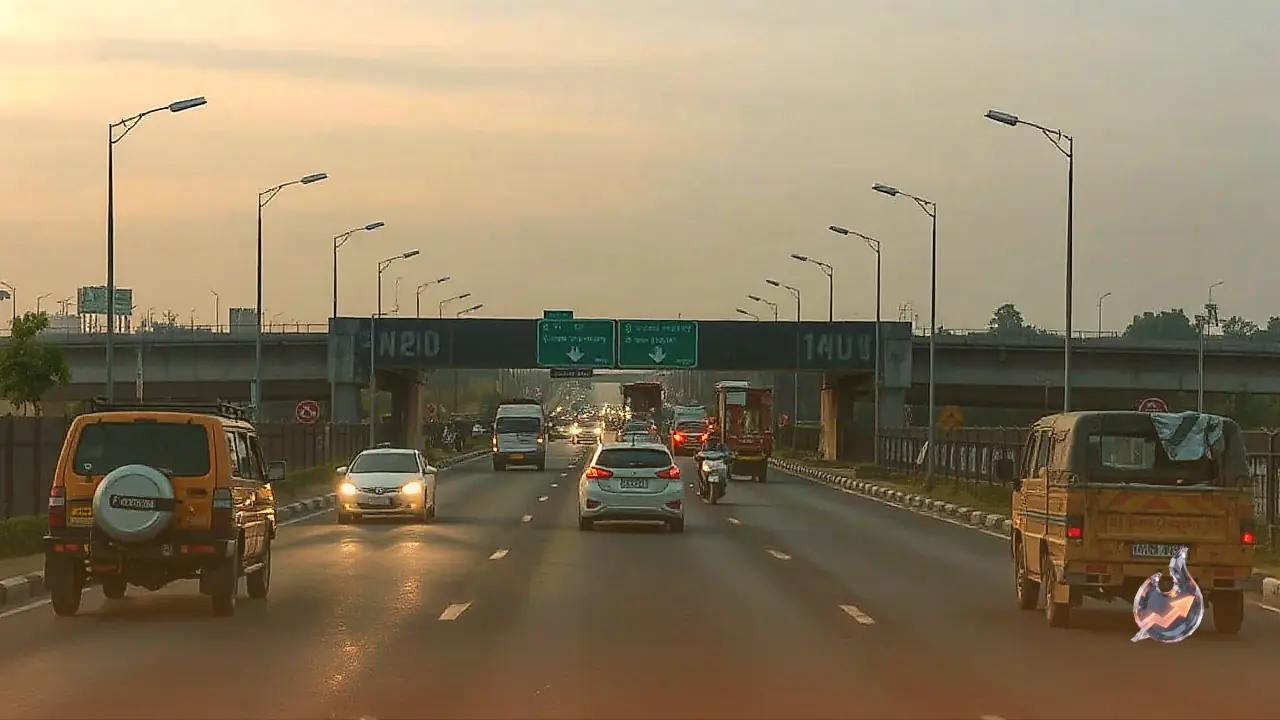

Ahead of the scheduled rollout of the third phase of the Barapullah elevated corridor in the national capital, transport authorities have put in place major traffic diversions on key road networks serving southern and eastern Delhi. Movement from the Delhi-Mumbai Expressway toward the Sarai Kale Khan exit has been completely suspended. Due to this closure, commuters heading into this transit hub from the expressway are compelled to take an alternate route that extends travel distances by roughly 11 kilometres. The revised arrangement has been instituted on a temporary basis until September 29, after which official assessments will determine permanent protocols following the elevated corridor's inauguration.
Traffic Diversions via Madanpur Khadar to Ease Sarai Kale Khan
Sarai Kale Khan stands as one of Delhi's most congested and structurally overburdened transit intersections. To prevent catastrophic traffic buildup when the Barapullah Phase-3 link opens, traffic police blocked the expressway exit to restrict direct vehicular flow into the junction. Incoming vehicles travelling along the Delhi-Mumbai Expressway are now diverted prior to the exit, rerouted through Madanpur Khadar toward Kalindi Kunj. This diversion has significantly intensified vehicular volume along the already congested Kalindi Kunj belt.
Defending the move, a traffic official stated, “Traffic is being diverted towards Kalindi Kunj. This might increase the pressure there, but traffic will not increase at a sensitive junction like Sarai Kale Khan.”
Inauguration Set for September 29
Designed as a signal-free elevated expressway, the Barapullah Phase-3 project creates a seamless bypass linking Mayur Vihar Phase-1 in East Delhi straight to Sarai Kale Khan. The protracted infrastructure project is set for its official opening on September 29. Union Home Minister Amit Shah and Delhi Chief Minister Rekha Gupta will be present during the inaugural event. Once active, the corridor is expected to provide fast-moving transit for travellers commuting across southern and eastern pockets of the city.
Traffic planning personnel note that while Barapullah Phase-3 could ease passage for vehicles moving between South Delhi and Mayur Vihar, that decongestion hinges upon keeping the expressway's Sarai Kale Khan exit barricaded. Permitting expressway commuters to exit simultaneously onto the junction would multiply vehicle counts beyond the intersection's carrying capacity.
The 14-Lane Bottleneck at Sarai Kale Khan
The core structural crisis at Sarai Kale Khan stems from the convergence of five high-speed corridors. Traffic feeding into this single interchange arrives via the Barapullah corridor, Outer Ring Road coming through Maharani Bagh and Ashram, the Delhi-Mumbai Expressway, and the Delhi-Noida Direct Flyway. Furthermore, vehicular streams connected to National Highway-9 and National Highway-24 must also cross through this intersection.
Within an extremely compressed stretch of roughly 200 metres, 14 lanes of high-speed traffic are abruptly funnelled into a narrow three-lane flyover. This massive reduction in capacity creates an unavoidable bottleneck, frequently causing traffic jams that stretch for several kilometres during peak commuting periods.
Traffic Shifts Following Delhi-Mumbai Expressway Launch
Since portions of the Delhi-Mumbai Expressway were opened to regular traffic in August, regional vehicular patterns have transformed considerably. Commuters travelling between Faridabad and Noida previously relied on the Kalindi Kunj arterial corridor, but the majority shifted toward the Delhi-Noida Direct Flyway route. This sudden migration pushed intense traffic straight into the mouth of Sarai Kale Khan.
The absence of dedicated loops and slip roads connecting the varied elevated corridors compounds these challenges. Motorists navigating from Faridabad toward Noida frequently need to execute complete U-turns at either Maharani Bagh or Sarai Kale Khan, generating multiple conflict zones where streams of vehicles interlock and stall movement.
Long-Term Widening Measures Proposed to PWD
Under the interim system, vehicles retain the ability to ascend onto the Delhi-Mumbai Expressway from Sarai Kale Khan, but outbound descents remain strictly blocked, pushing exiting cars 11 kilometres out toward Madanpur Khadar. To address chronic congestion over the longer term, the Public Works Department has been asked to widen the road stretch linking Maharani Bagh to Sarai Kale Khan. Additionally, urban planners have proposed expanding the existing three-lane Sarai Kale Khan flyover into a five- or six-lane elevated structure, though timelines for the execution of these upgrades remain under review.