
















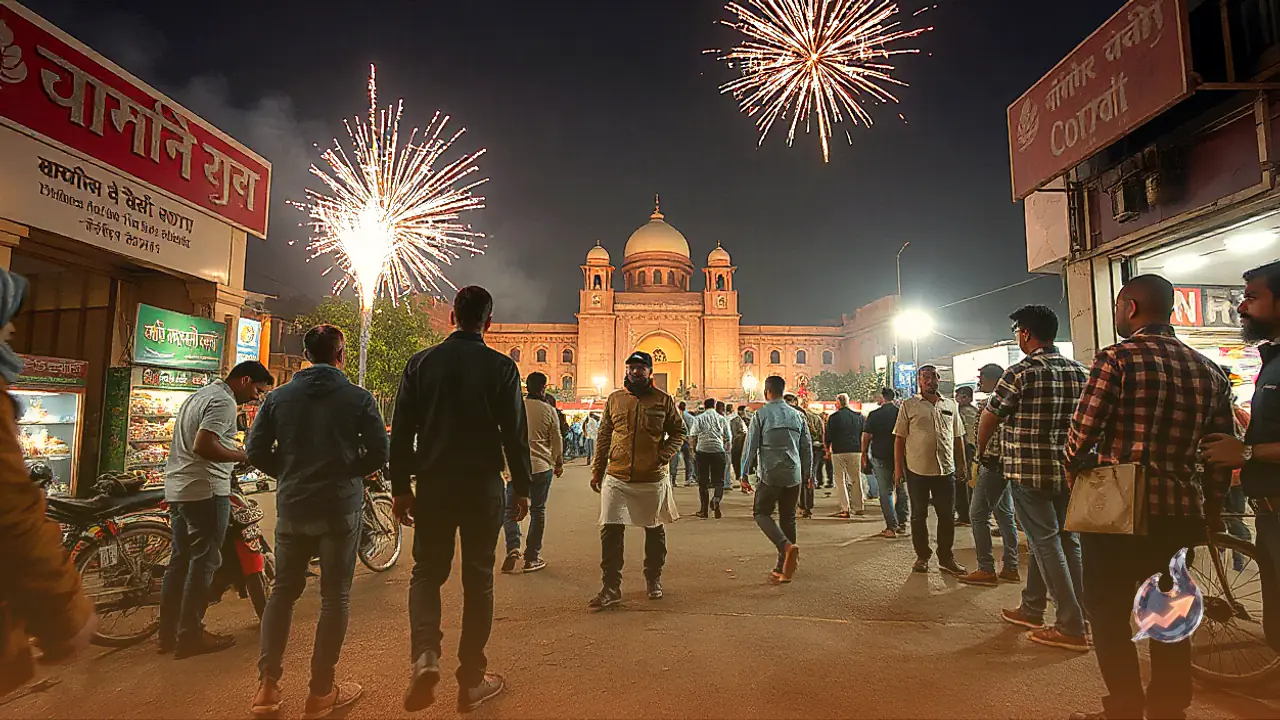

Deeply disturbed by widespread reports of fireworks flooding market stalls across the national capital in defiance of judicial restrictions, the highest court stepped in with stern instructions. Taking up the matter on Tuesday, 3 November 2026, a bench comprising Justice MM Sundresh and Justice Prasanna B Varale emphasized that open disobedience of judicial mandates would not be overlooked. The judges instructed Additional Solicitor General Aishwarya Bhati to review the alleged ground-level infractions immediately and initiate necessary corrective measures. The bench stressed that finding the market awash with unauthorized firecrackers right after its comprehensive orders of Monday, 2 November, was an unacceptable development.
Court Demands Action Over Widespread Counter Violations
During the courtroom exchange, Justice Sundresh drew the law officer's attention to visual evidence and disclosures demonstrating that shopkeepers were actively distributing all grades of fireworks regardless of regulatory compliance. The bench noted that unapproved inventory was being pushed without functional QR codes and without lawful vendor licensing.
Directing the law officer to take charge of the crisis, Justice Sundresh observed, "License or no license, QR code or no QR code, everything is available. Please look into this." The courtroom admonition followed revelations that conventional high-polluting fireworks were being circulated surreptitiously under the pretense of environmentally benign merchandise.
Two-Day Window and Strict Standards Laid Out in Previous Order
The bench had previously formulated a calibrated framework on 2 November to balance festive celebrations with ambient air quality concerns across Delhi-NCR. Under that arrangement, retail counters were authorized to vend authenticated green crackers exclusively between 4 November and 6 November. Residents were granted permission to set them off only across a two-day festive window spanning 7 and 8 November. The allowable hours were strictly confined to two daily slots: between 6:00 am and 7:00 am, and later in the evening from 8:00 pm to 10:00 pm. From 9 November onward, a total and blanket prohibition was scheduled to return automatically across the entire territory.
Compliance guidelines dictated that manufacturers and retailers could handle only products certified jointly by the Petroleum and Explosives Safety Organisation (PESO) along with the Council of Scientific and Industrial Research - National Environmental Engineering Research Institute (CSIR-NEERI). Stock lacking verified certification from both statutory bodies was deemed contraband.
Curbs on Online Portals, Serial Strings, and Toxic Additives
Judicial directions had also strictly prohibited retail operations outside designated municipal zones and placed a complete ban on transactions processed through digital e-commerce channels. Packaging rules required a distinct, product-specific QR code on every carton to enable buyers to confirm product legitimacy on the spot. Furthermore, the authorities placed an outright ban on interconnected fireworks strings (laris) as well as any chemical compositions utilizing hazardous barium salts.
Commercial Hubs Reveal Severe Enforcement Gaps
Spot checks conducted across critical trading hubs including Sadar Bazar, Chandni Chowk, Shastri Nagar, Sarojini Nagar, and New Friends Colony on 22 October and 2 November revealed widespread evasion of legal protocols. Storefronts displayed items marked as green, pollution-free, or zero-pollution, yet conventional varieties remained readily available beneath the counter whenever patrons requested them.
Inspections showed that several consignments entirely lacked mandatory QR stickers, while other packages featured barcodes that redirected smartphone scanners to simple commercial product catalogs instead of official testing certificates. Merchants kept unauthorized inventory tucked out of plain sight, retrieving it selectively for eager shoppers.
Judicial Frustration Over Institutional Lapses
Addressing persistent petitions on regional air quality, the Supreme Court acknowledged that past blanket bans had faltered in suppressing the underground trade of hazardous pyrotechnics. The bench voiced serious concern that toxic formulations continue passing into circulation masked under the green banner, highlighting that enforcement bodies have repeatedly fallen short in implementing judicial directives effectively.