

















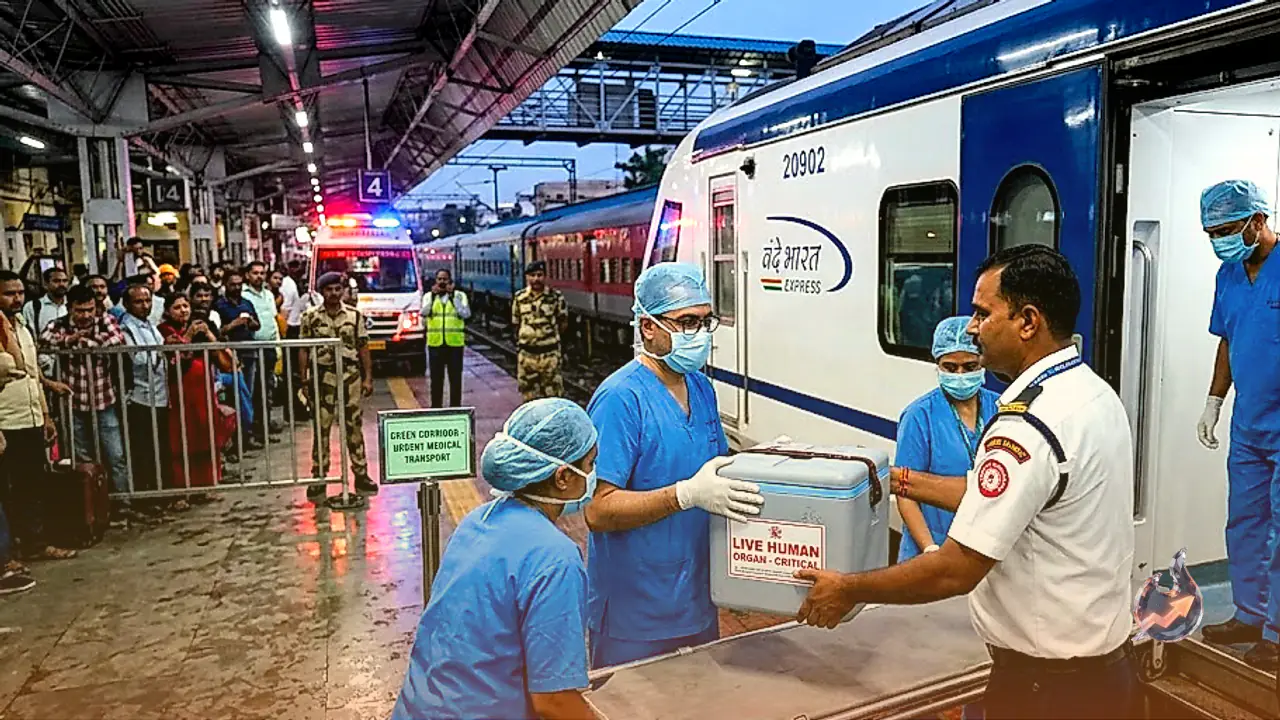

In an unprecedented medical and logistical accomplishment, Indian Railways has achieved a historic milestone by transporting a live human heart aboard a high speed passenger train. Traveling at speeds of up to 160 km/h, the Vande Bharat Express successfully carried the vital organ from Surat to Ahmedabad in Gujarat, racing against time to save a patient's life. The multi-agency operation required flawless execution and coordination between railway personnel, security forces, and medical experts. Thanks to a seamless green corridor and the train's swift transit, the heart was delivered safely within the strict critical timeframe needed for a successful organ transplant surgery.
A Race Against Time Between Surat and Ahmedabad
The life saving mission took place on the Mumbai Central to Gandhinagar Capital Vande Bharat Express (Train No. 20901). Operating along its designated route, the high speed train carried the beating human heart under specialized medical supervision from Surat to Ahmedabad. Upon arriving punctually at its destination, the organ was immediately transferred into a waiting medical vehicle. It was then transported straight to the U.N. Mehta Institute of Cardiology and Research Center, where a surgical team was fully prepared to execute the complex heart transplant procedure on an admitted patient. In organ transplantation, even the slightest delay can compromise viability, making the train's speed and reliability crucial to the mission's ultimate success.
Flawless Coordination and Green Corridor Execution
Organ transport operations demand absolute precision where every single minute counts. This mission succeeded due to intense collaborative efforts involving Indian Railways, the Railway Protection Force (RPF), Gujarat State Police, specialized medical teams, and organ transplant coordinators. As soon as Vande Bharat Express pulled up at Platform No. 1 of Ahmedabad Railway Station, uniformed personnel from the RPF and local police established a fully clear green corridor stretching from the platform all the way to the U.N. Mehta Institute. The ambulance navigated the route without encountering any traffic obstructions, enabling doctors to initiate the intricate surgical procedure without losing valuable time.
Why Vande Bharat Express Was Selected for the Mission
Railway administration officials highlighted that selecting the Vande Bharat Express to transport the live organ proved to be the most effective decision under emergency circumstances. Key factors influencing this choice included the train's top operating speed of 160 km/h, its exceptional punctuality record, advanced ride stability, and onboard modern amenities. Unlike road transport, which can face unpredictable congestion, the high speed rail corridor offered a guaranteed and rapid transit timeline. This successful endeavor demonstrates that the national rail infrastructure can extend far beyond standard passenger travel and freight movement, serving as a vital asset for urgent medical logistics during critical life saving scenarios.
Official Statement from DRM Ahmedabad Ved Prakash
Expressing deep pride in the achievement, Divisional Railway Manager (DRM) of Ahmedabad Ved Prakash described the event as a monumental moment for Indian Railways. Ved Prakash stated that it is a matter of immense satisfaction that a live heart could be transported safely and on time from Surat to Ahmedabad aboard the Vande Bharat Express. He emphasized that in life saving operations of this nature, every second carries immense weight. He credited the seamless synergy among railway staff, RPF personnel, police officers, and medical specialists for accomplishing the goal. Assisting in saving a human life, he noted, represents not just an official duty, but the highest service toward humanity.
Opening New Horizons for Emergency Medical Logistics
The triumph of this maiden transport mission opens up brand new possibilities for using India's expanding high speed rail network in emergency healthcare and organ transit. As high speed corridors continue to connect major urban centers across the country, rail transport offers a reliable, weather independent, and cost effective alternative for moving organs rapidly between cities. The successful coordination established between Surat and Ahmedabad sets a benchmark for future inter-city medical logistics operations across the nation.