



















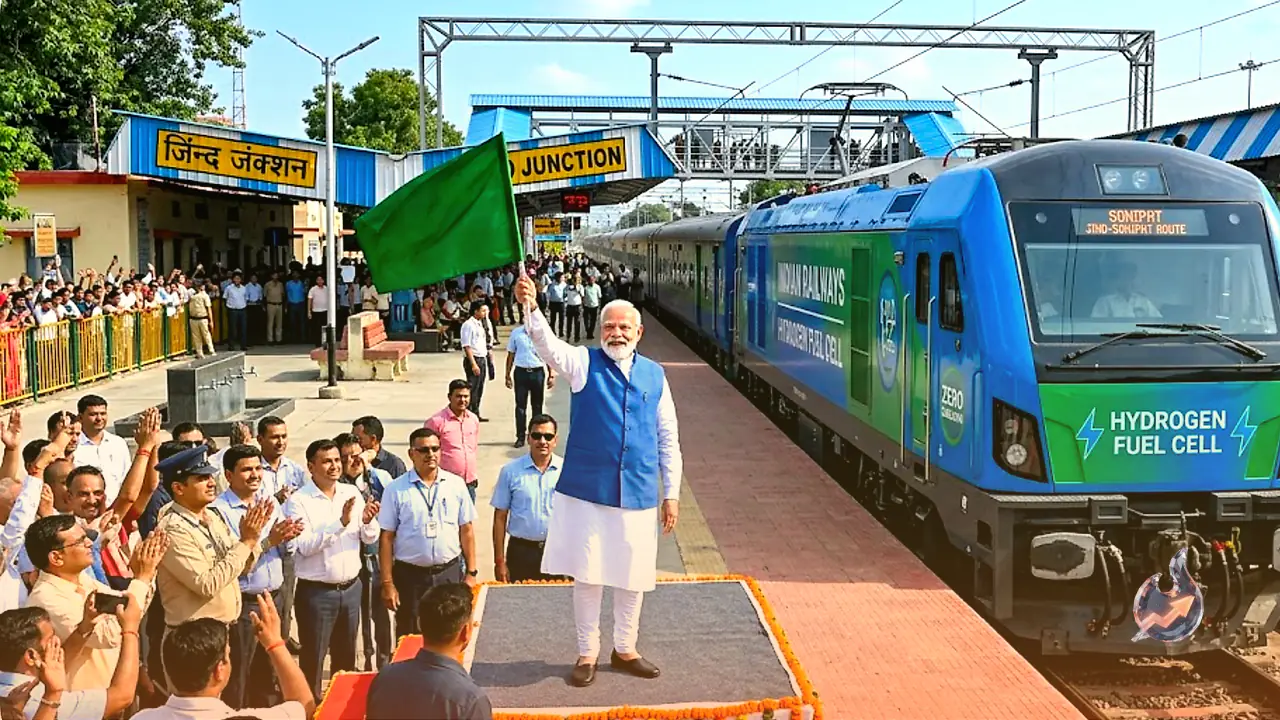

Indian Railways is about to write a fresh chapter in its history. On July 17, the country's first hydrogen-powered train will roll onto the tracks, and it will begin its journey in Haryana. The train will run between Jind and Sonipat, and Prime Minister Narendra Modi will flag it off. What makes it stand out is that it runs on hydrogen fuel cell technology, which means its pollution levels will be almost zero. It is being seen as a major win for India's green transport mission and the Make in India campaign.
For the everyday commuter, the biggest relief lies in the fare. The journey has been kept remarkably cheap, with passengers paying a minimum of just ₹5 and a maximum of ₹25. The train will cover roughly 90 kilometres in only one hour. At present, the same route takes about two hours to complete on a DMU train, so the time saved is direct and real. In a single trip, the train will be able to carry around 2,500 passengers.
Runs on hydrogen, releases no smoke at all
The train is fitted with a 1200 kilowatt hydrogen fuel cell propulsion system. It needs no diesel at all. Instead, a chemical reaction between hydrogen and oxygen generates electricity, and that is what powers the train. This entire process gives off only steam and heat, which means there is no smoke and no carbon emission. On a single fill of hydrogen, the train can travel about 250 kilometres, which makes it useful for longer routes as well.
Safety arrangements given full attention
Even with this new technology, no shortcuts have been taken on safety. The train carries around 27 hydrogen cylinders. To sound a warning before any danger, it has been equipped with a hydrogen leakage detector, a fire detector and a modern control system, all of which will be checked regularly. The train was designed by the RDSO in Lucknow, while it was manufactured at the Integral Coach Factory (ICF) in Chennai. From design to build, it is a clear example of Indian engineering.
A big step towards green transport
Built at a cost of about ₹89 crore, this train is being called a historic achievement for Indian Railways. If the project succeeds as hoped, hydrogen trains could soon run on other routes across the country too. This would cut dependence on diesel, save fuel and lay a strong foundation for protecting the environment. All in all, July 17 is set to go down in the history of Indian Railways as a clean and fresh new beginning.