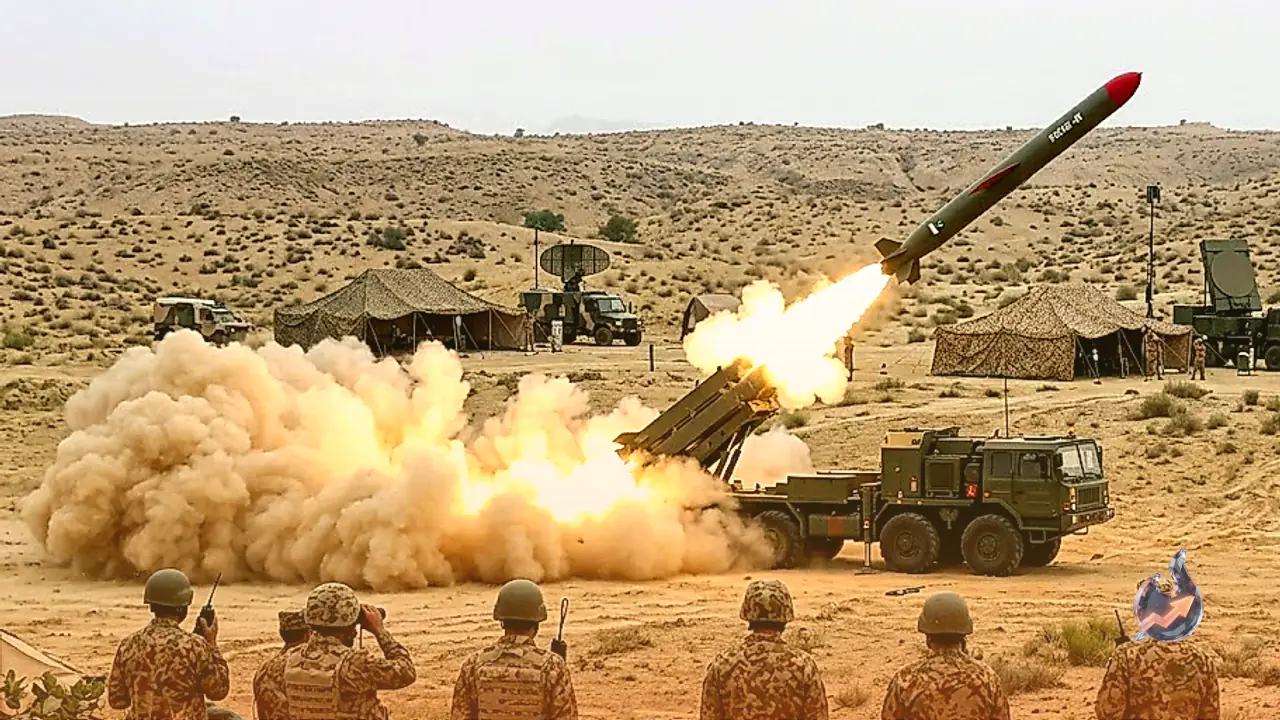























Pakistan's aviation authorities have issued a Notice to Air Missions (NOTAM) restricting all flight operations across an expansive 750-kilometer corridor of airspace for August 19 and August 20. While the official notice does not specify the explicit reason for closing such a massive air corridor, defense experts have taken sharp notice of its unusual geographic length and timing. The unexpected scale of the restriction has triggered wide speculation among military analysts regarding a potential live test of an advanced long-range missile or rocket artillery system.
Unusual Airspace Corridor and Potential Long-Range Testing
Temporary airspace closures for routine military exercises are not uncommon in the region. However, restricting a continuous 750-kilometer stretch of airspace is a rare development that naturally draws international attention. Closing an air corridor of this magnitude strongly suggests that Pakistan may be preparing for high-altitude or long-range weapon system activities. While authorities have not officially confirmed the precise nature of the operation, military observers note that such extensive coverage is typically required for testing systems capable of reaching extended distances. It remains unconfirmed whether this scheduled event focuses on a specific missile capability or forms part of a broader multi-arm military exercise.
The Fatah Missile Family and Strategic Precision Capabilities
Central to the ongoing speculation is Pakistan's Fatah missile series, which forms a key component of its efforts to enhance conventional precision-strike firepower. Defense analysts frequently track the developments within this missile family, where Fatah-1 and Fatah-2 are already established and recognized for their tactical roles. Reports regarding a Fatah-4 variant have also surfaced previously in strategic discussions. Furthermore, while Pakistan has officially announced the development of Fatah-3 and Fatah-5, public information regarding their specific operational parameters and guidance technologies remains minimal. The current 750-kilometer airspace restriction has heightened expectations that Pakistan may be using this window to evaluate a newer or upgraded variant within the Fatah series.