



















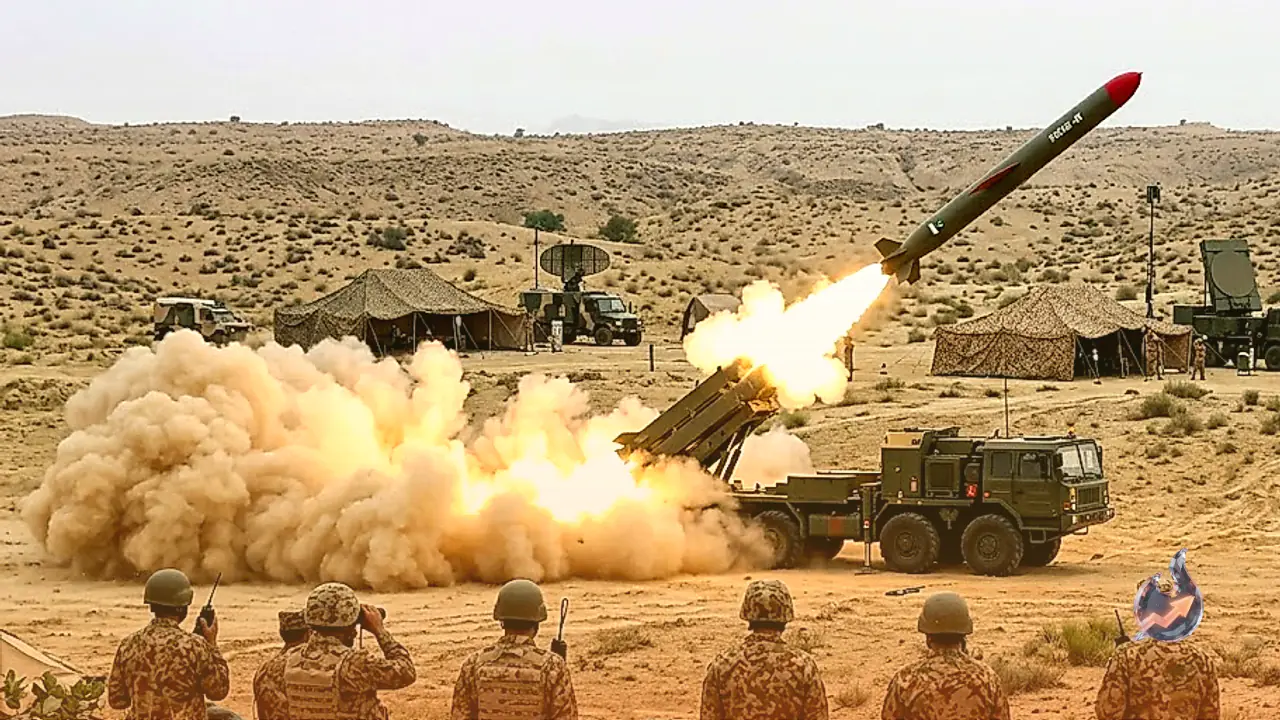

Struggling with severe financial insolvency, spiralling inflation, and widespread civil strife, Pakistan has conducted a fresh test of its upgraded Fatah-4 missile in an effort to project military capability. Coming in the wake of the severe setbacks suffered during Operation Sindoor and the extensive damage felt right up to Rawalpindi, the country's military leadership has turned once again to weapon trials to distract domestic public opinion. Despite an empty national treasury and recurring pleas for international bailouts, substantial financial resources continue to be diverted into missile experiments, even as defence experts point out that the system stands little chance against India's integrated multi-layered air defense grid anchored by the S-400 Triumf.
Pakistan's Publicised Claims Over the Fatah-4 Test
The media wing of the Pakistan armed forces, ISPR, made elaborate assertions regarding the performance of the upgraded weapon system. Official communications highlighted that this extended version incorporates enhanced operational range, upgraded avionics, and a modernized navigation suite. Following the launch, congratulatory messages were extended to scientists and military technicians by Pakistan's President, Prime Minister, and Chief of Army Staff. State media portrayed the event as a monumental technological milestone, although independent strategic analysts view the celebration primarily as a calculated move to mask the harsh economic and political realities facing the populace.
Technical Specifications and Defence Experts' Scrutiny
The Pakistani military has characterised the Fatah-4 as a sophisticated ground-launched cruise missile, emphasising several core performance parameters
- Extended Range and Targeting: Military spokespersons assert that the updated version can bypass adversarial air defense radars to deliver strikes across deeper distances.
- Advanced Navigation and GPS: The missile reportedly incorporates updated GPS receivers and terrain-following navigation to maintain low-altitude flight profiles and avoid radar detection.
- Satellite Guidance Capability: The system is said to feature terminal satellite guidance, allowing course corrections during the final approach to execute precision strikes.
Despite these official claims, international and regional defense specialists offer a far more measured assessment. Observers point out that the key guidance packages, airframe components, and avionics integrated into the missile system rely heavily on Chinese supply lines and borrowed technical blueprints. Without ongoing technical support, spare parts, and manufacturing equipment from China, Pakistan's domestic missile production infrastructure cannot maintain sustained independent operations.
S-400 Triumf and India's Layered Defense Architecture
The deployment of the S-400 Triumf air defense system by the Indian Air Force presents a virtually insurmountable obstacle to cruise missiles such as the Fatah-4. The vast performance disparity between the two systems is visible across multiple technical areas
- Long-Range Radar Acquisition at 250 to 400 km: The advanced radar suites of the S-400 are designed to detect, track, and lock onto incoming low-flying cruise missiles from distances between 250 and 400 kilometres, providing ample early warning and engagement windows.
- Hypersonic Mach 12 Interceptors: Subsonic and low-supersonic cruise platforms cannot match the closing speeds of hypersonic interceptors flying at Mach 12. A single interceptor from an S-400 battery is fully capable of destroying incoming projectiles in mid-air long before they breach Indian airspace.
- Layered Air Defense Network: In addition to the long-range S-400 umbrella, India operates an interconnected defensive shield featuring the Akash, Barak-8, and indigenous Ballistic Missile Defence (BMD) systems, leaving virtually no exploitable gaps for conventional cruise missiles.
Severe Economic Insolvency and Internal Instability
The decision to pour tens of millions of dollars into missile development comes at a time when Pakistan remains dependent on emergency loans from the International Monetary Fund (IMF) merely to keep essential public services operational. Ordinary citizens across the country face severe shortages of staple food items, flour, cooking fuel, and reliable electricity. Simultaneously, the internal security landscape has deteriorated sharply, with active insurgencies led by the BLA in Balochistan and the TTP across northwestern sectors continuously inflicting losses on Pakistani army personnel and officers. Directing state funds toward military posturing rather than basic economic survival underscores deep governance contradictions.
Three Underlying Motives Behind the Launch
Political and military analysts identify three primary strategic motivations driving this latest weapon display
- Distracting Domestic Attention: Diverting public anger away from the humiliation of Operation Sindoor and the collapsing standard of living through state-sponsored military spectacles.
- Rebuilding Military Credibility: Bolstering the dented institutional reputation of the army leadership following multiple internal and external security failures.
- Coercive Geopolitical Posturing: Projecting an image of military capability to global stakeholders in order to extract continued economic assistance and stave off bankruptcy.
Strategic experts maintain that regional deterrence and modern warfare are dictated by industrial depth, economic resilience, and domestic innovation rather than foreign-sourced components and rhetorical claims. India continues to maintain an uncompromising posture regarding the defense of its territory, backed by comprehensive air defense readiness.