



















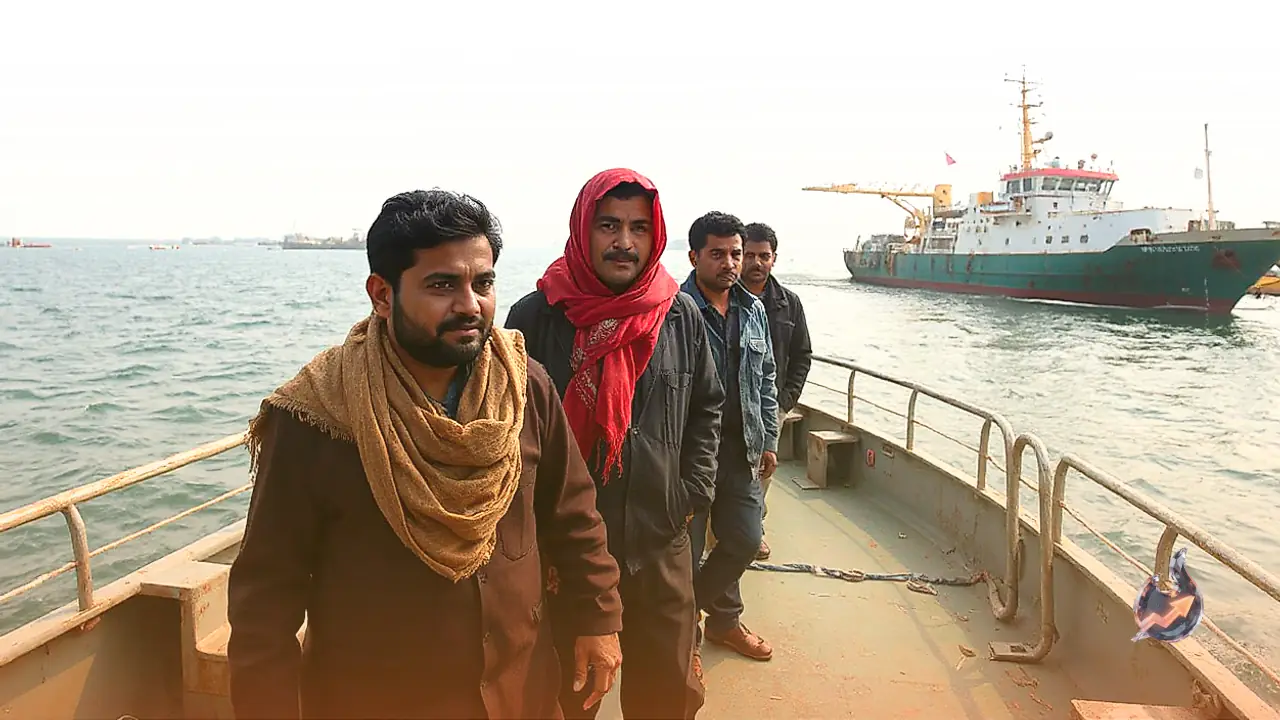

Six Indian nationals have remained stranded aboard an Iranian general cargo vessel docked at Karachi port for the past seven months under severe living conditions. Caught in an unresolved commercial dispute between an Iranian shipping operator and Karachi port authorities, the crew members are confined to the ship without power, facing critical shortages of food and water while their travel documents remain withheld by local authorities.
Voyage Route from Oman to Karachi and Subsequent Vessel Seizure
Vineet Kishore Mishra, a 35-year-old Chief Officer from Prayagraj in Uttar Pradesh with a decade of merchant navy experience, joined the Iranian cargo vessel KEVER on 25 February 2026. The ship sailed through regional maritime corridors connecting Iran and Oman before arriving at Karachi port on 17 April 2026.
Mishra and five other Indian crew members were employed under a standard six-month contract that officially concluded in August 2026. Under standard seafaring procedures, the completion of this contractual period meant they were due for sign-off and repatriation to India. However, following the ship's docking, port authorities initiated legal and administrative action against the vessel over a pre-existing commercial dispute with the Iranian shipping company. The port administration seized the vessel, impounded all crew passports and Continuous Discharge Certificates (seaman books), and placed a strict embargo preventing crew members from going ashore.
Extended Blackout and Depletion of Basic Living Provisions
As the legal standoff dragged on, conditions on board rapidly deteriorated due to an administrative cutoff of shore utilities and the exhaustion of onboard fuel supplies. The ship has now spent three continuous months in a total blackout state.
Without electrical power, all onboard fans, air conditioning, and ventilation equipment are completely non-functional, leaving the six Indian mariners confined within dark, humid metallic cabins. Provisions on board have reached near-depletion levels. Daily rations have dwindled to just two biscuits each morning, with late meal distribution seeing lunch served at approximately 4:00 PM and dinner around 11:00 PM.
Telecommunications connectivity remains severely restricted due to the lack of cellular signal on the vessel. When port infrastructure allows brief communication windows every 15 to 20 days, crew members are granted only one or two minutes to speak with their families. Back in India, dependent families, including young children, continue waiting for news of their safe return.
International Maritime Standards and Crew Protection Protocols
The situation highlights critical questions regarding the implementation of international conventions governing the treatment of merchant marine personnel, specifically the Maritime Labour Convention (MLC 2006).
Under accepted international maritime jurisprudence, operating crew members cannot be held legally or practically accountable for commercial disputes or financial defaults arising between ship owners and port operators. Port state authorities maintain a legal obligation to ensure basic humanitarian provisions, including regular food supplies, clean drinking water, adequate power, and medical assistance, are continuously made available to any crew stationed within their waters.
Withholding essential travel identity documents, including passports and seaman books, violates standard maritime rights. International regulations mandate that once an employment contract concludes, local authorities must facilitate the crew's safe disembarkation and repatriation to their home nations, irrespective of pending litigation involving the vessel itself.
Potential Diplomatic Pathways and International Escalation
The prolonged confinement of Vineet Mishra and his fellow crew members has evolved into a sensitive diplomatic matter requiring coordinated external communication across several official channels.
Direct consular engagement represents an immediate diplomatic avenue, with India's Ministry of External Affairs and the Indian High Commission in Islamabad capable of raising the detention with Pakistan's Ministry of Foreign Affairs (MOFA). Formal consular access would allow officials to assess crew welfare directly, supply emergency medicine, fresh provisions, and clean water, and coordinate the return of confiscated paperwork.
Additionally, given the total lack of electrical power and the ongoing threat to life aboard the disabled vessel, international maritime bodies such as the International Maritime Organization (IMO) and the International Transport Workers' Federation (ITF) could be engaged to intervene. Coordinated multi-agency involvement could facilitate formal sign-offs and ensure the crew's repatriation while commercial claims against the shipping company proceed independently.