
























A fundamental shift in aerial doctrine has altered the strategic landscape in South Asia, where the Indian Air Force has developed the capability to engage hostile installations without placing its combat aircraft inside enemy airspace. Known in military terminology as a standoff range air-launched missile doctrine, this approach eliminates the tactical requirement for fighter jets to penetrate hostile air defense umbrellas. Pilots can release precision munitions from hundreds of kilometers away within secure boundaries, targeting military command posts, logistics depots, and reinforced bunkers. To counter this persistent tactical vulnerability, Pakistani defense planners have rushed to institute a three-pronged counter-strategy.
The Core Components of India's Standoff Weapon Arsenal
Over recent years, Indian defense planners have systematically upgraded the nation's air wing with long-range precision weaponry designed to neutralise ground installations from extreme distances. The centerpiece of this inventory is the BrahMos supersonic cruise missile, which delivers destructive payloads across distances ranging from four hundred to over five hundred kilometers. Cruising at three times the speed of sound, its velocity compresses defensive response windows to absolute minimums.
Complementing this capability is the SCALP cruise missile, integrated aboard the Rafale fighter fleet, capable of seeking out and destroying heavily defended enemy assets roughly three hundred kilometers away. The inventory further benefits from Israeli-designed Rampage and Crystal Maze munitions, explicitly tailored to decimate enemy runways, logistics centers, and surveillance radars from distant launch points. India has also operationalised the indigenous Rudram anti-radiation missile, engineered by the Defence Research and Development Organisation (DRDO) to seek out and suppress active hostile emitters and radar installations. By pairing high standoff distance with extreme targeting accuracy, the operational danger to frontline Indian pilots is effectively eliminated while retaining the ability to strike deep inside Pakistani territory.
Pakistan's Three Defensive Rings Explained
In an attempt to offset this technical asymmetry, Pakistan has assembled a three-layered defensive framework resting predominantly on Chinese hardware deliveries and upgraded air defense operational plans.
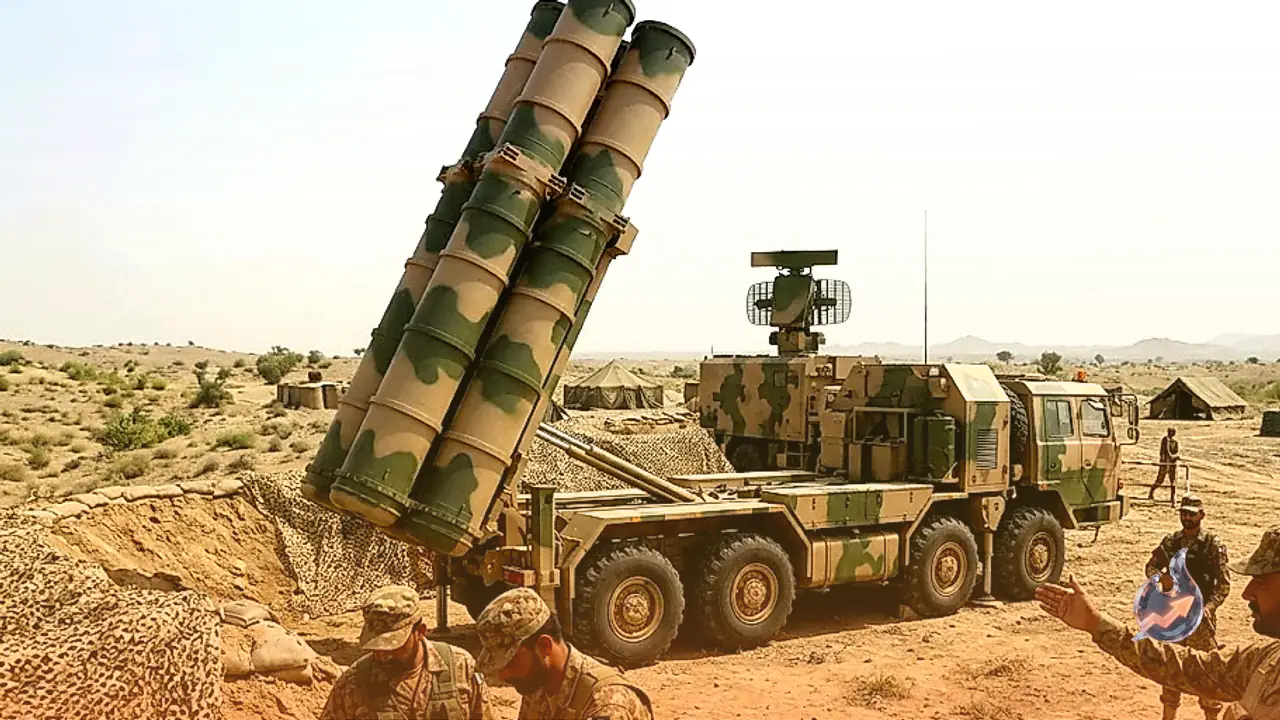
The first defensive layer involves the deployment of long-range surface-to-air missile systems supplied by Beijing. The military establishment has integrated Chinese HQ-9P and HQ-16 air defense systems around key operating airbases, sensitive military installations, and primary urban hubs. The core premise of this deployment is to detect Indian strike fighters operating close to the border corridor at early stages and threaten them with long-range interceptor salvos.
The second countermeasure relies on beyond visual range (BVR) air-to-air missiles mounted on modernised combat aircraft. Pakistan has paired PL-15E missiles with Chinese-supplied J-10CE jets and jointly manufactured JF-17 Block 3 aircraft. Featuring an operational engagement reach reported at approximately one hundred and fifty kilometers, these air-to-air weapons are positioned to deter Indian strike packages from approaching border-adjacent launch baskets.
The third strategic measure focuses on airborne early warning integration and electronic warfare upgrades. Efforts are underway to bolster aerial radar surveillance platforms and expand ground-based electronic jamming networks. The direct operational intent is to disrupt GPS guidance links and data signals governing Indian precision weapons mid-flight, attempting to force incoming ordnance off its programmed trajectory.
Comparative Analysis of Strategic Strike and Defense Capabilities
A rigorous examination of both air services reveals structural differences in technological depth, range, and supply-chain diversity. India deploys a balanced spectrum of standoff weapons including BrahMos, SCALP, Rampage, Rudram, and Astra, covering operational ranges spanning between one hundred and fifty kilometers and well over five hundred kilometers. The guiding operational philosophy focuses on surgical precision with minimal platform exposure, drawing engineering resilience from a diversified base that integrates indigenous DRDO innovations with advanced technologies from France, Israel, and Russia.
In contrast, Pakistan's defensive doctrine relies heavily on PL-15E interceptors and ground-based HQ batteries, confining its primary engagement envelopes to ranges between one hundred and two hundred kilometers. The entire doctrine depends almost exclusively on active interception and electronic jamming countermeasures. Most crucially, Pakistan faces acute supply chain vulnerability, with more than ninety percent of this specific defensive ecosystem dependent on a single supplier, China, limiting technological resilience.
Three Critical Vulnerabilities in Pakistan's Defense Plan
Military analysts highlight that establishing advanced air defense cordons may fail to neutralize India's standoff doctrine and could create significant operational complications for Pakistan.
The foremost hurdle stems from Pakistan's fragile economic standing and persistent financial strains. Modern radar architectures, sophisticated surface-to-air batteries, and precision interceptors demand immense continuous capital expenditures. Given prevailing budget constraints and economic pressure, sustaining, maintaining, and upgrading complex electronics over extended operational cycles presents a massive logistical burden.
The second technical impediment is the sheer velocity of Indian precision munitions. Cruise missiles such as BrahMos travel at Mach 3 speeds, leaving hostile radar operators with only mere seconds to detect, compute, track, and fire interceptors. Intercepting a high-speed target maneuvering through contested airspace within such narrow engagement windows remains an extraordinarily difficult task for existing air defense systems.
The third tactical obstacle is India's saturation strike doctrine. Should Indian forces coordinate multi-axis salvos combining dozens of supersonic cruise missiles, anti-radiation munitions, and decoy assets simultaneously, opposing tracking radars can quickly become overwhelmed by track volume. Sensor saturation degrades automated fire control solutions, leaving high-value assets exposed to catastrophic kinetic damage despite multi-layered defensive preparations.