




















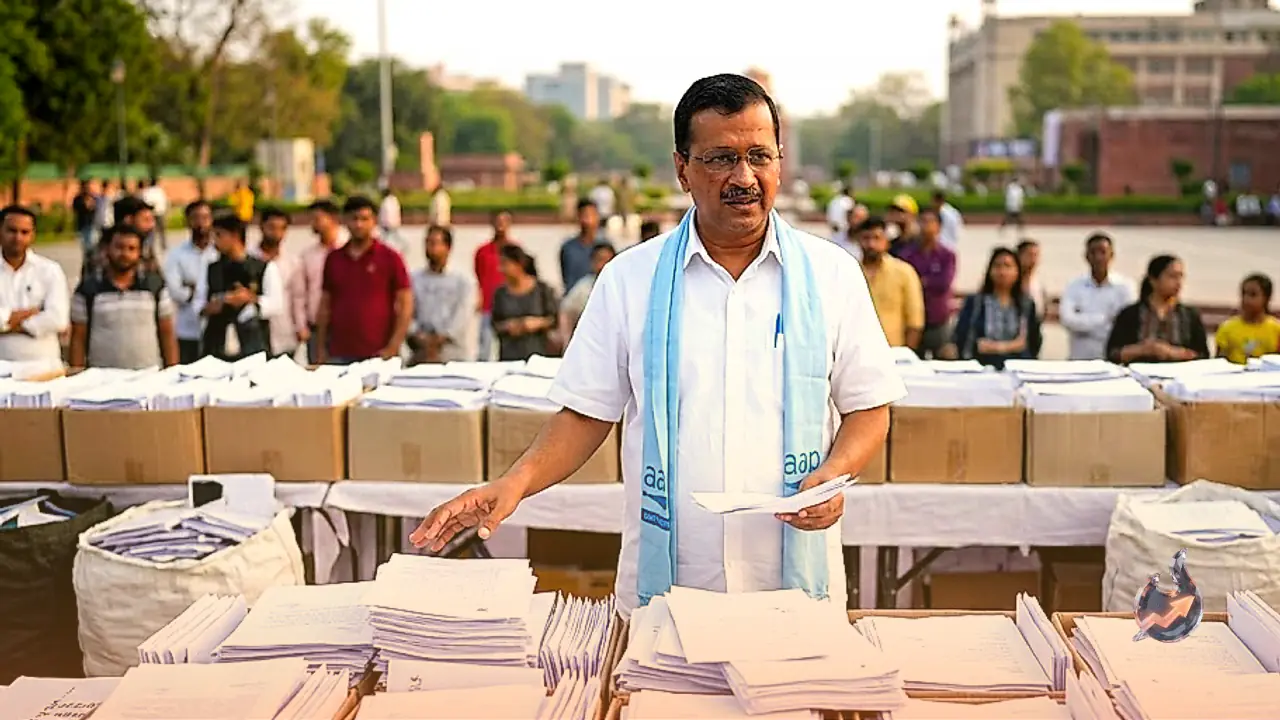

The political conflict over the mandatory implementation of E20 blended petrol in New Delhi has taken a dramatic turn. AAP National Convenor Arvind Kejriwal has escalated his opposition against the central government's fuel policy by announcing a high-profile march to the Prime Minister Residence on Tuesday. Accompanied by approximately 100 representatives, Kejriwal plans to personally deliver over 2 lakh signed letters collected through an extensive online petition launched against E20 petrol. The move signifies a major political push by the party to transform fuel blending technicalities into a broader public debate centered around consumer choice, petrol pricing, and vehicle maintenance costs.
Plan to Visit PM Residence With 2 Lakh Protesting Letters
Arvind Kejriwal clarified that the upcoming delegation to the Prime Minister Residence is far from a mere symbolic political gesture. Instead, it represents the collective voice of more than 200,000 citizens and vehicle owners who actively signed the online petition initiated by AAP. Kejriwal stated that he will lead around 100 delegates to hand over these signed letters directly to the central administration on Tuesday.
The primary objective of this public campaign is to compel the government to address growing citizen anxieties regarding E20 fuel. Vehicle owners across the capital and beyond have expressed deep concern over reduced fuel efficiency, potential engine damage, and unfair pricing mechanisms. AAP maintains that unless the government offers transparent options and consumer-friendly regulations, the party will continue pushing this issue across civic and administrative forums.
Three Main Demands Presented to Central Government
The groundwork for this escalated campaign was laid on August 1 during a massive 'National Town Hall' meeting organized by AAP at the Constitution Club inside Mavlankar Hall in New Delhi. The event drew an overwhelming crowd, completely packing both the upper and lower seating levels of Mavlankar Hall, with large numbers of attendees gathered outside the venue. Addressing the packed hall, Kejriwal outlined three explicit demands addressed to the central government.
- Consumer Choice at Petrol Pumps: The first demand mandates providing clear choices at every fuel station nationwide. Drivers who prefer E20 petrol should be allowed to purchase it, while those opting for pure petrol must be guaranteed access to unblended fuel.
- Reduced Pricing for E20 Petrol: The second demand emphasizes that because E20 petrol contains 20 percent ethanol, its retail price should be significantly lower than that of pure petrol. Charging standard or higher rates for blended fuel is unfair to consumers.
- Capping Retail Petrol at Rs 84 Per Liter: The third demand focuses on international crude oil trends. Citing recent declines in global crude oil prices, Kejriwal demanded that the retail price of petrol in India be reduced below Rs 84 per liter so that citizens receive the direct economic benefit of lower global oil rates.
Ethanol Blending Mechanics and Pre-2023 Vehicle Concerns
E20 petrol refers to a fuel mixture consisting of 80 percent conventional petrol and 20 percent ethanol. While the central government promotes ethanol blending as a measure to curb crude oil imports and save foreign exchange, the policy has sparked widespread apprehension among motorists, particularly those owning vehicles manufactured prior to 2023.
Automotive experts and car owners point out that vehicles built before 2023 were not engineered or calibrated to run on E20 fuel blends. Utilizing 20 percent ethanol petrol in older engines can lead to a noticeable drop in mileage and overall fuel economy. Furthermore, due to the corrosive chemical properties of ethanol, key engine components made of rubber, plastic, and soft metals risk accelerated wear and degradation, ultimately inflating routine vehicle maintenance and repair bills for vehicle owners.
Questions Raised on Environmental Impact and Foreign Pressure
During his press conference, Arvind Kejriwal raised serious questions regarding the financial and environmental viability of the ethanol blending program. He claimed that ethanol production and procurement are actually more expensive than petrol itself, countering government assertions that blending lowers fuel production costs. He further alleged that local farmers are not receiving the financial gains promised under the scheme.
Kejriwal added that official claims regarding foreign exchange savings are misleading. He also highlighted environmental risks, expressing concern over potential groundwater contamination occurring near ethanol processing plants. Questioning why the government is imposing E20 on the public if ethanol is universally beneficial, Kejriwal speculated that external trade pressures, including potential influence from the United States, might be driving the aggressive push for E20, though he acknowledged that no formal documentary proof has been submitted for this specific claim.
Political Outlook and Anticipated Response From the Center
The combination of the well-attended Town Hall at Mavlankar Hall and the planned submission of 2 lakh signed letters to the Prime Minister Residence marks a significant intensification of AAP's political campaign. By focusing on everyday financial burdens such as petrol prices and vehicle longevity, the party aims to resonate directly with middle-class vehicle owners. Attention now turns to Tuesday to see how the central government responds once the 2 lakh petitions reach the Prime Minister Residence.