



















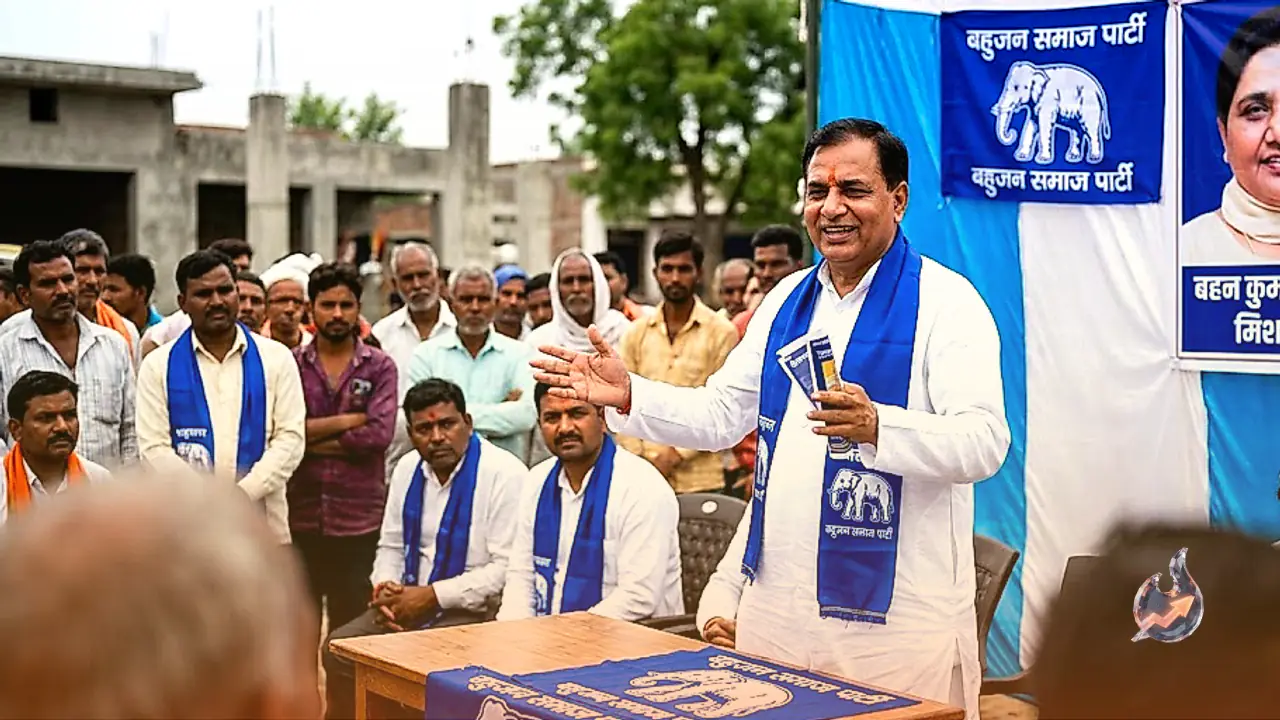

Political maneuvering for the upcoming 2027 Uttar Pradesh assembly elections has already gathered significant momentum across the state. Major political forces including the Bharatiya Janata Party, Samajwadi Party, and Congress are actively trying to recalibrate their respective social equations. Amidst this intense political activity, the Bahujan Samaj Party has dropped a major political hint through its initial candidate announcements. By fielding Brahmin faces successively in Hathras and Kheragarh, Mayawati has once again signaled her focused attention toward the Brahmin electorate. The party has officially declared Neeraj Rawat as its candidate from the Kheragarh assembly constituency in Agra district.
Brahmin Faces From Sadabad to Kheragarh
According to media reports, the Bahujan Samaj Party has nominated Dr. Avin Sharma as its official candidate from the Sadabad assembly seat in Hathras district. On August 10, Akash Anand announced the name of Dr. Avin Sharma during a public political meeting held in Sadabad. Following this development, Neeraj Rawat was named as the party candidate from the Kheragarh seat in Agra. Both constituencies have now seen the deployment of Brahmin candidates, underlining the party's renewed emphasis on this demographic. The announcement regarding Kheragarh was officially made on September 16, following weeks of internal discussions and floating of multiple potential names for the constituency.
Mayawati's Focus on the Brahmin Community
These ticket distributions by the Bahujan Samaj Party cannot be viewed merely as localized candidate selections when connected with Mayawati's recent public statements. Back in June 2026, Mayawati had explicitly stated that the party has begun selecting candidates by keeping the upper castes, particularly the Brahmin community, in primary focus. She also made specific references to the landmark 2007 assembly elections during her addresses. Earlier in May 2026, she invoked the 2007 polls while recalling the party's old political model encompassing all sections of society. According to her statements, the party successfully formed a majority government back then through active participation from Brahmins and various other social groups.
Understanding the political dynamics of 2007 has become crucial in the current context. During those elections within the 403-member Uttar Pradesh legislative assembly, the Bahujan Samaj Party secured a massive victory by winning 206 seats. That particular electoral success is widely regarded as the benchmark of the party's Dalit-Brahmin social engineering experiment. The party successfully bridged its traditional Dalit vote bank with outreach toward Brahmins and multiple other communities. This very coalition became the core narrative behind the party securing an absolute majority. Now, ahead of 2027, Mayawati is frequently invoking that era, emphasizing Brahmin representation and incorporating faces from the community in early candidate lists.
Adapting the Old Formula to a New Context
This is where the real political narrative for the 2027 elections begins to take shape. The core question is not simply about the party giving tickets to two Brahmin faces, but rather whether the party intends to expand its overall social base through this approach. The traditional backbone of the Bahujan Samaj Party has consistently been its Dalit voter base. However, relying on a single social foundation while attempting a massive expansion in state-wide assembly elections remains a formidable challenge. Consequently, distributing tickets to Brahmin candidates serves as part of an ongoing effort to reconstruct the old social alliance within a completely transformed political environment.
Brahmin Politics Involving BJP and SP
The Bahujan Samaj Party is not the sole political player actively courting the Brahmin vote bank in the state. Other prominent political formations in Uttar Pradesh are also aggressively stepping up their outreach toward this influential community. The Samajwadi Party has held dedicated meetings with influential Brahmin leaders to formulate strategies for expanding its representation and influence among the demographic. Viewed in this broader context, the Bahujan Samaj Party fielding Brahmin candidates early on aligns directly with the macro electoral picture unfolding across Uttar Pradesh as parties prepare for 2027.
The nomination of Dr. Avin Sharma in Sadabad carries distinct importance because he has previously contested from the exact same constituency on a party ticket. During the 2022 assembly elections, Dr. Avin Sharma stood as the official Bahujan Samaj Party candidate and finished in third place. Available electoral records indicate that he secured 32,555 votes in that election. Rather than experimenting with a completely untested newcomer for 2027, the party has placed its trust back in a previously tested candidate. Similarly, in Kheragarh, the early declaration of Neeraj Rawat provides the candidate with ample time to establish groundwork in the region, reflecting a deliberate organizational timeline.
Broader Social Engineering Ahead
At this stage, the candidate announcements in Sadabad and Kheragarh represent only an initial phase of the Bahujan Samaj Party's wider electoral strategy. Drawing absolute conclusions about the entire election based solely on these two constituencies would be premature. Nevertheless, it is evident that Mayawati is openly addressing the political representation of Brahmins ahead of 2027. The party is allocating tickets to this demographic while continuously recalling the successful 2007 social coalition. The upcoming phase will reveal how many more Brahmin candidates are fielded and how representation is balanced among Dalits, backward classes, Muslims, and other communities to determine the true scope of the strategy.