























A deep ideological split is opening on the American left as political figures and grassroots activists scramble to understand the implications of artificial intelligence. The friction was highlighted by a recent viral post authored by the Tech Action Working Group of the NYC DSA, the largest Democratic Socialists of America chapter in the country. The social media post, which focused on tech regulation issues, garnered more than 25,000 likes on Instagram, but the comments section quickly devolved into a battleground. One commenter called it a "horrible and dangerous take," while another countered that "sometimes sounding the alarm is justified." This public disagreement underscores a fundamental conflict over how progressives should approach the rapid rise of AI.
At the heart of this dispute is a critical question: should progressives believe the claims of multi-billion-dollar tech corporations that their artificial intelligence products are so powerful they could eventually bring about the end of human civilization? This debate is no longer confined to academic circles or Silicon Valley boards; it is actively shaping the policy agendas of leading progressive politicians and grassroots organizers across the United States, dictating the future of technology regulation.
Theoretical Doom Versus Material Exploitation
Many activists and tech critics on the left are deeply skeptical of the "existential risk" narrative. They question the utility of elevating highly theoretical, sci-fi-esque scenarios about AI's future power over the concrete, immediate harms currently being inflicted on communities. Critics argue that repeating the apocalyptic warnings promoted by frontier AI labs—such as OpenAI and Anthropic—actually plays directly into the hands of these very corporations. By framing their software as a potentially world-ending superintelligence, companies build massive hype, attract vast sums of capital, and distract regulators from addressing real-world issues like wage theft, intellectual property exploitation, and algorithmic discrimination.
Alan Deng, an active member of the Tech Action Working Group, explained that AI has quickly become a powerful tool of capitalist exploitation. He noted that the damage caused by unregulated and misused AI is already visible across the country in displaced workers and automated surveillance. Deng emphasized that, as socialists, members of the group do not trust massive tech corporations to write or influence their own regulatory frameworks. From their perspective, corporate-led warnings of "AI doom" are a form of marketing designed to make their systems appear incredibly powerful and indispensable.
The Populist Crusade of Bernie Sanders
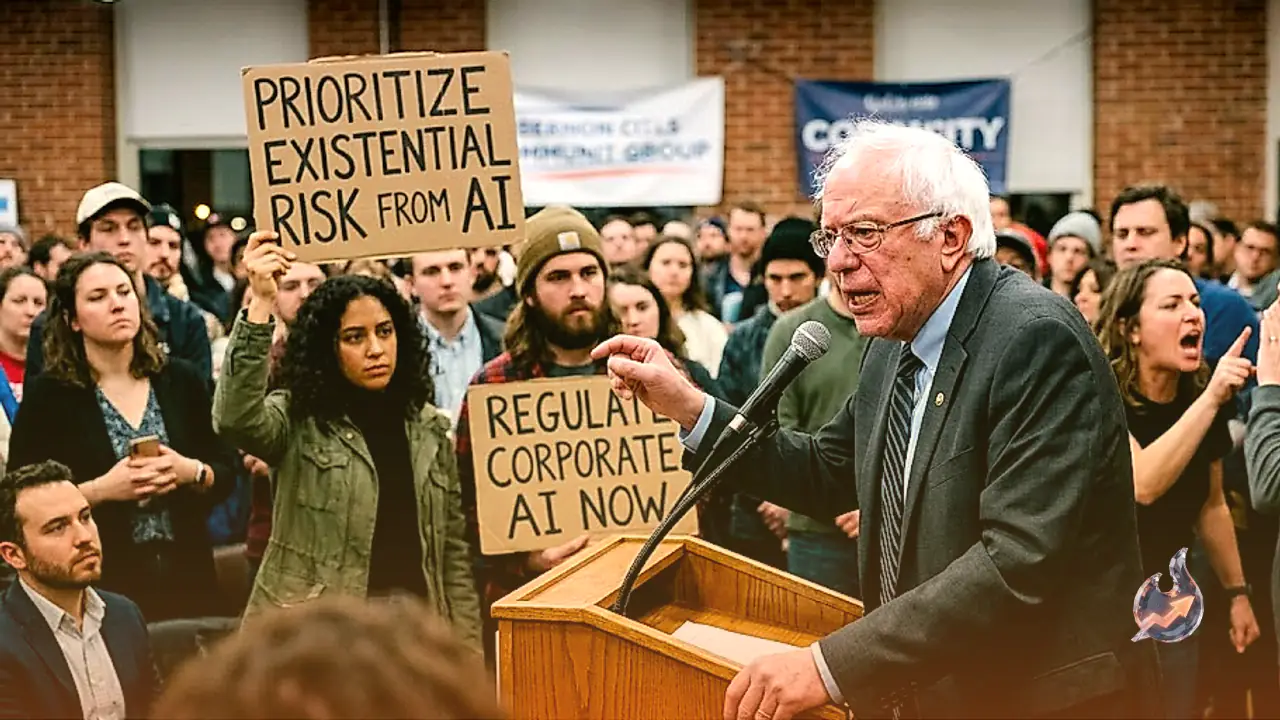
Conversely, another wing of the American left, heavily influenced by Senator Bernie Sanders, has taken a vastly different path. The 85-year-old senator, who remains the unofficial leader of the American progressive movement, has enthusiastically championed the cause of AI safety, warning his populist base that AI poses a genuine existential threat that could eliminate humanity. Proponents of this view argue that the left does not have to choose between fighting immediate corporate abuses and preventing future technological catastrophes; instead, they believe it is possible and necessary to address all AI-related harms simultaneously.
Alexander McCoy, a prominent Democratic strategist working closely on AI policy, defends this comprehensive approach. He argues that the strategists and researchers concerned with frontier governance and the rise of superintelligence are the same individuals working to mitigate current algorithmic harms. McCoy asserts that progressives must push for a "yes, and" strategy that regulates surveillance tools while simultaneously governing the development of frontier AI capabilities, which he insists are rapidly growing in power and are not merely marketing hype or industry exaggeration.
Over the past year, Sanders has brought AI safety discussions, which were once isolated to elite Silicon Valley rationalist circles, directly to Washington and his working-class populist base. Sanders was exceptionally early in identifying the environmental risks of massive, energy-intensive data centers, which have become a major organizing target for local activists. In March, Sanders introduced a data center moratorium bill that explicitly linked a temporary pause on new construction to the urgent need for federal regulations designed to secure the long-term survival of humanity.
Unorthodox Alliances and Internal Friction
Sanders' aggressive messaging on AI safety has led him into some highly unusual political alignments, most notably drawing praise and shared rhetorical ground with Steve Bannon, Donald Trump's former adviser and a prominent right-wing populist podcast host. It has also heavily influenced the political messaging of progressive candidates nationwide, many of whom have begun linking local anger over data centers with broader warnings about AI's threat to humanity. On September 9, just a day before the controversial NYC DSA post, six political candidates affiliated with the Working Families Party—including four backed directly by Sanders—released public statements demanding federal action to prevent existential threats from AI.
This political shift has met with intense public and private resistance from prominent figures within the tech community. Celebrated AI researcher and tech industry critic Timnit Gebru has publicly accused Sanders and other leftists of taking their cues from "literal doomsday eugenicist cults," referencing the effective altruism and rationalist philosophical movements that dominate the AI safety discourse in Silicon Valley. This friction has caused significant anxiety and confusion within progressive groups, with one NYC DSA member with a tech background privately questioning Sanders' political trajectory, asking, "what happened?"
The Venture Capital Playbook and Regulatory Capture
Rumman Chowdhury, CEO and founder of the nonprofit Humane Intelligence and former head of the machine learning ethics, transparency, and accountability team at Twitter, understands the deep skepticism felt by grassroots activists. She warns that the immense attention generated by existential risk narratives ultimately serves the interests of major frontier AI labs. Chowdhury explains that by projecting extreme, dramatic futures, tech executives successfully capture public attention, political energy, and investor capital, only to quietly walk back their wildest claims when convenient, all while ignoring the practical expertise of independent ethicists.
Chowdhury notes that terrifying, world-ending narratives appeal greatly to venture capitalists and high-stakes investors. The more powerful, dangerous, and world-altering a CEO makes their product sound, the more eager investors are to back it. Furthermore, for companies like OpenAI and Anthropic that are reportedly targeting public listings (IPOs) in the coming years, establishing a regulatory regime centered on "existential risk" serves as a crucial legal shield. It allows these companies to present regulatory compliance documentation to investors, demonstrating they have mitigated hypothetical worst-case scenarios, while simultaneously establishing high regulatory barriers that block smaller, open-source competitors from entering the market.
Local Resource Battles and the Climate Analogy
Pragathi Barusubramanian, a key organizer within the NYC DSA Tech Action Working Group, has focused on the material, localized impacts of tech expansion. Barusubramanian helped lead the campaign that secured a major political victory earlier this year: a one-year moratorium on data center construction in New York. They point out that in working-class communities fighting the physical footprint of these tech giants, abstract concerns about AI wiping out humanity are virtually nonexistent. Instead, the focus is entirely on the fact that these massive data centers consume immense amounts of water and local electrical grid capacity, proving that tech corporations do not have the public's best interests at heart.
Despite these grassroots concerns, Alexander McCoy insists there is no fundamental split among actual progressive leaders on the issue. He points out that several active DSA members, including New York mayor Zohran Mamdani, have recently made public statements referencing Coxon's warnings and the security vulnerabilities exposed by the Hugging Face hack. McCoy argues that critics like Gebru are unrepresentative and are creating an artificial divide, emphasizing that regulating immediate harms like intrusive Flock surveillance cameras does not prevent the government from also managing the risks of frontier AI models.
Phil Aroneanu, executive director of Irreplaceable, a left-leaning pro-AI safety organization, compares the debate to his years of experience in climate change activism. He believes that the progressive movement is fully capable of fighting immediate and long-term threats at the same time. Aroneanu points out that climate activists successfully fight the direct, localized impacts of fossil fuel extraction and oil spills while simultaneously organizing a global movement to combat long-term greenhouse gas emissions and global temperature rise. He sees a direct parallel in addressing both immediate AI-driven worker displacement and long-term algorithmic safety concerns.
Alexandria Ocasio-Cortez and the Path Forward
Even among the most high-profile progressive figures in Congress, there is a clear divergence in framing. While New York representative Alexandria Ocasio-Cortez co-sponsored Sanders' data center moratorium legislation and kept the language regarding existential risks to humanity in her House version of the bill, she has pointedly avoided participating in the high-profile AI safety forums that Sanders has frequented. Instead, her public statements have focused on immediate economic concerns, such as mass job losses, resource consumption, and the danger of an AI-driven financial bubble collapsing.
When questioned by reporters regarding her stance on AI safety, Ocasio-Cortez maintained a carefully balanced position, stating that "two things can be true at once." She warned that unchecked AI development poses severe dangers, but also highlighted the imminent risk of an overhyped economic bubble colliding with a raw technological frontier. As the safety debate moves quickly through statehouses and the federal government, the primary challenge for the American left is determining which specific regulatory frameworks to back with their limited political capital. While groups like the DSA Tech Working Group advocate for comprehensive rules targeting corporate behavior at all levels, a draft resolution before the national DSA proposes supporting a bill by Sanders and representative Greg Casar to ban superintelligence entirely. Ultimately, public anxiety remains high, with a national poll showing that two out of three Americans believe AI poses a risk of destroying humanity, ensuring that this debate will remain central to progressive politics. Barusubramanian notes that, despite the internal divisions, they are simply glad that the public is finally having a serious conversation about AI.