



















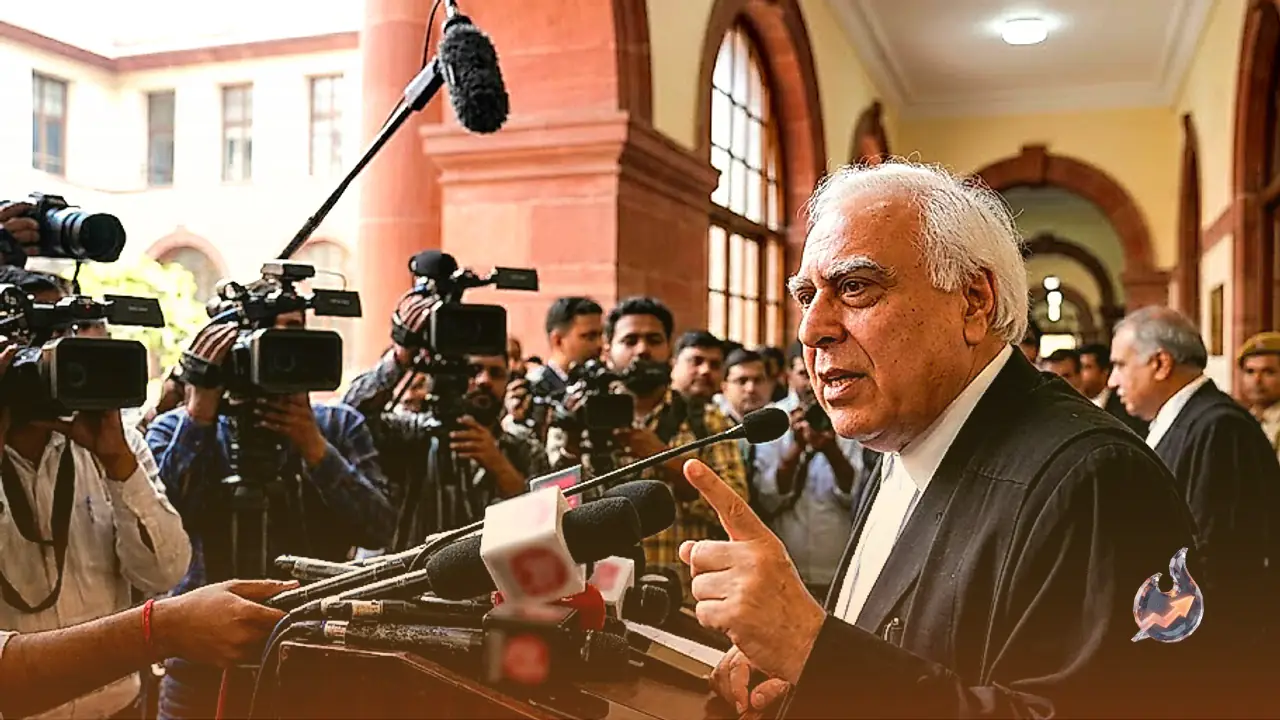

A high-stakes legal battle erupted once again in the highest court of the land over the contested Shiv Sena name and the bow-and-arrow election symbol. Appearing before a Supreme Court bench headed by Chief Justice of India (CJI) Surya Kant, senior advocate Kapil Sibal, representing the Uddhav Thackeray faction, mounted a sharp attack on the functioning and statutory jurisdiction of the Election Commission of India (ECI). Sibal raised fundamental questions concerning institutional integrity and democratic principles during the proceedings. Expressing deep concern over modern political defections, he remarked, "Defection is a constitutional sin, but unfortunately, it has now become a badge of honor." He further cautioned that if citizens lose faith in constitutional bodies, it will inevitably lead to widespread instability and chaos within the democratic framework.
Challenging ECI Jurisdiction Over the 2018 Party Constitution
Presenting a detailed chronology of events before the apex court, the senior counsel highlighted the pivotal meeting held on July 26, 2022, under the chairmanship of Eknath Shinde. He explained how the minutes of that specific meeting were utilized as the foundation to overturn the approved 2018 party constitution of Shiv Sena. Sibal questioned the very jurisdiction of the Election Commission, asking under what legal authority it set aside the 2018 constitution when both opposing sides, the Uddhav Thackeray and Eknath Shinde factions, had explicitly conceded that they were operating under that exact 2018 framework.
Addressing the ECI ruling issued on February 17, 2023, Sibal categorized the decision as legally unsustainable. Citing established precedents from the Delhi High Court, he pointed out that the Election Commission possesses strictly limited powers regarding party constitutions. Sibal presented numerical facts showing that Uddhav Thackeray commanded clear support among 160 members of the party national executive, whereas the rival group held zero support in that body. Despite this stark organizational imbalance, the Election Commission treated a split in the legislative wing as a split in the entire political party, which he argued is completely erroneous in law. To fortify his argument, Sibal cited historical judicial precedents including cases involving the Kerala Congress and the Samajwadi Party.
Legislative Majority Versus Organizational Party Structure
Elaborating on statutory provisions, Kapil Sibal analyzed Section 29A of the Representation of the People Act (RP Act) alongside the Symbol Order. He told the bench that Indian electoral jurisprudence does not recognize the concept of determining the real political party solely on the basis of numerical strength within the legislative wing. He contended that misinterpreting Paragraph 3 and Paragraph 4 of the Tenth Schedule, which governs anti-defection laws, creates an impermissible safe harbor for dissident members. Giving priority to legislative numbers over the organizational structure, Sibal argued, undermines the foundation of party political democracy.
Dilemma of Symbol Allocation Prior to Disqualification Rulings
Reminding the Supreme Court of his earlier submissions, Sibal explained that deciding the election symbol prior to adjudicating disqualification petitions bound the case in a severe legal dilemma. He stated that because the Constitution Bench had previously rejected his preliminary submission on this sequence, his clients were left stranded in midstream. According to Sibal, allocating the party symbol before resolving member disqualification facilitated the formation of an unconstitutional government while simultaneously stripping his faction of its legitimate election symbol.
Supreme Court Bench Observations and Hearing Schedule
Responding to the aggressive arguments, Justice Bagchi, sitting alongside CJI Surya Kant, observed that while the factual background and issues of symbol allocation and member disqualification are undeniably interconnected, the inquiry conducted by the Assembly Speaker regarding disqualification constitutes a distinct legal procedure. The Speaker, acting as a tribunal, is required to determine specifically whether a member has voluntarily given up membership of their political party.
In response, the Supreme Court clarified that voluntarily relinquishing party membership does not automatically equate to severing ties with the political party itself, though the court noted this was not a final judicial finding. After hearing extensive submissions from both sides, the bench led by CJI Surya Kant scheduled the next hearing for Tuesday or Wednesday of the coming week. The firm stance of the court and the assertive arguments presented by counsel indicate that this milestone legal controversy will see further intense debates in the days ahead.