





















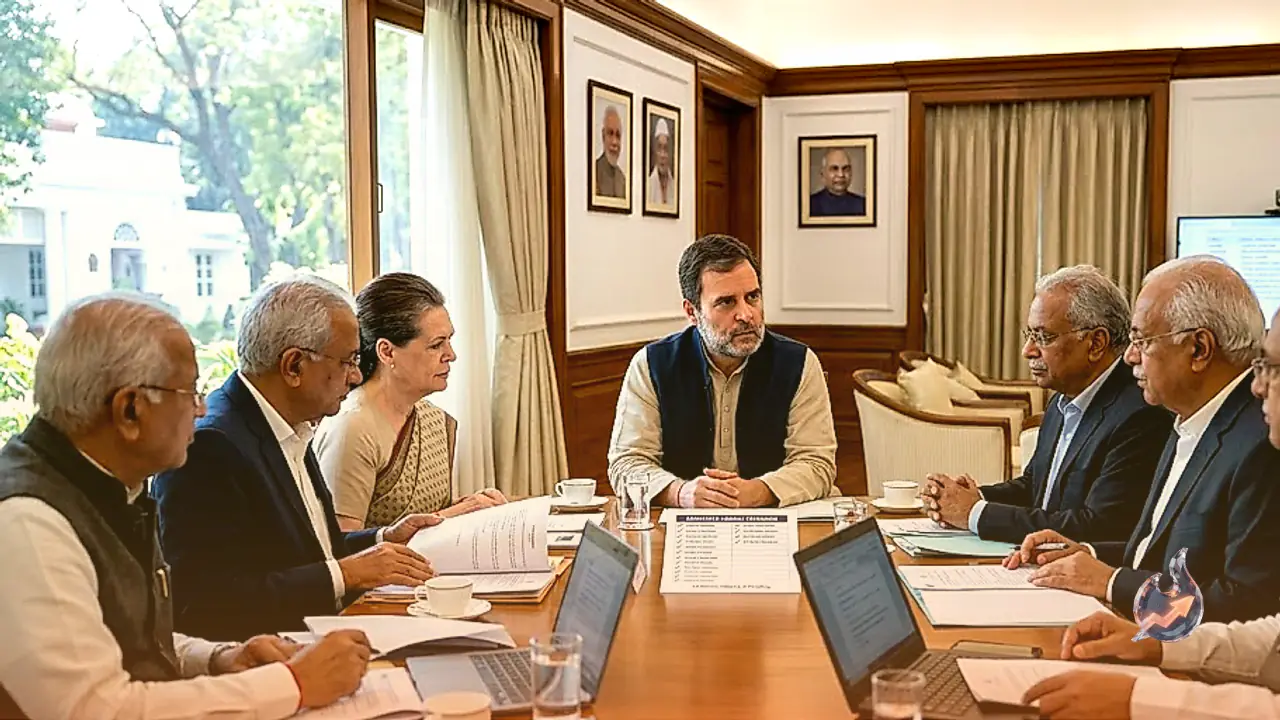

Political developments in Karnataka are approaching a definitive stage as the Congress party leadership gathers in New Delhi to finalize the state government's pending cabinet expansion. Chief Minister DK Shivakumar, who assumed office on June 3, has been running the administration with an incomplete cabinet for nearly two months. Following weeks of intense political maneuvering and demands for regional, caste, and gender representation, a crucial meeting attended by Rahul Gandhi on Wednesday is set to seal the final list of ministerial inductees. If all operational details are approved, the oath-taking ceremony for the new ministers is scheduled to take place on Thursday.
High Command Deliberations in New Delhi and Swearing-In Preparations
Following extensive consultations among senior leaders, the blueprint for the expanded cabinet has largely taken shape. During a key meeting held on Tuesday in the presence of AICC General Secretary KC Venugopal, consensus was successfully reached on approximately 14 ministerial slots. The decision on the remaining 6 vacancies now rests with Rahul Gandhi, who will finalize the names after consulting top state leaders.
Meanwhile, state administrative machinery in Bengaluru has commenced preliminary arrangements for the expected swearing-in event. Verbal instructions have already been conveyed to the Lok Bhawan administration to complete all necessary protocols. However, the official schedule and final list of inductees will only be published after receiving explicit approval from the party high command.
Factional Proposals and the Proposed 60:40 Representation Model
Internal discussions regarding cabinet composition have brought forward differing perspectives within the state leadership. Chief Minister DK Shivakumar favors injecting fresh energy into the administration by allocating nearly 75 percent of the cabinet posts to first-time MLAs and younger leaders.
On the other hand, former Chief Minister Siddaramaiah emphasizes retaining several seasoned leaders to ensure governance stability and leverage extensive administrative expertise. To reconcile these viewpoints, the Congress high command is deliberating on a balanced 60:40 model that aims to combine 60 percent new faces with 40 percent experienced figures.
Social Engineering: Proposals for Two Additional Deputy Chief Ministers
Alongside filling ministerial berths, the Congress leadership is leveraging the cabinet exercise to balance key caste and regional dynamics ahead of upcoming electoral battles. Serious deliberations are underway regarding a proposal to appoint two additional Deputy Chief Ministers.
Under the proposed formula, one Deputy Chief Minister post may be assigned to a prominent leader from the Lingayat community, while the second position is slated for a leader representing the Scheduled Tribes (ST). Currently, G. Parameshwara, who belongs to the Scheduled Castes (SC) community, serves as the state's Deputy Chief Minister.
Minority and Female Leadership Claims Alongside Organizational Harmony
The high command is also placing significant emphasis on expanding women's representation in the state cabinet. Prominent female leaders under active consideration include Lakshmi Hebbalkar, Roopakala, Aarti Krishna, Nayana Motamma, and Kaneez Fatima.
Furthermore, Chief Minister DK Shivakumar is advocating for the inclusion of six-term MLA Tanveer Sait, senior leader Saleem Ahmed, and young legislator Rizwan Arshad. Meanwhile, Karnataka Congress in-charge and AICC General Secretary Zameer Ahmed Khan is attending the New Delhi meetings. Having recently issued an apology over the Davanagere by-election dispute, his involvement reflects ongoing efforts by the party leadership to resolve internal friction and foster organizational unity.


