




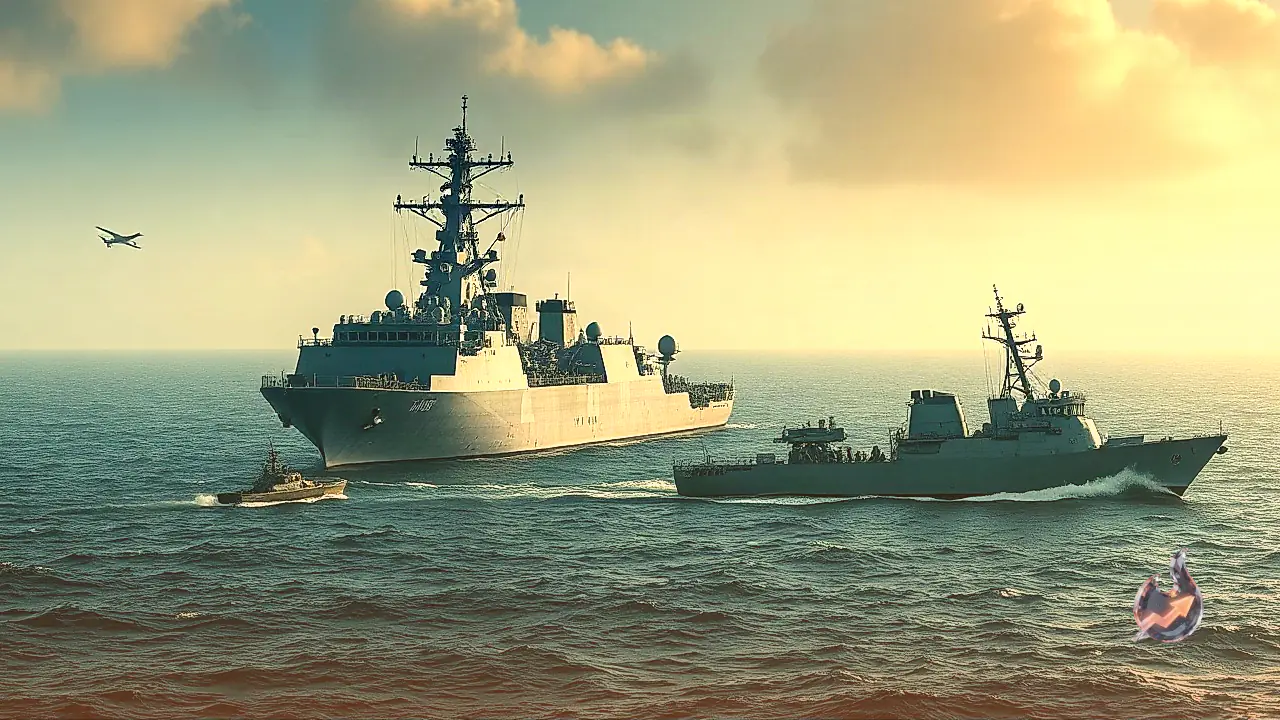


















The collision that took place on September 15 in international waters within the northern Arabian Sea, situated 120 nautical miles away from the Gulf of Oman, involving an Indian Navy patrol warship and Pakistan's PNS Hunain, is far more than a routine maritime accident. This event lays bare the subtle yet profound naval power dynamics continuously playing out between India and Pakistan across the Arabian Sea. The true evaluation of naval capability is never determined merely by counting the total number of ships a nation possesses, but rather by deciding which force can successfully establish sea control during a conflict and which one retains the capacity for sea denial.
India Vision: Power Projection and Sea Control
The Indian Navy operates well beyond mere coastal defense, functioning as a blue-water navy across the entire Indian Ocean Region. The primary objective for India remains safeguarding critical sea lanes of communication and maintaining a forward presence to keep adversaries contained near their own shores. In terms of air dominance, India maintains a decisive edge with two active aircraft carriers, INS Vikrant and INS Vikramaditya. An aircraft carrier is far more than a simple vessel; it functions as a floating airbase capable of projecting air defense coverage hundreds of miles away from the mainland.
According to 2026 data from GlobalFirepower.com, the structural gap between the two navies is stark. India fields a layered combat capability featuring guided-missile destroyers built under Project 15B, such as INS Visakhapatnam and INS Surat, which provide carrier battle groups with robust anti-air and anti-surface defense. Additionally, the Nilgiri-class stealth frigates developed under Project 17A, including the recently inducted INS Mahendragiri, are heavily armed with BrahMos and MR-SAM systems to operate effectively in complex, multi-threat environments.
Strategic Expansion and Regional Mandate
With an extensive coastline stretching approximately 11,098 kilometers, a 2.4 million square kilometer Exclusive Economic Zone, and the vital responsibility of protecting 90 percent of India's maritime trade, the nation's naval force is inherently ocean-centric rather than pak-centric. The overarching strategy emphasizes endurance, long-range power projection, and establishing comprehensive control over vast oceanic expanses rather than restricting operations to narrow coastal confines.
Pakistan Vision: Asymmetric Warfare and Sea Denial
Lagging behind India significantly in its surface fleet, Pakistan focuses its core maritime strategy less on fighting large conventional engagements and more on denying India the freedom of movement across the Arabian Sea, a concept known in naval terminology as sea denial. The cornerstone of Pakistan's naval strength lies in its submarine warfare capabilities. Through the ongoing Hangor-class submarine program backed by Chinese cooperation, which features eight vessels equipped with air-independent propulsion technology, Pakistan retains a formidable capability for stealth attacks.
Within the confined geography of the Arabian Sea, the Pakistani Navy attempts to carve out an anti-access and area-denial zone by leveraging coastal missile batteries, maritime patrol aircraft, and short-range corvettes. Dismissing Pakistan as a naval adversary entirely would represent a strategic error, as advanced submarines and asymmetric threats can pose serious hazards even to much larger fleets.
Industrial Sustainment: The Ultimate Test of Strength
The ultimate endurance and operational reach of any naval force depend entirely on its industrial sustainment and indigenous shipbuilding ecosystem. While India emphasizes extensive operational reach, long station times, and overarching regional control, Pakistan concentrates narrowly on challenging Indian advances close to its own shores. The September 15 incident serves as a small glimpse into this ongoing strategic friction.