















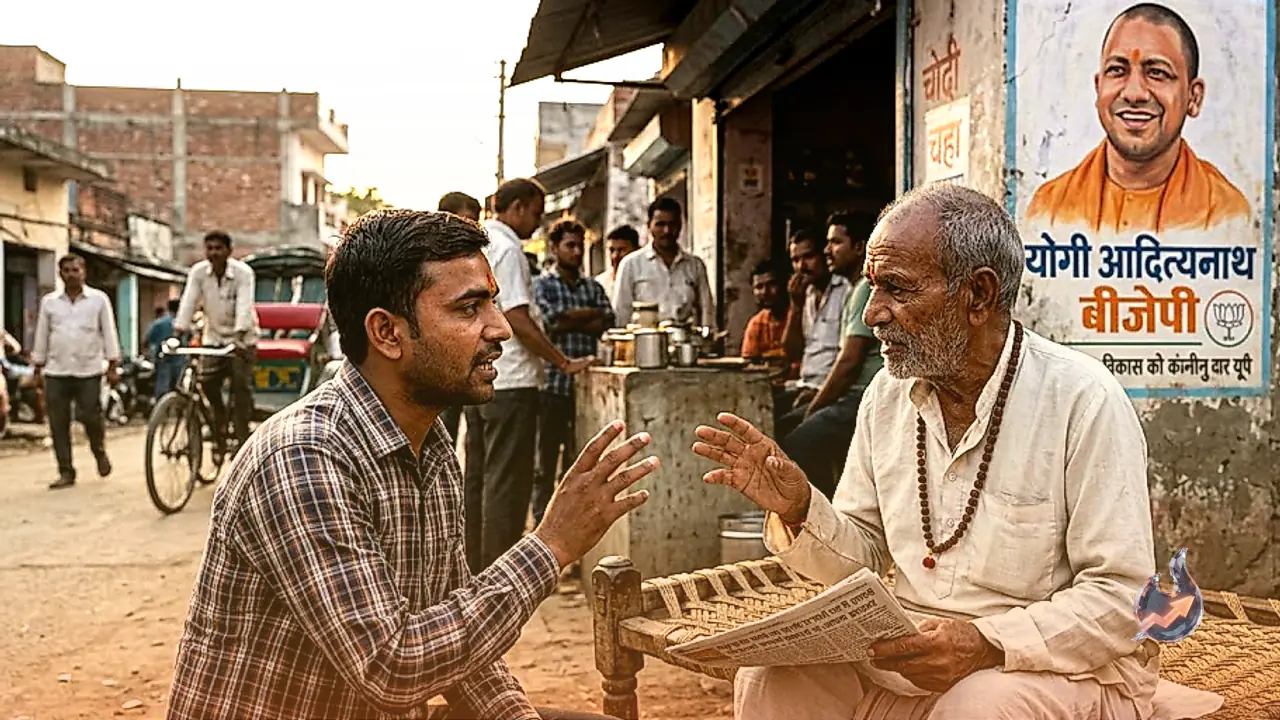

In the political landscape of Uttar Pradesh, Brahmin voters are traditionally regarded as the ultimate key to victory or defeat for any political faction. Although this community does not constitute a demographic majority, its intellectual influence, social standing, and role in shaping public opinion from rural village squares to urban intersections make it the most influential kingmaker in the state. As the groundwork for the 2027 Uttar Pradesh assembly elections gradually commences, efforts to consolidate and court the Brahmin vote bank are already underway. While the Bharatiya Janata Party is systematically working to safeguard its traditional stronghold at all costs, Samajwadi Party chief Akhilesh Yadav is experimenting with his social equations to reach out to the community.
Demographic Distribution and Legislative Seat Math
The share of Brahmin voters in the total population of Uttar Pradesh is estimated to be between 10 to 12 percent. Out of the 403 total assembly seats across the state, there are only 7 constituencies where the Brahmin population exceeds 30 percent, but more than 97 seats have an upper-caste population above 15 percent, giving them the direct capacity to alter electoral outcomes. Purvanchal has historically been the most robust stronghold for Brahmins, where districts such as Gorakhpur, Deoria, Kushinagar, Ballia, Sant Kabir Nagar, Varanasi, Prayagraj, Jaunpur, Bhadohi, and Gonda-Balrampur feature a significant presence influencing roughly 41 seats.
Regional Influence Across Different Zones
In the Awadh region, encompassing Kanpur Nagar, Kanpur Dehat, Unnao, Lakhimpur Kheri, Lucknow, Ayodhya, and Sultanpur, Brahmin voters maintain a substantial presence and play an effective role across nearly 42 seats. Additionally, voters from this community hold a decisive sway in parts of Banda, Chitrakoot, and Jalaun within the Bundelkhand region. In western districts such as Meerut, Bulandshahr, Aligarh, Muzaffarnagar, Baghpat, and Shamli, their population ranges from 3 to 8 percent, which frequently proves decisive in triangular or tightly contested electoral battles.
The Ruling Party Strategy and Consolidation Efforts
During the 2017 and 2022 elections, the ruling party secured over 80 percent of the Brahmin vote. To make this electoral fortress impregnable by 2027, a three-tiered strategy has been devised. This involves leveraging Hindu cultural renaissance through the Kashi Vishwanath Corridor, the grand Ram Mandir construction, and the Mahakumbh among the community. Prominent senior Brahmin leaders like Deputy Chief Minister Brajesh Pathak and Jitin Prasad are being fronted to signal that their social respect and administrative standing remain intact. Furthermore, through alliances with Jayant Chaudhary's Rashtriya Lok Dal, intellectual conferences are being organized in western regions to reinforce a Jat-Brahmin-Gurjar coalition.
Divergent Sentiments Between Western and Eastern Regions
Do the political perceptions of Brahmins in western Uttar Pradesh differ from those in Purvanchal regarding Chief Minister Yogi Adityanath? The answer lies within the regional and social fabric of the state. The political arithmetic of Purvanchal is largely driven by local political dominance and social identity, where historical rivalries between upper-caste groups periodically surface. While local grievances occasionally arise regarding specific issues, the overarching impact of temple construction and urban development in Varanasi and Gorakhpur ensures that a major segment of the population stands firmly with the administration. Conversely, the calculus in western Uttar Pradesh is distinct, where law enforcement and security remain paramount. For residents weary of extortion and communal tension prior to 2017, the zero-tolerance policy against crime functions as the single most critical factor.
Opposition Outreach and Alternative Narratives
Samajwadi Party leader Akhilesh Yadav has adjusted his strategy by redefining his core social coalition to explicitly include the Pandit community, alongside organizing public events dedicated to Parshuram. The opposition leadership is actively offering electoral tickets to leaders who feel alienated or sidelined by the ruling administration. In central belts such as Kanpur, Unnao, and Lucknow, where narratives surrounding past police actions and local grievances were formed, the opposition intends to capitalize on underlying discontent. Select constituencies in Purvanchal are also witnessing similar targeted outreach efforts.
Outlook and Final Electoral Projections
While the inclusion of the community within broader opposition frameworks and the hosting of symbolic events appear to benefit the opposition's outreach, the core pillars of Hindutva, temple construction, and aggressive crime control remain formidable strengths for the incumbent administration. A secure environment and the presence of a double-engine government strongly favor the ruling party, although local dissatisfaction with incumbent legislators and bureaucratic hurdles could pose challenges. Nonetheless, the majority of Brahmin voters are still widely projected to favor the current leadership in 2027, driven primarily by cultural nationalism and security, except in specific constituencies where severe local anti-incumbency might compel voters to explore alternative political choices.