






















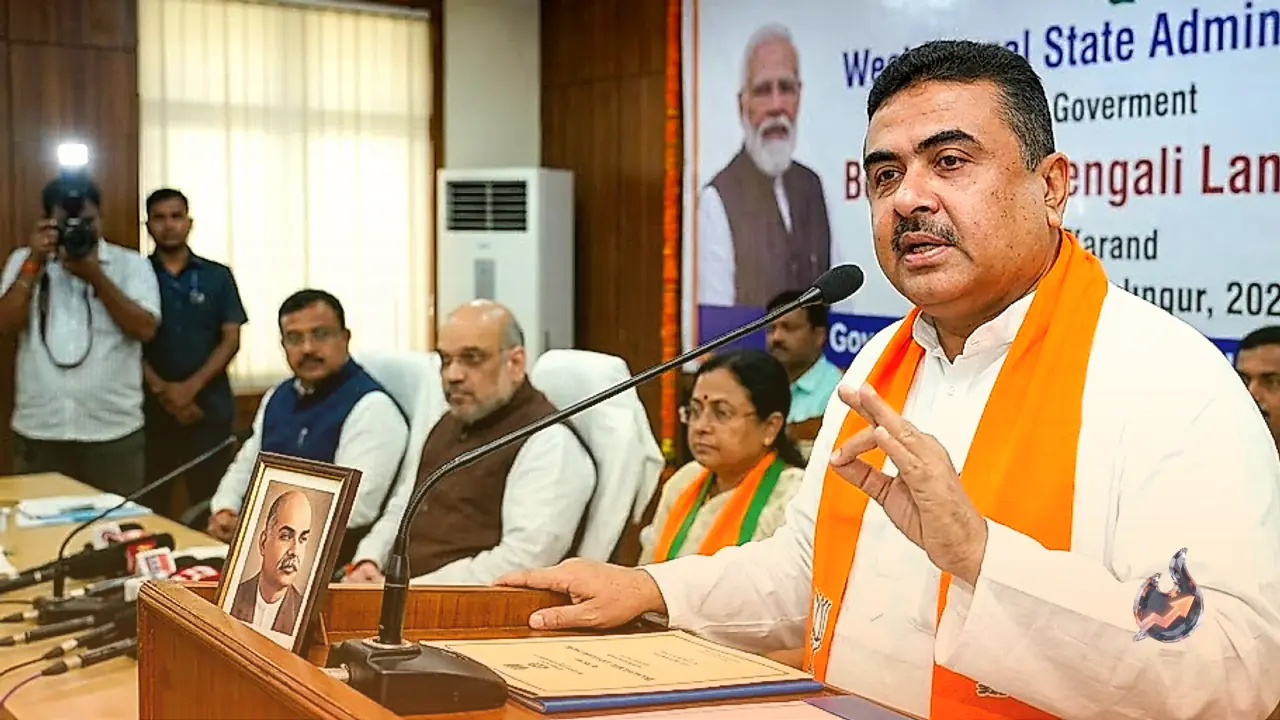

West Bengal Chief Minister Suvendu Adhikari has announced a sweeping administrative overhaul, mandating the use of the Bengali language across all state government operations. Starting on September 1, the mother tongue will become compulsory for all official administrative work within the state. This transition aims to fundamentally change how the general public interacts with the administration, ensuring that governance is conducted entirely in the language most familiar to the local population. The administration is presenting this policy as a major step toward linguistic pride and practical accessibility.
Extensive Departmental Changes
The new language policy will have a broad and immediate impact, touching every level of the state machinery. According to the Chief Minister, the mandate applies uniformly to all government offices, ranging from the grassroots land and land reforms department all the way up to the Chief Minister's Office. A wide variety of crucial public interactions will now be processed exclusively in Bengali. This includes essential citizen services, the filing of First Information Reports with the police, legal affidavits, digital applications, and all official government notifications concerning civil rights. Adhikari highlighted that preparations are already in motion to ensure the state is ready for the September 1 deadline. The administration is actively finalizing the necessary translation frameworks and deploying translators across various departments to prevent any disruption of services. The Chief Minister described the move as a crucial step that goes beyond mere good governance, focusing heavily on maximizing public convenience.
Inspiration From Historical Figures
The decision to enforce this language mandate was heavily influenced by the 125th birth anniversary of Dr. Syama Prasad Mookerjee, the historical founder of the Bharatiya Jana Sangh. Adhikari pointed out that Mookerjee was a staunch pioneer for the preservation and promotion of Indian languages throughout his political career. Mookerjee firmly believed that citizens should be governed in their own language rather than a colonial holdover, arguing that native tongues must hold a prominent place in administration, public life, and the education sector. The current state government views the new policy as a practical and fitting implementation of Mookerjee's long-held vision, purposefully timed to coincide with his milestone birth anniversary celebrations.
New Protocols For Central Communication
The language shift will also alter how the West Bengal administration communicates with the central government and other states across the country. Adhikari stated that the state will systematically move away from using English, which he categorized as a foreign language, for official inter-governmental correspondence. Instead, all future communication with New Delhi and other state governments will be conducted in Bengali alongside Hindi, the official language of the Union. The Chief Minister affirmed his personal commitment to this new administrative protocol, confirming that he will lead by example and draft his future official letters in both Bengali and Hindi.
Amit Shah's Visit And Language Advocacy
This major policy shift directly follows a recent three-day official visit to West Bengal by Union Home Minister Amit Shah. During his regional tour, Shah wrote a formal letter to Chief Minister Adhikari in the Bengali language, which the Chief Minister cited as a direct catalyst for the new mandate. In the correspondence, the Home Minister reiterated Mookerjee's enduring beliefs regarding the absolute necessity of linguistic representation in robust governance. A day prior to sending this communication, Shah had also officially inaugurated a 'Shabd Sangrahalay' in the region. Speaking at the inauguration event, the Home Minister emphasized the critical need to protect the nation's vast linguistic diversity in order to safeguard its deep civilizational identity. Furthermore, he urged citizens across the country to learn at least one other Indian language in addition to their own mother tongue.
Commission Report Publication
In a separate administrative development mentioned during the language policy announcement, Adhikari provided an update regarding the Justice Sushant Chatterjee Commission. He noted that a specific committee had been established by the previous state government on July 21 to review matters related to the commission's scope. The Chief Minister confirmed that the findings of this committee have now been finalized, and the associated report will be officially published and tabled in the state assembly today.