


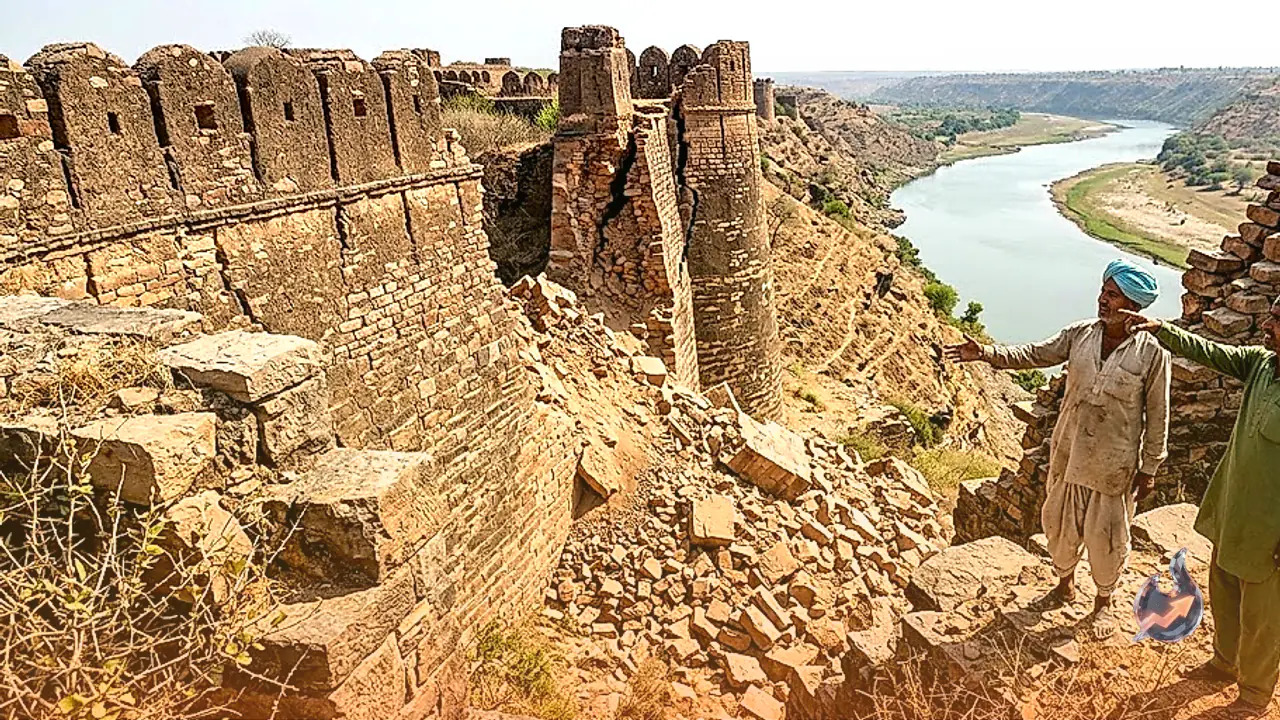


















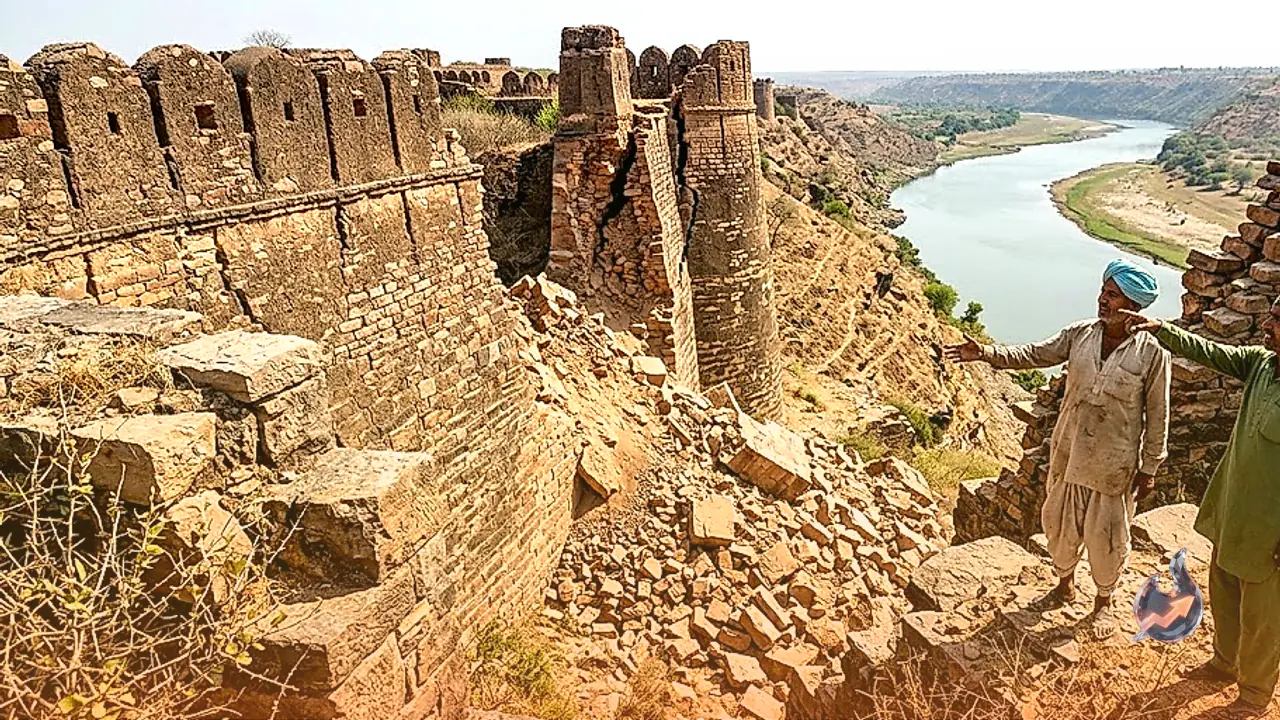

Nestled amidst the rugged ravines on the banks of the Chambal River in Rajasthan's Dholpur district, the centuries-old Shergarh Fort is on the verge of turning into ruins. Holding nearly nine centuries of glorious regional history, this once-formidable stronghold is suffering from fragile, collapsing walls and heavily damaged approach roads. Prolonged administrative indifference and a lack of timely preservation efforts have left this majestic monument in a state of severe neglect.
Boundary Wall Collapse Blocks Main Approach Route
The current structural integrity of the historic complex is in a precarious state. The ancient defensive walls have weakened considerably over time, with loose masonry shedding regularly. Recently, a major section of the fort's protective boundary wall caved in without warning, spilling heavy rubble directly onto the primary approach road. The scattered debris has created severe hurdles for visiting tourists and devotees attempting to reach the site.
Furthermore, the main road leading to the fort has deteriorated extensively. The surface has completely worn off in multiple spots, leaving behind massive potholes that make vehicular traffic and pedestrian movement extremely hazardous.
Foundation Laid by Yaduvanshi Rulers in the 12th Century
According to local historian Arvind Sharma, the fort situated deep within the Chambal ravines represents a crucial chapter in the heritage of Dholpur. The stronghold was originally established during the 12th century by Yaduvanshi ruler Dharampal Singh. Throughout its long existence, the fort endured several military invasions and fierce armed conflicts. Records show that Maharaja Rana Keerat Singh established his primary capital here from 1806 to 1811.
During its peak military era, several massive cannons guarded the ramparts of the fort. One of these historic heavy cannons has been preserved and placed on display at the Dholpur Circuit House, standing as a tangible testament to the fortress's tactical importance.
Strategic Mention in Babur's Autobiography
Shergarh Fort's prominence extended far beyond local boundaries and was intertwined with imperial Delhi. The founder of the Mughal dynasty, Babur, documented this fortification in his autobiography, Tuzuk-i-Baburi, referring to it as the Dholpur Fort. Later, during the reign of the Afghan monarch Sher Shah Suri, the stronghold was renamed Shergarh Fort, the moniker it carries to this day.
Historical chronicles also record an invasion launched against the fort by Delhi Sultan Sikandar Lodi. At that time, the territory was governed by Vinayak Dev, who maintained a close alliance with the illustrious ruler of Gwalior, Man Singh Tomar. These recorded conflicts highlight the immense geopolitical weight the fort carried throughout the medieval period.
Urgent Calls for Tourism Development and Restoration
Historian Arvind Sharma emphasized that the state government, local authorities, and public representatives must immediately initiate targeted conservation measures for this invaluable monument. He noted that developing the site thoughtfully for tourism would allow visitors to experience the natural beauty of the Chambal River, the mystery of the ravines, and the rich history of Dholpur simultaneously.
Sharma had previously recommended the construction of a scenic watchtower named Chambal View to then District Collector Abhay Kumar. Such an observation tower would provide panoramic views overlooking both the winding Chambal River and the rugged ravine topography. If substantial restoration work is not undertaken soon, future generations risk losing all physical remnants of this 900-year-old architectural landmark.