




















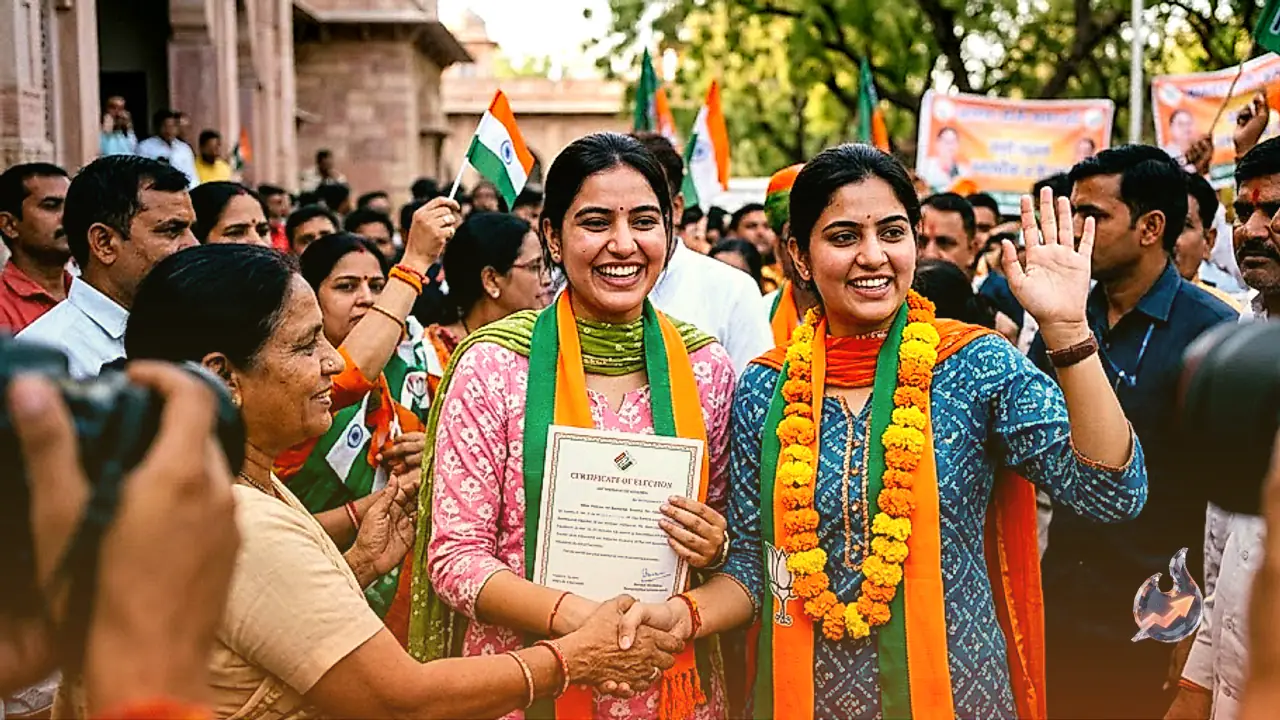

The landscape of grassroots governance in Rajasthan is undergoing a remarkable transformation, driven by a new wave of youthful energy and enthusiasm. In the recently concluded local body elections across the state, the traditional focus on experienced politicians and seasoned campaigners has been disrupted. Instead, a fresh crop of Gen-Z candidates has captured the public's attention, demonstrating that age is no barrier to entering active public service. Among these newcomers, two 21-year-old women have emerged as the faces of this modern political shift, proving that the younger generation is ready to take charge of local governance.
Neha Sharma: The Young Journalist Stepping into Public Service
In the Thanagazi Municipality of Alwar district, a young professional has made a successful transition from reporting the news to becoming the news itself. Neha Sharma, who is just 21 years and 4 months old, contested the municipal elections from Ward 6 on a Bharatiya Janata Party (BJP) ticket. Despite her tender age and the challenges of a competitive local election, her campaign resonated deeply with the local electorate. She managed to secure a total of 262 votes, defeating her closest rival by a clear margin of 101 votes. Neha's background as a journalist provided her with a unique perspective on community issues, helping her connect with voters who were eager for a fresh approach to civic administration.
This election was not merely about securing a seat; it represented a bold step for a young professional choosing to enter the electoral arena instead of following a conventional career path. By deciding to run for the post of ward councillor, Neha showcased the determination of Gen-Z to actively participate in decision-making processes. Her victory in Thanagazi is being discussed as a classic example of how young women are breaking barriers and carving out a space for themselves in local bodies, which have historically been dominated by older, male political figures.
Kashyapi Sankhla: Engineering a Historic Win in Ajmer
Parallel to the success story in Alwar, another remarkable victory unfolded in Ajmer, where a young student proved that academic pursuits and public service can go hand in hand. Kashyapi Sankhla, a 21-year-old BTech student, contested the Ajmer municipal elections from Ward 80. Representing the BJP, Kashyapi managed to pull off an incredibly dominant performance in what was her very first electoral outing. She garnered an impressive total of 3,323 votes, securing her victory with a massive margin of 1,275 votes over her nearest opponent.
For a young engineering student to manage a rigorous academic curriculum while simultaneously running a high-stakes municipal campaign is a noteworthy achievement. Kashyapi's massive victory margin indicates a deep trust placed in her by the voters of Ajmer, who chose to back an educated, tech-savvy youth over more conventional political choices. Her entry into municipal politics highlights a growing trend of highly educated individuals choosing to work at the grassroots level, bringing analytical and modern problem-solving skills to local administrative bodies.
A New Era of Youth Participation in Local Governance
These election results in Rajasthan signal a broader, structural change in how political parties and voters view local leadership. The success of Neha Sharma and Kashyapi Sankhla highlights a shifting voter demographic that increasingly values fresh ideas, educational qualifications, and energetic representation over long decades of political maneuvering. The fact that both candidates are young women around the age of 21 adds another layer of significance to these outcomes, pointing towards a future where women's leadership at the local level is both organic and powerful.
With these Gen-Z representatives now preparing to take up their official duties as ward councillors, the focus will inevitably shift to how they translate their youthful energy into effective governance. Managing local infrastructure, addressing community grievances, and navigating bureaucratic structures will present a new set of challenges for these first-time politicians. However, their initial victories have already laid a strong foundation, encouraging more young people to look at local administration as a viable and impactful medium for social change. How these young leaders perform in their respective wards could very well set the tone for the next generation of leadership in Rajasthan's political landscape.