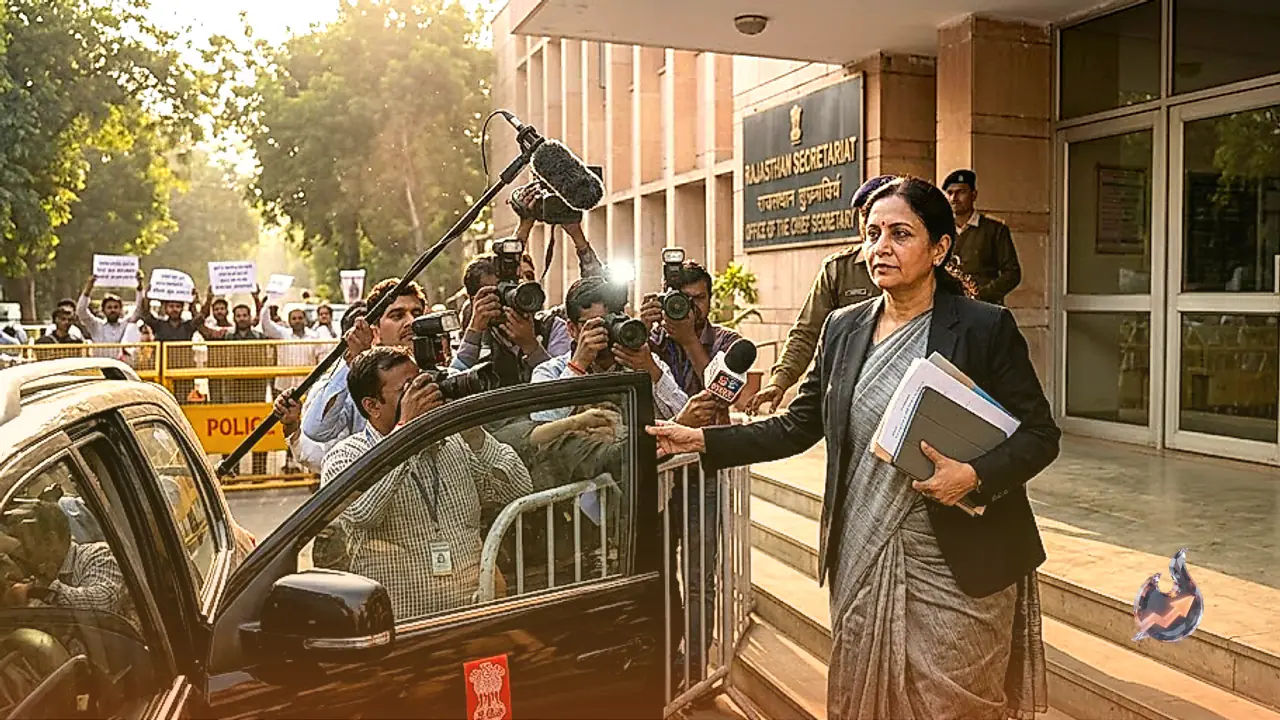























Internal rebellion has surfaced within the Bharatiya Janata Party in the backdrop of candidate selection for the upcoming Alwar Municipal Corporation elections. Following the announcement of potential candidate lists across 65 local wards, resentment among party cadres and office-bearers overflowed into the public domain. Just ahead of peak campaigning, key local leadership including several Mandal presidents, a senior general secretary, and a prominent Mahila Morcha functionary submitted their resignations in protest. The dissenting leaders alleged that dedicated workers who spent years consolidating the party's foundation were entirely sidelined. Instead, newcomers and individuals with Congress backgrounds were reportedly favored. The sudden wave of resignations has sent shockwaves through the party's local apparatus, posing serious threats to its electoral performance.
Vivekanand Mandal Chief Steps Down, Levels Direct Allegations
The first major setback to the local unit emerged from Vivekanand Mandal, where Mandal President Jitendra Singh Rathore resigned from his position to signal his protest. In his communication to party leaders and public remarks, Rathore highlighted that long-serving ground workers who built the party block by block were completely ignored when tickets were allocated. He claimed that candidacies were instead offered to individuals whose party background and commitment remained doubtful. Rathore explicitly alleged that loyal, old-guard cadres were systematically bypassed in favor of recent entrants coming from a Congress background.
Furthermore, Rathore questioned the adherence to seat reservation guidelines during candidate selection. He pointed out that candidates from non-general categories were fielded in wards reserved for the general category, disrupting local socio-political balances. Holding local ministers and senior figures accountable for betraying the grassroots base, Rathore emphasized that civic body elections are driven by booth-level workers rather than individual high-profile leaders. He warned that neglecting front-line workers would inevitably reflect on the final voting outcomes across wards.
Keshav Mandal President Quits Citing Neglect of Cadres
The unrest extended to Keshav Mandal as well, where Mandal President Mahesh Nihalwani resigned over the candidate allocation strategy. Nihalwani criticized the leadership's approach, noting that dedicated workers had consistently engaged in door-to-door outreach to strengthen the party's foundation at the grassroot level. Despite their sustained efforts, the leadership opted to trust outsiders over proven local party members during ticket distribution.
Nihalwani asserted that when workers who labor selflessly for years get overlooked during crucial election cycles, internal dissatisfaction is bound to flare up. He challenged the transparency of the candidate selection process and stressed that winning municipal elections becomes an uphill battle if the self-respect of active party workers is compromised.
Resignations Spread to Senior General Secretary and Mahila Morcha
Dissatisfaction within the organization is not restricted to Mandal heads alone; senior executive members have also voiced strong opposition. Senior General Secretary Sanju Yadav, who has served in various organizational capacities within the party since 1999, expressed deep disappointment over how candidates were chosen. Yadav remarked that after spending more than two decades working for the party's expansion, continuing under a system that disregards the opinions and dignity of workers becomes unviable for loyalists.
Simultaneously, the party's women wing suffered a hit as senior Mahila Morcha official Madhu Arya announced her departure from the party. Arya stated that ground-level female cadres play a vital role during local municipal contests, yet their input and recommendations were totally ignored during candidate finalization, forcing her to part ways with the organization.
Mayor Aspirations Threatened as Leadership Faces Dual Challenge
The flurry of resignations right on the eve of the municipal elections represents a formidable challenge for the party organization. While the BJP leadership had crafted plans to secure an absolute majority board and capture the Mayor post in Alwar Municipal Corporation, the widespread internal revolt has disrupted its political calculations.
The local leadership now faces a double-edged task: managing campaign efforts for its declared nominees across 65 wards while simultaneously attempting to pacify disgruntled leaders and workers. Political observers note that unless the party quickly placates its rebellious faction, vote division in wards where the resigning leaders command local influence could deal a blow to the party's mayor ambitions.