


















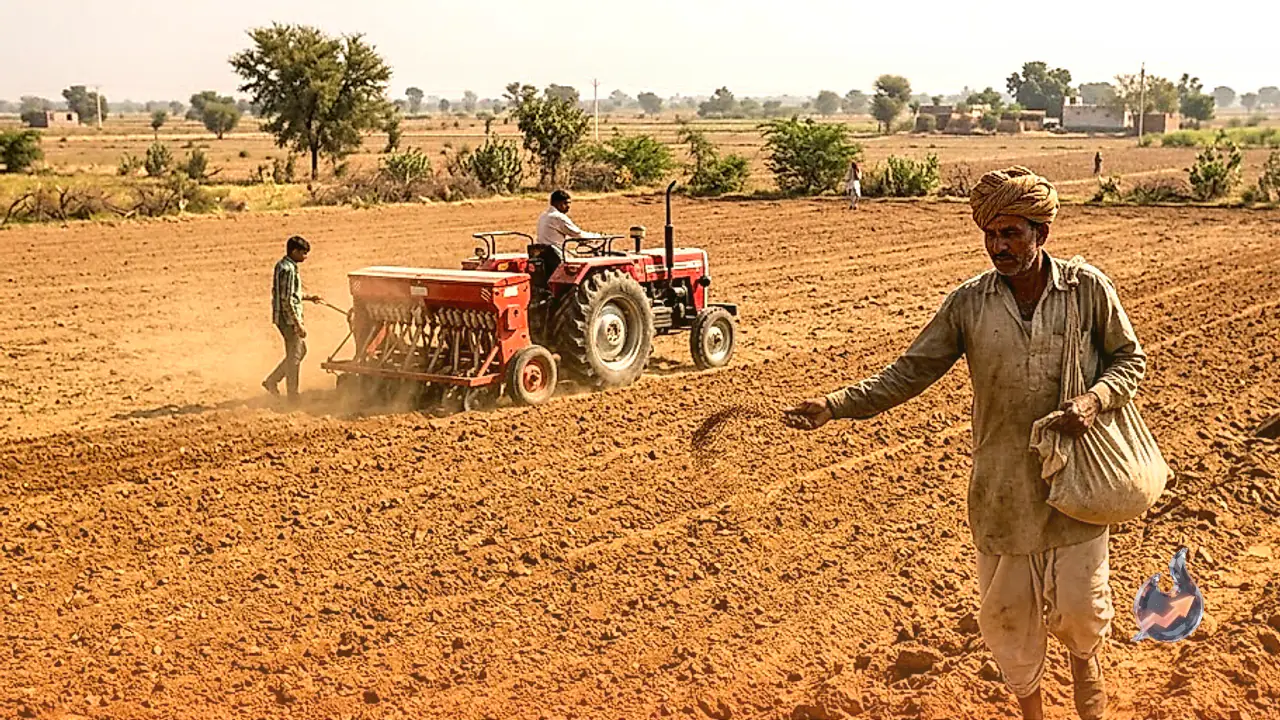

Fields across Bharatpur district in Rajasthan are buzzing with activity as the winter mustard sowing season officially gets underway. Renowned across the state as a premier belt for oilseed production, the region sees cultivators paying meticulous attention to every stage of farm management, starting from initial ploughing and soil preparation to seed selection and planting. To secure robust crop yields, local farmers primarily rely on two distinct planting methodologies: mechanised line sowing using specialised seeders, and the traditional direct broadcast method of scattering seeds across prepared ground.
Precision and Efficiency with Mechanised Line Sowing
Under the mechanised approach, cultivators begin by thoroughly ploughing the land multiple times until the topsoil turns fine, loose, and aerated. Sowing machines are then brought into the fields to place mustard seeds into precise rows at predetermined depths and measured spacing. This systematic line-planting technique offers a critical agronomic advantage by allowing strict regulation over seed volumes and ensuring uniform gaps between adjacent saplings. Furthermore, orderly linear rows significantly simplify subsequent farm operations, making weeding, hoeing, and intercultural operations far more manageable during the vegetative growth phase.
The Traditional Broadcast Method and Its Operational Hurdles
The alternative technique is the time-honoured broadcast method, which continues to be widely practised by many traditional growers. Once the field undergoes standard ploughing and levelling, farmers manually scatter mustard seeds evenly across the open soil surface. Following the broadcast, a light round of ploughing or harrowing is conducted to cover the scattered seeds with a thin layer of soil. While this method remains quick and accessible, it often poses operational difficulties in achieving uniform seed distribution, making it challenging to maintain ideal distance between emerging plants, which can lead to uneven crop density across the field.
Certified Inputs and Expert Agronomic Recommendations
Agricultural specialist Dr. Udaybhan Singh pointed out that achieving optimum mustard yield hinges not solely on planting methods, but on an integrated approach involving thorough field preparation, high-quality certified seeds, balanced fertiliser application, and timely sowing. He advised farmers to select their planting methodology strictly according to the specific soil texture and residual moisture levels present in their fields. Seeking direct technical guidance from the agriculture department regarding calibrated seed rates per acre and ideal planting depth is equally vital for crop success.
Sustaining Bharatpur's Leadership in Mustard Cultivation
The Bharatpur belt occupies the top position across Rajasthan in terms of dedicated mustard acreage, with local farmers cultivating this oilseed far more extensively than any other cash crop. With sowing preparations accelerating across the district, cultivators are striving to integrate recommended agronomic techniques to maximise per-hectare productivity and reinforce the district's standing as the state's foremost mustard production hub.